
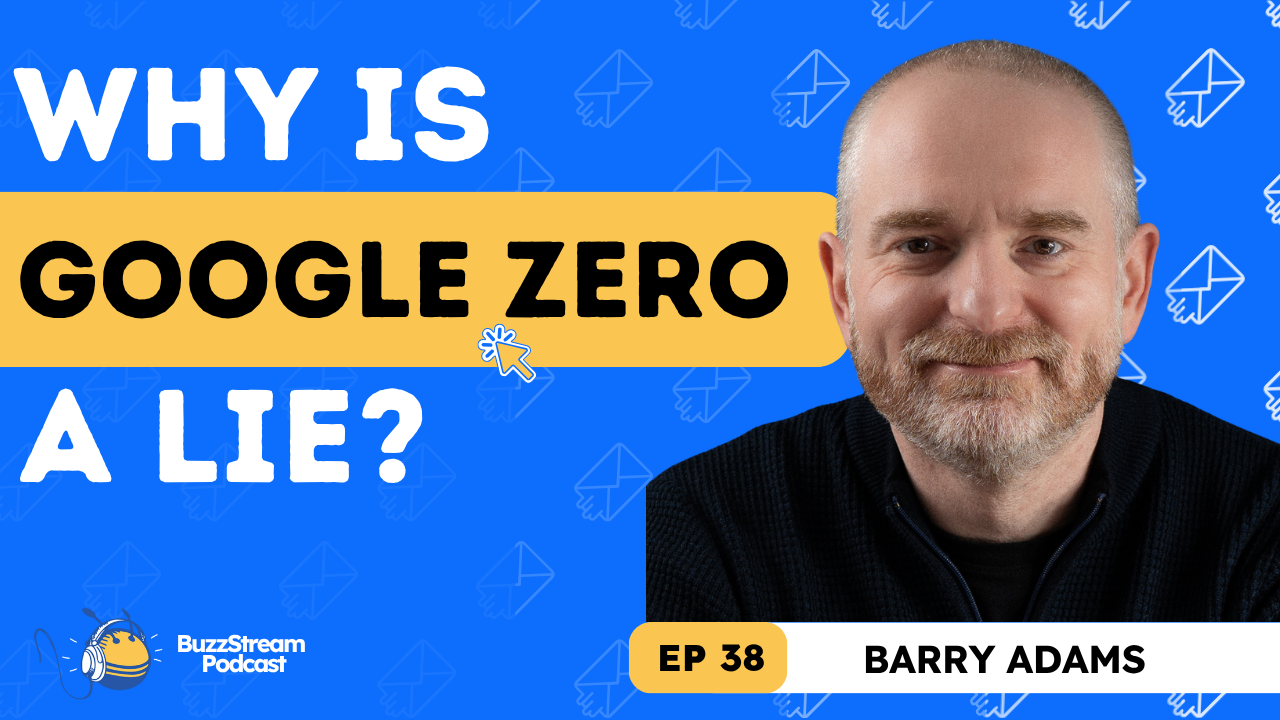
- “Google Zero” is overstated — traffic isn’t vanishing, growth has just leveled off.
- SEO is now a zero-sum game — if you win the click, someone else loses it.
- Many publishers mistake flat traffic for actual decline.
- AI overviews reduce clicks, but they’re not the core problem.
- Pulling back on SEO can create the very traffic drop publishers fear.
We’ve all heard the narrative: news publishers are dying, and it’s Google’s fault. (And if you haven’t, check out this podcast from The Verge.)
The idea of “Google Zero” is frightening for our industry.
But Barry Adams, SEO consultant with Polemic Digital and writer of SEO for Google News Substack, recently wrote a post entitled “Google Zero is a Lie”.
So, I wanted to invite him on our podcast to explain just what is behind this troubling (and potentially misleading) concern about publishers losing traffic to Google.

Below is a slightly-edited podcast.
Can you explain what “Google Zero” is?
Barry: The term was first coined by Nilay Patel at The Verge, who predicted that traffic from Google to news websites would continue declining until it reached zero. He had data and traffic trends to back it up. When I first heard it, I thought it was a useful concept — a way for publishers to understand that Google was becoming a more challenging traffic source, which it genuinely has.
But the term has taken on a life of its own. A lot of publishers now believe Google traffic is going to disappear entirely. The data doesn’t support that.
What’s actually happened is that publishers have coasted on Google’s overall growth rather than building their own share of voice. For years, search as a platform kept growing — more queries, more traffic distributed across the web. That rising tide lifted everyone’s boats. Now that growth has flatlined. Google isn’t shrinking dramatically, but it’s no longer expanding. That means SEO is now a zero-sum game: if you get the click, your competitor doesn’t.
That’s a new dynamic, and publishers have to compete harder for traffic they once took for granted. For many, the traffic line from Google has flatlined, and they’re interpreting that as decline. Add in algorithm updates, spam penalties, and AI-generated answers — suddenly there’s an AI buzzword to attach the panic to.
I won’t deny that AI overviews have accelerated the problem. They do reduce click-through rates for certain types of content. But the idea that Google traffic is vanishing? Publishers are now making the conscious decision to reduce investment in SEO because of that belief — and that’s where it becomes dangerous. It becomes a self-fulfilling prophecy. Stop investing in search, and your search traffic will fall.
Meanwhile, I work with publishers who are doing the opposite, and they’re growing. Publishers with hard paywalls, niche editorial focuses — by conventional metrics, they “should” be struggling. They’re not, because they keep investing in search.
That’s why I wrote the piece. “Google Zero is a lie” is a deliberately provocative headline, meant to force a more nuanced conversation. The truth is somewhere in the middle: some decline is real, but the apocalyptic version isn’t backed by data. When one extreme dominates, sometimes you need to take the opposite position just to find the middle ground.
Vince: Your article pointed to some specific data problems. The Chartbeat presentation at a recent conference showed a lot of publishers losing Google traffic — but you’ve worked with some of those brands personally and know that’s not what’s happening. What’s going on there?
Why is Chartbeat showing declines?
Barry: A few things. Chartbeat aggregated their data without normalizing for publisher size or context. I also read their Q1 2026 traffic report, and there are some genuinely misleading graphs in it. For example, it showed Facebook traffic to publishers nearly equal to Google search traffic — which bears no resemblance to what I see across my clients.
They also use an internal traffic metric that inflates the internal traffic category, because every internal click gets logged there. I don’t understand why they lump all of that together.
Others have pointed out that the initial graph compares 2024 — a US election year, always a peak news moment — with 2025, a non-election year. That comparison alone will skew results dramatically. Then add in the site reputation abuse penalties Google introduced in 2024, which hit publishers running affiliate content hard. Their news traffic may have been fine, but their product review traffic collapsed — and the aggregate figures reflect that.
There are just too many confounding variables to take that data at face value. It tells a story, but not necessarily the right one.
The publishers feeling the most pain tend to be those who over-indexed on maximizing Google clicks, chasing Evergreen content, affiliate links, product reviews, and lifestyle content alongside their news — moving away from their core purpose. The publishers doing well are the ones who just report the news.
There are two types thriving: national publishers that do pure news, nothing else, and hyperlocal publishers covering specific towns and cities. Neither is being meaningfully hurt. Google can’t replicate breaking news with AI — it can only summarize it after the fact. What AI can replace is Evergreen content, product comparisons, listicles — the stuff publishers layered on top of their journalism to chase traffic. That content is losing visibility to AI overviews across every platform.
And I want to make one broader point: this is not new. Before AI overviews, there were featured snippets. Google Maps disrupted local search. Sports score sites were gutted when Google started showing live match results directly on the results page. Google has always enriched its search results with direct answers. The publishers most upset now are the ones who built their strategies around exploiting those gaps — and the gaps are closing.
Vince: That makes sense. The New York Times is a good case study here — they’ve grown their journalist headcount significantly, but partly through acquisitions like The Athletic and Wirecutter, and diversified revenue through games, podcasts, newsletters, and subscriptions. That seems like a smarter approach than trying to be everything to everyone.
Barry: Absolutely. And I do think the paywall model will become increasingly important. It’s a far more reliable revenue stream than one built on page views and ad impressions. The publishers that have figured out how to convert readers — rather than just attract them — are the ones who will survive the transition.
Is this a global issue, or is it different in different markets?
Barry: Broadly global, with some exceptions. France, for example, doesn’t have AI overviews in Google search for legal reasons. Some countries are shielded from certain features that are standard in English-speaking markets.
But the underlying trend — Google’s growth flatlining — is universal. English-language markets tend to feel it first because that’s where Google rolls out new features and where most of the web is indexed. Elsewhere, the same dynamics play out, just on a slight delay.
One variable worth noting: in South America and Southeast Asia, Android has a 95%-plus market share, which means Discover feed traffic plays a much larger role for publishers in those regions. That’s a separate conversation, but it’s worth being aware of.
Do you think platform diversification is a major driver of the perceived decline?
Barry: Yes, and I have a longer-term perspective on this. Every generation appears to consume news differently when they’re young — and then, as they age, they tend to drift toward more traditional formats. The “young people don’t read news” narrative is actually as old as newspapers. It tends to look more alarming in the moment than it proves to be over time.
That said, the underlying mechanics have genuinely changed. Facebook was once a massive traffic driver for publishers — until they deprioritized external links in the feed. Twitter/X was meaningful for news until it shifted away from link-sharing culture. Now, visual-first platforms like TikTok, Instagram, and YouTube Shorts dominate — and those platforms don’t drive traffic in any traditional sense. They drive views and brand awareness. If your business model depends on clicks, that’s a problem.
But I think there’s still a case for publishers being present on those platforms — not as traffic drivers, but as top-of-funnel brand building. Someone who’s been watching your journalists on TikTok for a year is much more likely to pay for a subscription when they eventually encounter your paywall. The goal isn’t a direct click — it’s an eventual conversion. Publishers who understand that are using social media strategically. Those who are chasing views as a substitute for traffic are burning resources without a return.
Newsletters, paid YouTube, podcasts — these are real revenue streams for publishers willing to invest in them. And the smartest content strategies treat a single piece of journalism as raw material: you write the article, you record a short video, you splice it for social, you release a podcast episode. One story, multiple distribution channels, multiple monetization paths.
Vince: That sounds obvious to anyone in digital marketing — but it seems like news organizations, especially the legacy ones, have been slow to embrace it.
Barry: “Marketing” has historically been a dirty word in newsrooms. It’s been associated with the commercial side of the house, selling advertising — not something editors want to think about. But marketing at its core is just understanding your audience and delivering what they value. That’s exactly what news publishers need to do right now.
The institutions that struggle most are the ones that see this as a departure from journalism, rather than a complement to it.
What happens if news publishers continue to decline?
Barry: We’d be in a better position than you might expect, actually.
First, I don’t think most publishers are going to disappear. There will be casualties and restructuring. But news as a product has a durable audience — people want more news, not less. The business model needs to evolve, but the underlying demand is there.
More importantly for digital PR: the value of a news mention has actually increased in the AI era. Brands increasingly care about being cited in AI-generated answers — product recommendations, research summaries, comparison lists. And one consistent signal that appears to increase your citation rate in those answers is being mentioned on high-authority sites, including publishers.
What’s changed is that you no longer necessarily need the link. A mention in the right context, on the right site, is already a win — because it feeds the signals that AI systems use when deciding what to recommend. The direct link → ranking correlation matters less than it used to; the mention → authority → AI citation chain matters more.
So digital PR is actually becoming more strategically valuable, even if the tactics need to evolve. It’s less about blasting press releases to journalists and more about crafting narratives that tie into the news cycle, providing data that journalists can genuinely use, and being creative about the angles that earn coverage. The floor is higher, but so is the ceiling.
Any final thoughts?
Barry: Just this: whenever someone gives you a blanket statement — “X is dying,” “Y will change everything” — look for the nuance. Don’t take it at face value. Search has gotten harder. AI has accelerated some changes. Those are real. But we’ve been here before. Every new feature Google rolls out has caused a version of this panic. The industry adapts.
GEO, AEO, whatever the latest acronym is — at its core, it’s SEO thinking repackaged for a new context. The fundamentals still apply: deliver value, earn authority, serve your audience. And stay willing to change your mind when new data comes in. I’ve been wrong plenty of times in 25 years, and I’ll be wrong again. The practitioners who stay adaptable are the ones who last.

Vince Nero
Vince is the Director of Content Marketing at Buzzstream. He thinks content marketers should solve for users, not just Google. He also loves finding creative content online.
His previous work includes content marketing agency Siege Media for six years, Homebuyer.com, and The Grit Group. Outside of work, you can catch Vince running, playing with his 2 kids, enjoying some video games, or watching Phillies baseball.
[ad_2]
Source link