

- Focus on earning a few high-quality links rather than chasing volume.
- Use tightly targeted outreach instead of mass emailing journalists.
- Lead every pitch with a clear, compelling story—not a link request.
- Tie campaigns to timely trends, news, or seasonal angles.
- Create original, data-driven content that journalists can’t produce themselves.
In the wake of AI, I’ve seen numerous agencies begin offering digital PR services.
This is unsurprising, given studies like Ahrefs correlating brand mentions with exposure in AI results or experts like Mike King pushing digital PR as part of his relevance engineering workflow.
Digital PR is primarily seen as a link-building tactic for getting coverage from high-authority news sites, whereas link building is broader in scope.
Many link builders transitioning into digital PR carried over the wrong tactics, infuriating journalists and confounding newcomers.
So, in this post, I’m going to outline the differences and help outline the steps needed to transition from link building to digital PR.
>1. Change your mindset from link quantity to link quality
With digital PR, you will see fewer results as compared to traditional link building, but that’s not a bad thing.
There are fewer journalists to go around due to layoffs, but a lot more people in digital PR right now.
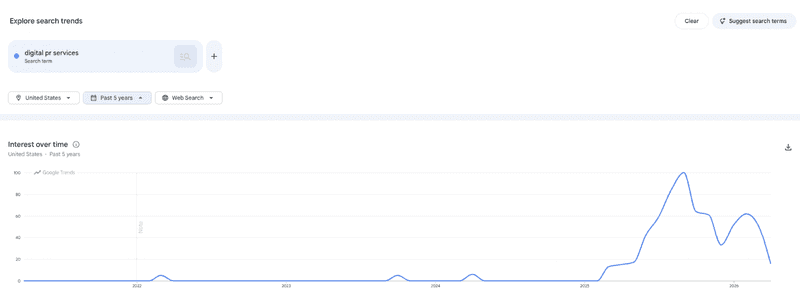
Demand for digital PR services is at an all-time high.
Muck Rack’s State of Journalism has been tracking the increase in pitch numbers yearly, and they just keep going up.
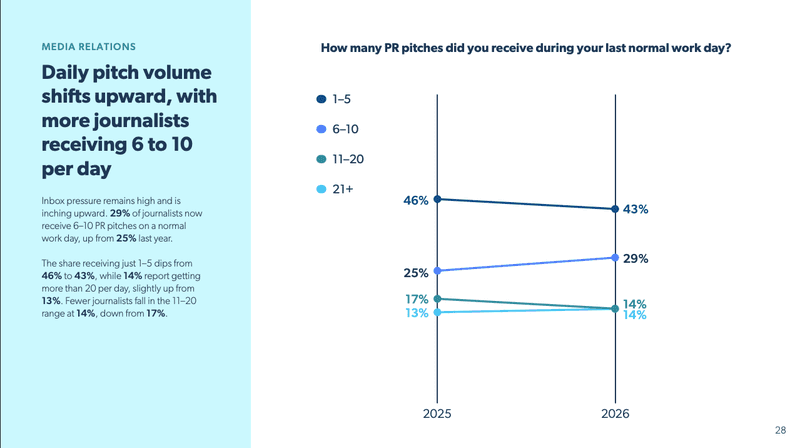
But that’s not necessarily a bad thing. Because typically, with link building in the past it’s just been a numbers game.
With digital PR, it’s all about quality, and fewer links are needed to move the needle.
Relaying this to a client might be tricky, so point them to our study on how many backlinks you need.
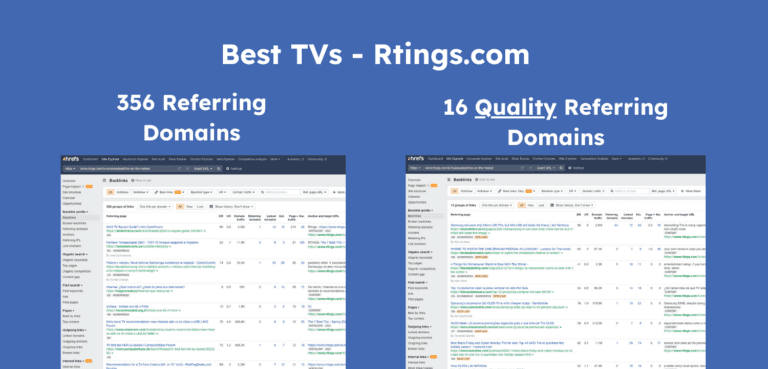
Here’s the gist: If you filter competitor link profiles for quality links, you’ll notice that the link totals you are trying to compete with become much more manageable.
For instance, if I wanted to rank for Best TVs, I see that the top-ranking post on Rtings.com has 356 links, but only 16 quality links:
By focusing on quality, not quantity, it should also help prevent burnout from you or your teams.
What I’ve seen typically happen at any agency is that junior employees have link quantity goals they need to hit.
They may even have quality guidelines in place, but when the time crunch inevitably happens or outreach fatigue sets in — and they both always do — so-so sites start to creep in.
The next thing you know, your agency’s reputation is soiled.
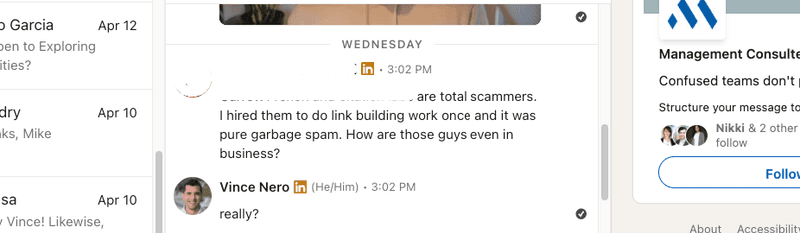
Focusing on quality can help avoid this.
How to get started:
- Set a minimum quality for teams (e.g., DR 65+ or recognizable brands).
- Set expectations upfront: ~20–50 pitches per campaign, ~3–10 pieces of coverage is strong.
- Don’t scale outreach to compensate—improve targeting instead with tools like ListIQ.
With this in mind, you need to reconsider your outreach strategies.
2. Digital PR outreach is hyper-targeted (and harder to scale)
Digital PR requires fewer outreach emails sent than other link building tactics.
Typically, link building is a numbers game: the more emails you send out for things like link exchanges and guest posts, the more likely you are to get some bites.
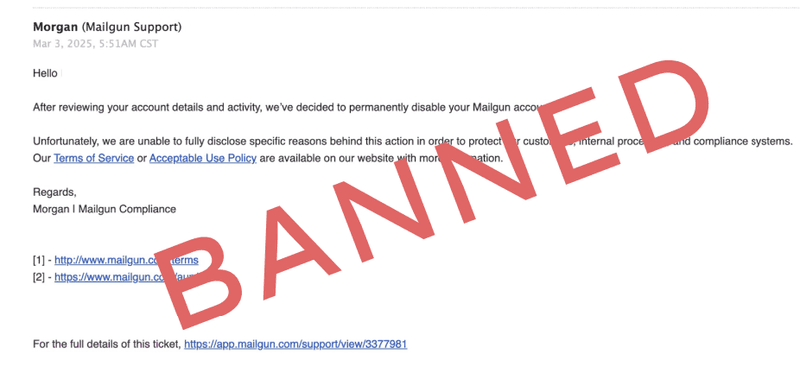
Do that with PR and you’ll find yourself in spam folders, or, at worst, banned from your email platform (yes, this actually happened to a BuzzStream customer).
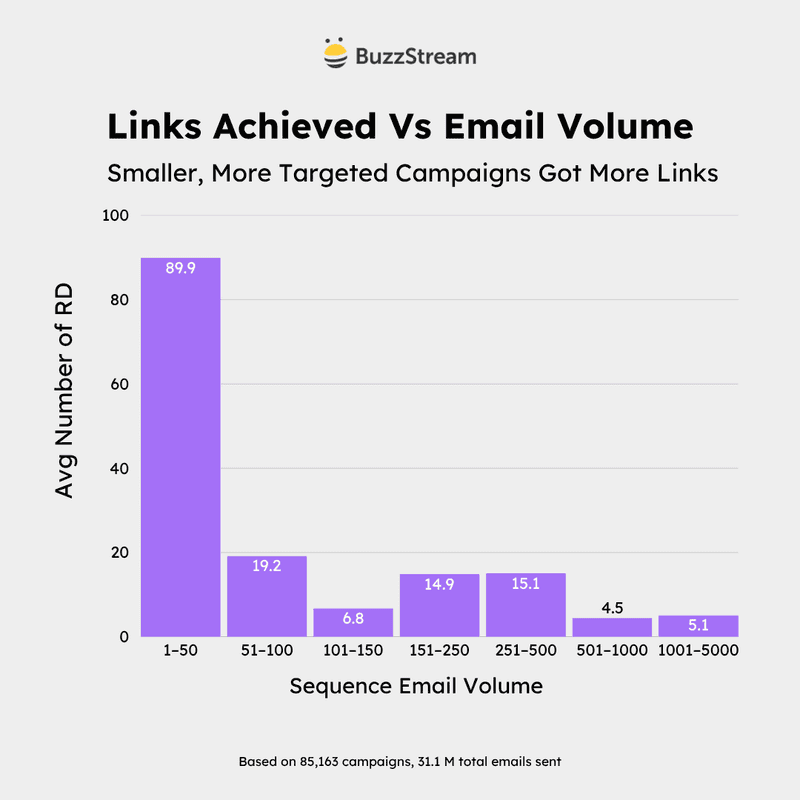
We conducted an entire study on the spray-and-pray tactic and found that, with digital PR, the more targeted you are, the more links you get.
But this doesn’t mean you simply cut your list in half and have success; good digital PR requires digging into journalists to see if they are actually a fit.
I’ve outlined a 20-step evaluation process, but it boils down to this: you need to know what industry a journalist covers and what type of content they cover.
You can do this by simply reading their recent content.
For instance, here’s Sammi Caramela from Vice.
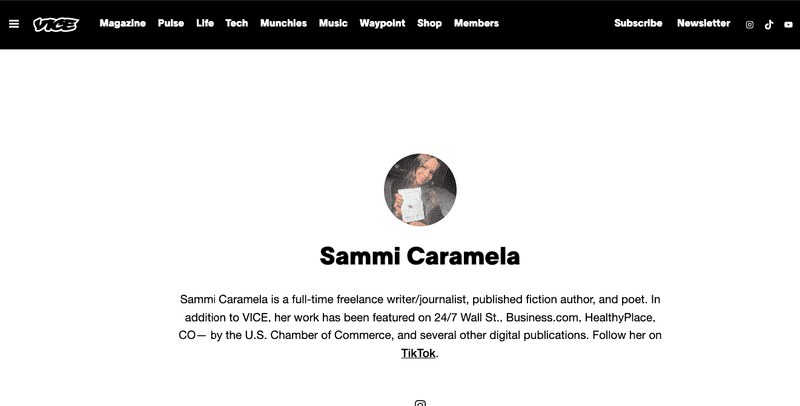
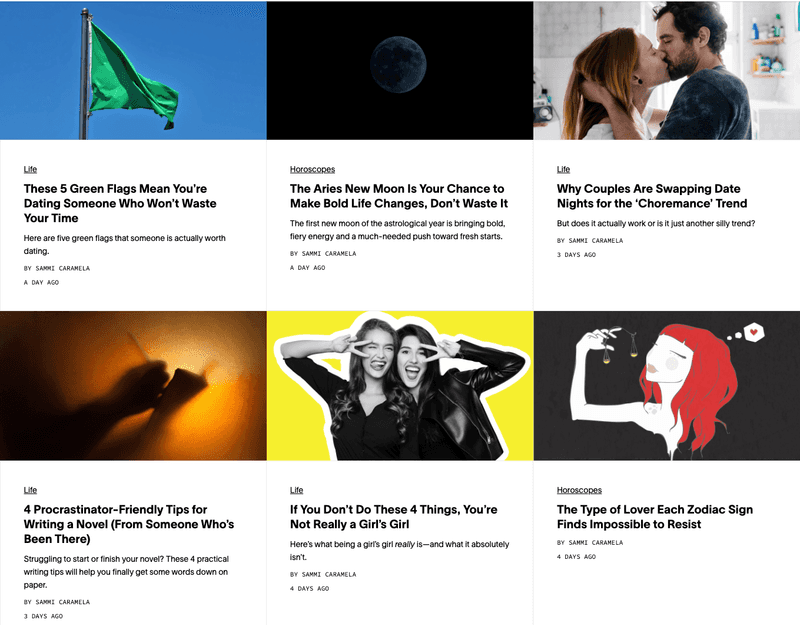
I can see here on Sammi’s author page that there is a lot of life and horoscope-related content.
But are these opinions? Are they third-party studies like the ones digital PR typically pitches? Does she use expert commentary in her posts?
I have to click in and read to find out.
Here’s a piece Sammi wrote about starting yoga, where an expert is cited:
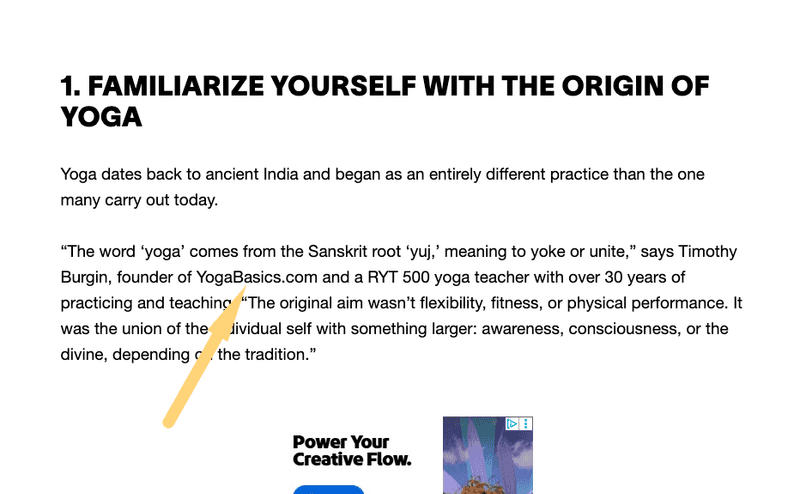
But in the 10 posts I scanned, she rarely links to external sources or mentions third-party studies or experts.
So she’s probably not a great fit for digital PR outreach.
(I also did an entire webinar on how to find the right journalists.)
This manual review process does take more time (which is why many try to take shortcuts).
We built our media list building tool ListIQ, to drastically cut down the time.
ListIQ helps extract key information on the journalist right from a Google News SERP.
Instead of manually going through the steps to find all of the information about a journalist, like their email address, bio, recent articles, and others, it pulls it directly into a Google Sheet.
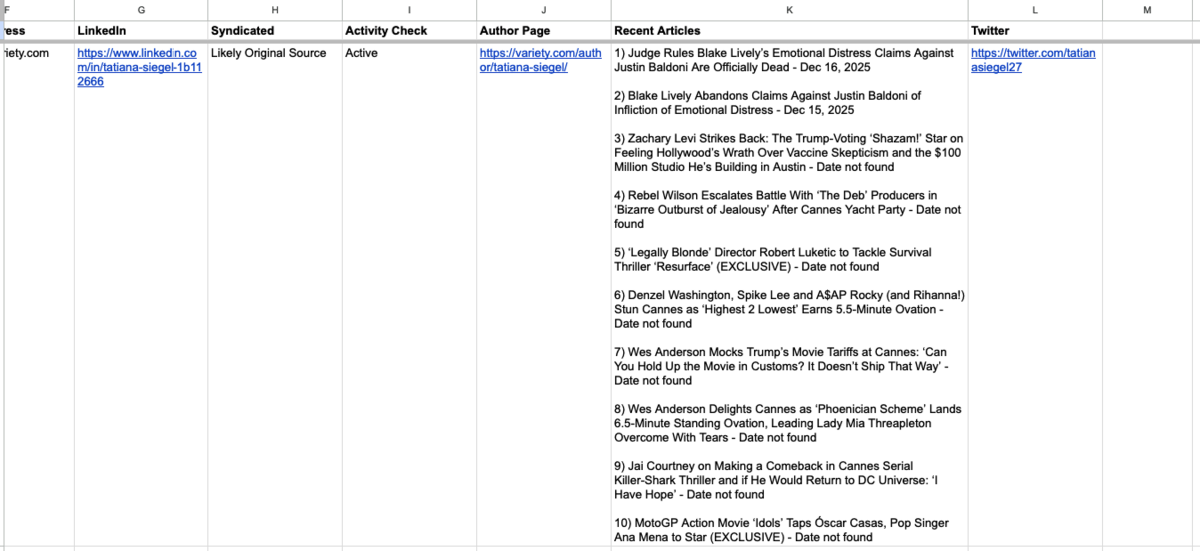
Get started with ListIQ for free.
How to get started:
- Build a focused list of 20–50 journalists per campaign angle.
- Validate fit by matching their beat and citing at least two recent, relevant articles.
- Remove any contact that can’t be clearly justified as a fit in one sentence.
But once you find the right journalists, you need to pitch them differently.
3. Focus on the story in your email pitch
The best digital PR outreach pitches have a strong hook and contain everything a journalist needs to write a story, whereas a link building outreach email may only contain an ask.
This is another huge mindset shift for link builders.
These kinds of pitches don’t work on journalists:
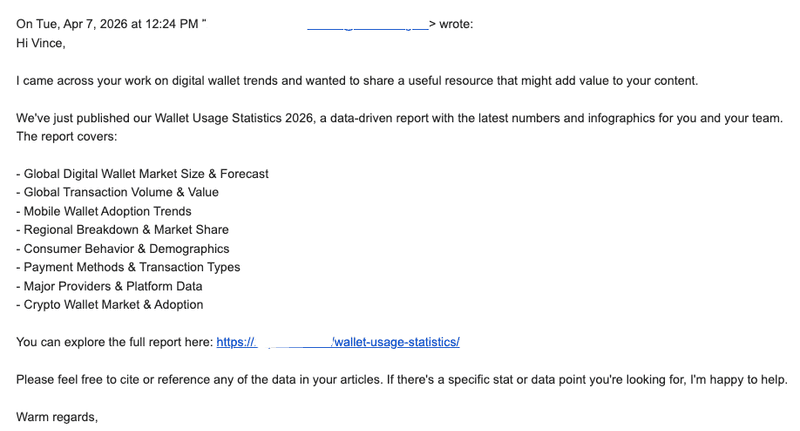
Journalists don’t care about your useful resources. Ultimately, they care about a good story that their audience and beat will care about.
Why?
Because digital PR requires pitching to journalists who also have traffic goals of their own.
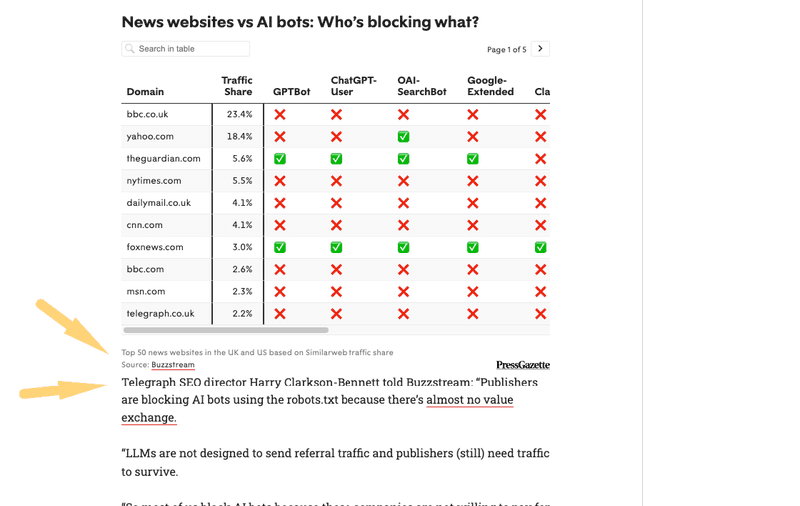
Here’s a pitch I sent to someone at The Press Gazette that landed coverage on our study about publishers blocking AI crawlers.
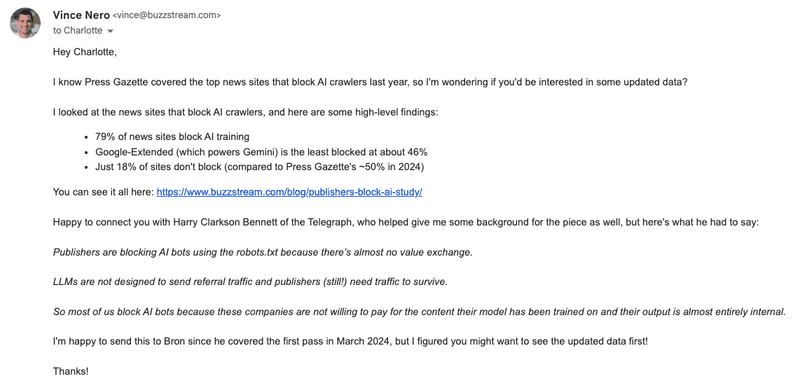
It has everything a media pitch needs:
- Why they should cover: They covered this topic last year, and I have an update
- Main takeaways: Three bulleted points that are surprising
- A quote from an expert: Harry Clarkson-Bennett was the source of the quote used in the article.
Ultimately, they covered my study and used the quote:
You can check out our full list of media pitch templates for some extra direction on pitching.
How to get started:
Use this simple pitch structure:
- Subject line: clear and newsy (not clever)
- First line: the core story in one sentence
- 2–3 bullet points with key data
- Optional quote for attribution
- Link to full data/source
Quick test:
- Could a journalist write the article from this alone?
- Does the pitch clearly explain why it’s worth covering?
There’s another aspect of my pitch that I think made it even more likely to get covered…
4. Focus on timeliness
Most traditional link building occurs in a somewhat of an evergreen bubble, whereas digital PR is all about timeliness; attaching to a trending topic, seasonal trend, holiday, or major event.
The aforementioned pitch from me stemmed from Press Gazette’s ongoing coverage of publishers blocking AI bots.
In a study that I did looking at all of YouGov’s top-performing survey content, timely content outweighed evergreen content.
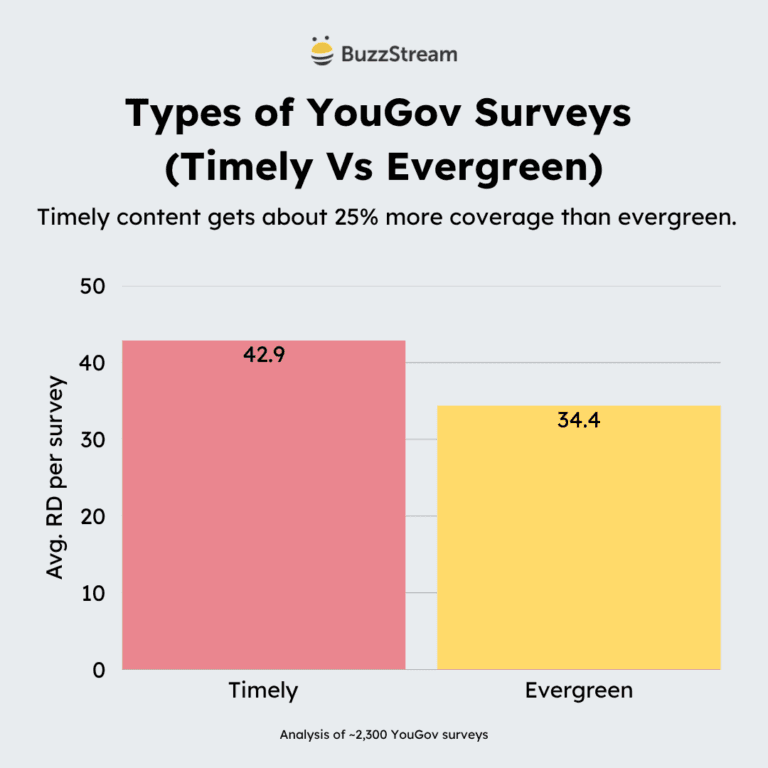
So if there is a trending topic, holiday, or event, you’re more likely to have success pitching a relevant data point or topic.
The other important piece is that by staying current, you’ll also spot potential coverage overlaps.
For instance, if you go to pitch a story to a writer in Business Insider and they have just covered something similar, you wouldn’t pitch them again because they just covered it.
For instance, here’s a piece by Katie Notopoulos covering a Pew study finding that Snapchat is the number one app for teens.
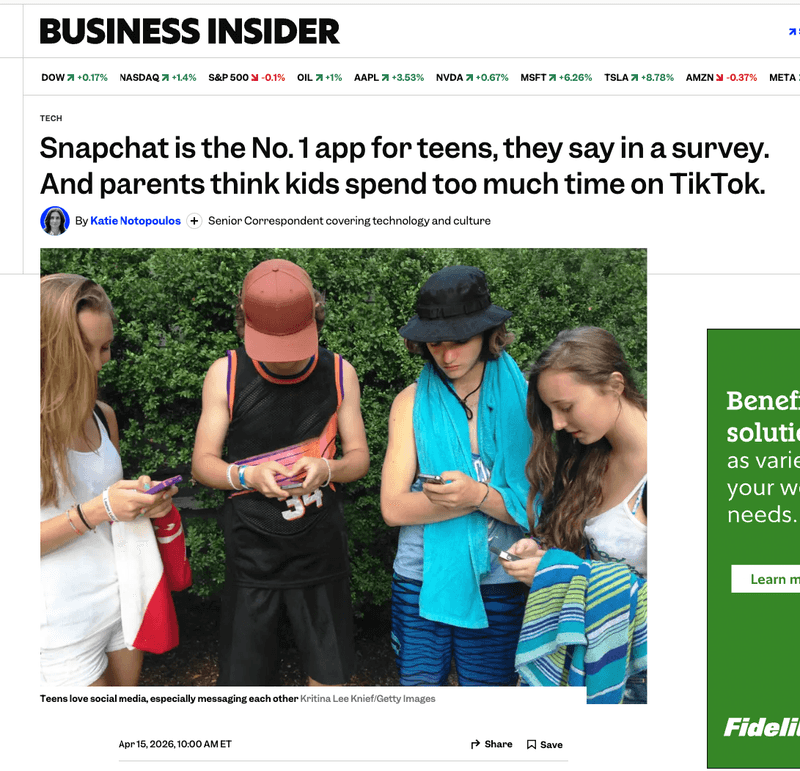
If I had tried to pitch Katie a similar study on social media usage among teens, TikTok, or any of the same takeaways,I would most likely end up with a response like this:
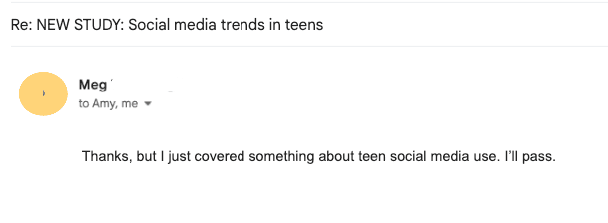
I’d wait at least 2-3 weeks before pitching this journalist a similar study.
That said, if you are following a trend and have something new to add, a fresh angle, or a controversial alternative take, journalists can sometimes be more open.
Again, to do this, you need to look at their recent coverage to see how often they cover certain topics.
For instance, looking at Katie’s recent articles, I see two stories related Mark Zuckerberg (three if you count Meta) all within 10 days.
But if you look closer, they are very far away from one another. One is about the metaverse and the other is about Mark and tension around the company.
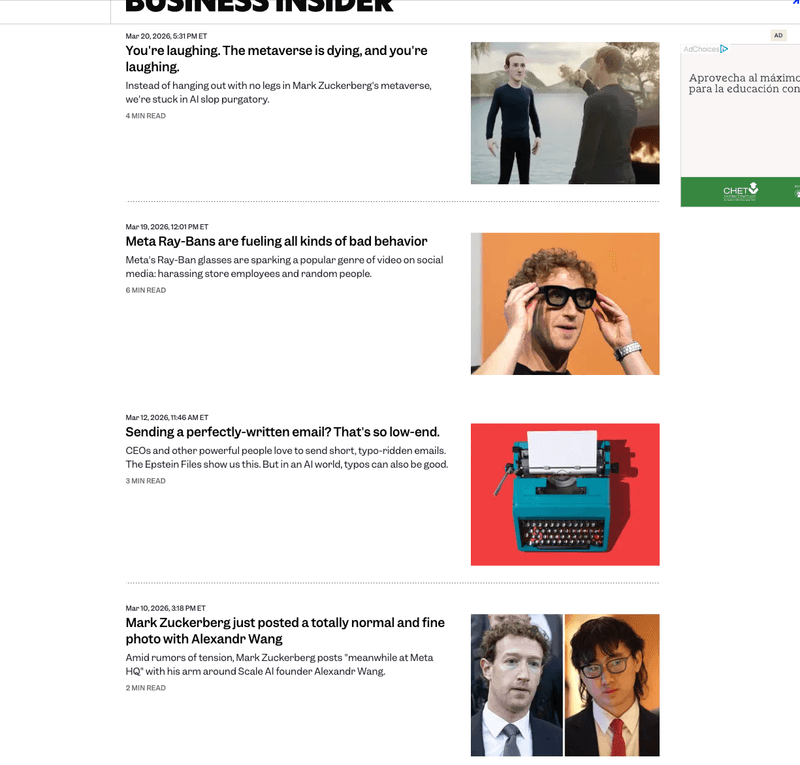
However, if we consider something like reactive PR, these recency rules become less important.
For instance, if I had a proprietary quote from a Meta employee explaining why there is tension within the company, it would add to Sammi’s ongoing coverage of Meta, and I would consider pitching right away.
So, this is where analyzing recent articles is so important.
Many people skip this step because it is time-consuming, but tools like ListIQ can speed things up.
How to get started:
- Start every campaign by asking: “Why now?”
- Anchor ideas to trends, seasonal events, or active news cycles.
- Scan industry headlines daily to spot timely opportunities.
- Review recent journalist coverage to ensure your angle is fresh.
- Wait 2–3 weeks before re-pitching similar topics unless you have a new angle.
This brings us to our next point: keeping up with current events.
5. Teams must stay plugged into the news and trends
Digital PR is definitely always on, whereas link building is not.
This is because it’s virtually impossible to be successful with digital PR without understanding the news cycle and staying on top of current events.
But it doesn’t stop there.
The best digital PR teams are also locked into social media trends as well.
Successful agencies are doing this in several ways:
- Daily or weekly team chats (Slack or in-person), sharing trending topics, and figuring out how to get a brand/client inserted into the conversation
- Monitoring Google Trends, TikTok Trends, Pinterest Trends, etc
This tool, called Splode, looks at trends on platforms like Google, X, YouTube, and others:
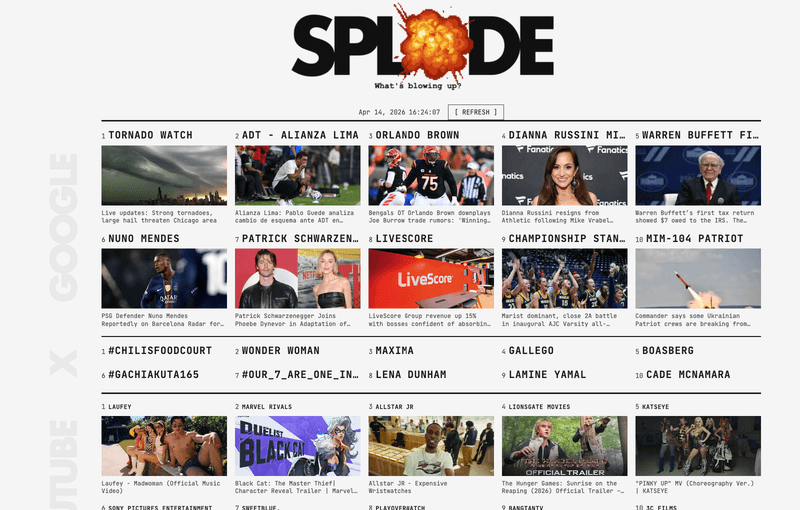
Once a trending topic is identified, digital PR uses strategies such as reactive PR and newsjacking to secure coverage for clients.
How to get started:
- Spend 15–30 minutes daily scanning platforms like Google Trends, X, TikTok, LinkedIn, and Pinterest.
- Subscribe to relevant industry newsletters to stay informed.
- Create a shared doc or Slack channel to capture and discuss story ideas.
- Aim to generate 2–3 reactive story angles each week.
- Assign a dedicated team member to monitor trends consistently.
Another huge mistake I’ve seen link builders make when transitioning to digital PR is trying to come up with stories that aren’t helpful to journalists.
6. Ditch the guest posts and embrace data-driven content
The most valuable kinds of digital PR assets are data-driven, like city index studies, surveys, and other proprietary data-based content.
Traditional link building tactics are guest posting, blogger outreach, link exchanging, link buying, broken link building, resource page building, and digital PR.
The effectiveness of most of these (excluding digital PR) is waning in 2026.
Journalists typically don’t have time to compile data themselves, or they are looking for data to support their own stories.
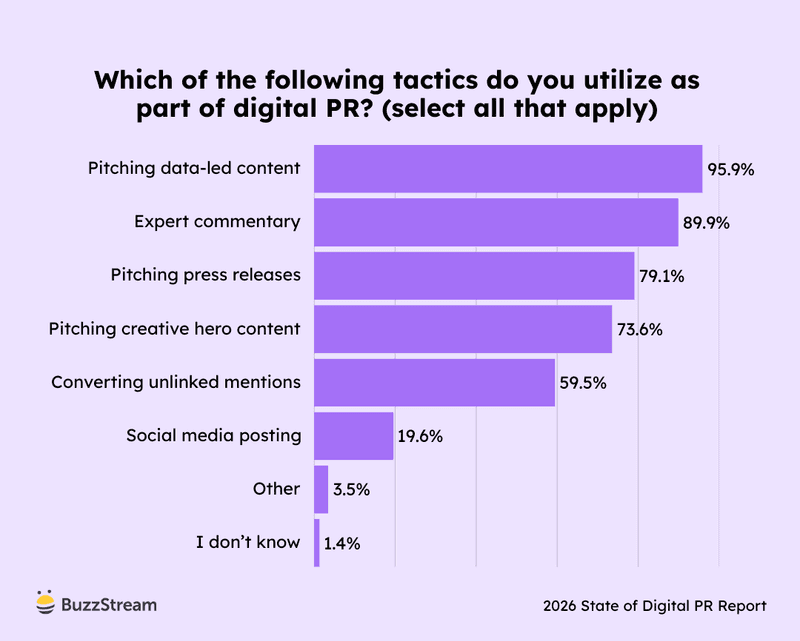
This is why data-led content is the number one tactic utilized by digital PRs today:
These data-driven assets typically require much more time and effort than just putting together a guest post.
For instance, in one data-driven study on Blackcircles, a tire company, a digital PR agency called Digitaloft spent weeks gathering data via Freedom of Information Act (FOIA) requests to produce the UK Pothole Report.
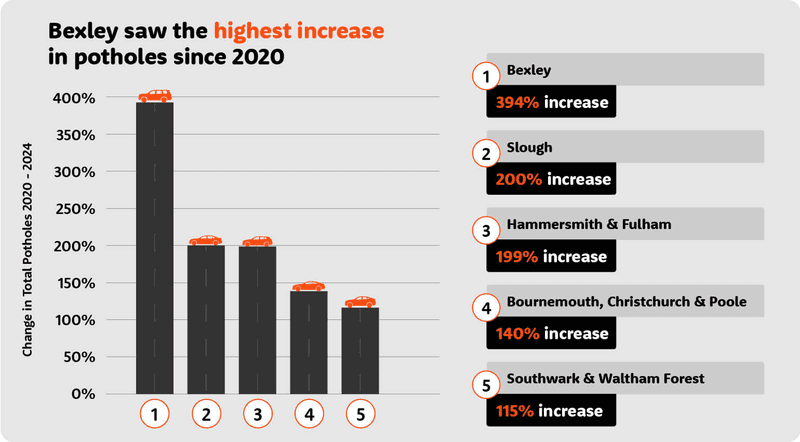
In addition to FOIA requests, they surveyed 2,000 people to understand how potholes affected them.
This kind of data is something a journalist doesn’t have time to get themselves, making it truly valuable.
How to get started:
- Analyze competitor campaigns and identify what’s earning coverage in your niche.
- Start with a simple data format:
- Survey (e.g., 500–2,000 respondents)
- Internal data analysis
- Public dataset with a unique angle
- Ask: “What stat would make a headline?”
- Develop 3–5 strong, newsworthy findings.
Providing value can build trust with journalists, but not following through can quickly erode that trust, bringing us to our next point.
7. Be available for journalists
Along the same lines as the previous two tips, digital PR requires more responsiveness than traditional link building.
Bloggers or guest post sites rarely require deadlines, whereas journalists can sometimes rely on digital PRs for quotes and data immediately.
Expert commentary, which can be responding to journalist requests, or providing quotes as reactive PR is another widely used strategy in digital PR.
It also adds value, as journalists typically want experts to weigh in on topics to make their pieces feel more authoritative.
But with great value comes great responsibility.
Some link builders may already be using Qwoted, Help a Reporter Out (HARO), or Featured to pitch expert quotes and respond to journalist requests, but I’ve already heard from some journalists that unresponsive contacts are starting to really hurt them.
There are the obvious deadlines on pitch platforms like HARO:
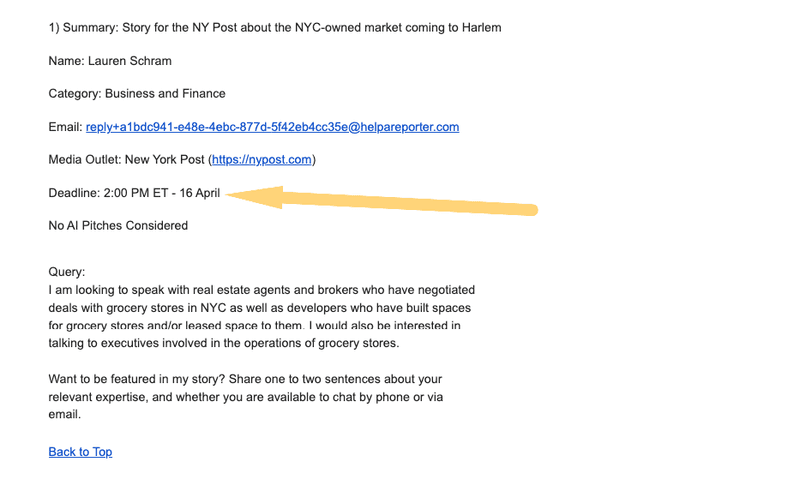
But the communication doesn’t always end with a pitch…
Freelance journalist Joni Sweet shared a compelling story with me in our podcast episodeabout what it means when link builders (or PR pros) aren’t responsive:
“I’ve sometimes put out a call for pictures for doctors or dietitians in the health space, and a PR person will email me and say, ‘I have this amazing client. They can speak to X, Y, and Z. Do you want them for your story?’ and I’ll say yes, and then they fall off the face of the earth.
I say ‘hey I need answers by noon on Friday and 4 p.m.’ and if on Friday those answers still haven’t come in, I’m in a real bind now because now I have to find somebody over the weekend and convince them to give me the time of day so that I can meet my deadline on Monday and still make my editor happy and get paid, right?”
How to get started:
- Respond to journalist replies within hours—not days.
- Prepare pre-approved quotes or expert sources in advance.
- Only pitch when you can reliably meet tight deadlines.
With timeliness and quickness in mind, let’s look at what that means for results.
8. Expect potentially quicker impact with digital PR
It takes about 3-6 months to see measurable results from digital PR, according to our State of Digital PR Report.
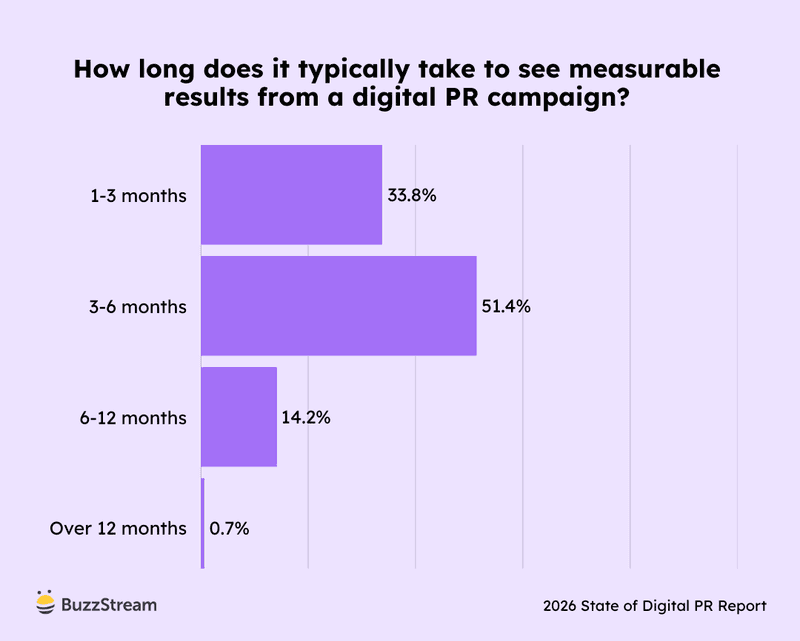
This is somewhat in line with our findings in our link building trends report (although the timelines are a little different).
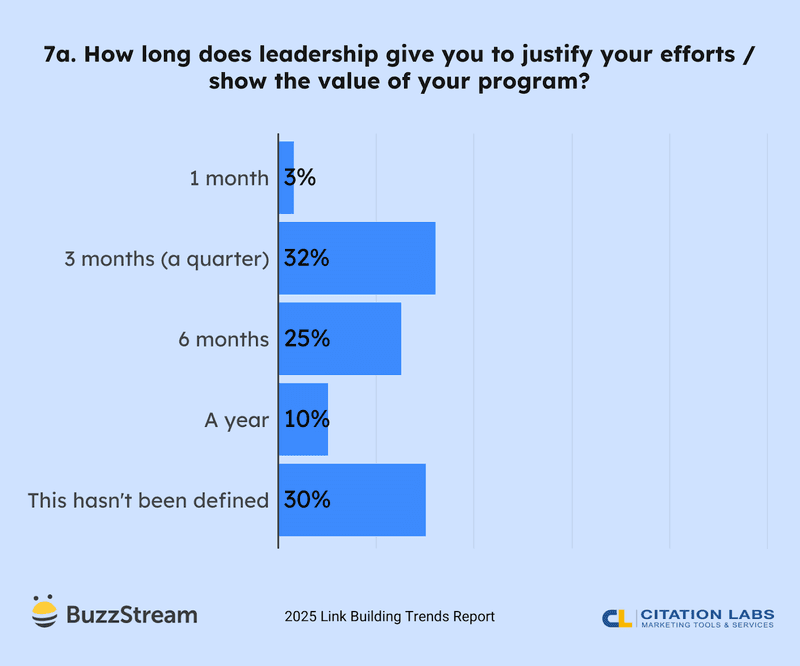
However, links from high-authority, highly trafficked sites can yield quicker results in organic traffic and rankings because they are much more likely to be crawled and indexed.
And if your campaigns are adequately internally linked, you can see quicker results.
How to get started:
- Add internal links from new coverage pages wherever possible.
- Track mentions across social media and other channels.
But with digital PR you may notice some changes in link numbers.
9. You should charge more for digital PR services
Most digital PR agencies don’t charge per link. In fact, about one-third didn’t even know their cost per link when we surveyed them about digital PR costs.
Instead, charge for asset creation (design, web development) and data collection costs, such as survey costs, on a monthly retainer.
This helps reframe the conversation for clients away from the antiquated CPL.
It can also be helpful to convey to clients that with more competition in the space and fewer links to go around, a solid link from a high-authority publication is typically worth a lot more than a standard guest post link.
I analyzed costs from a popular link buying database and here’s how it broke down:
To buy a top-tier link through a vendor costs upwards of $950.
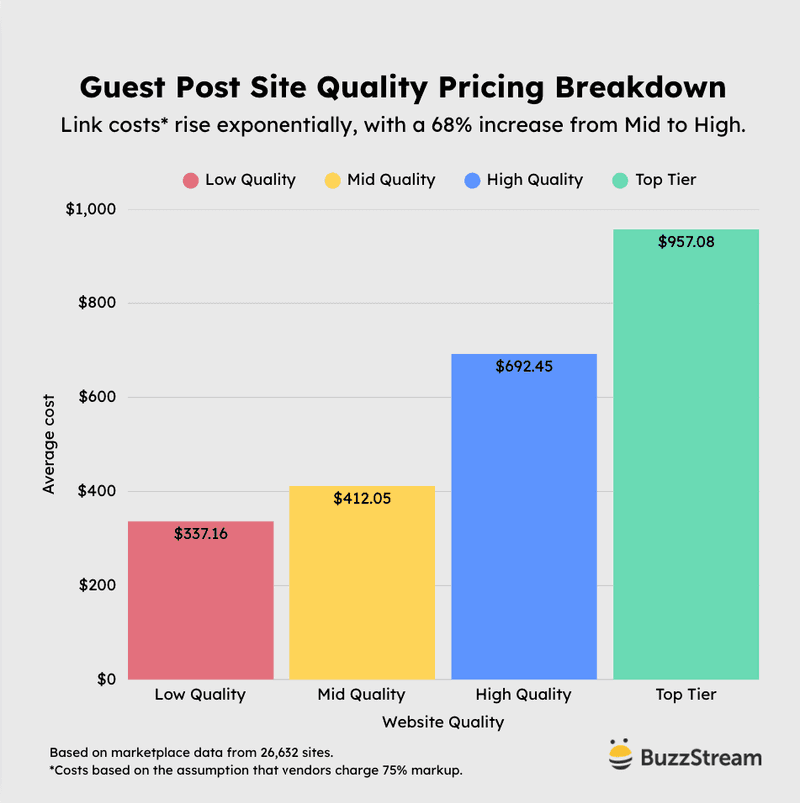
Some sites on the list, like Forbes and Associated Press, cost upwards of $10,000 for a placement.
To give you a sense of the monthly contract size for digital PR, here’s what our respondents told us:
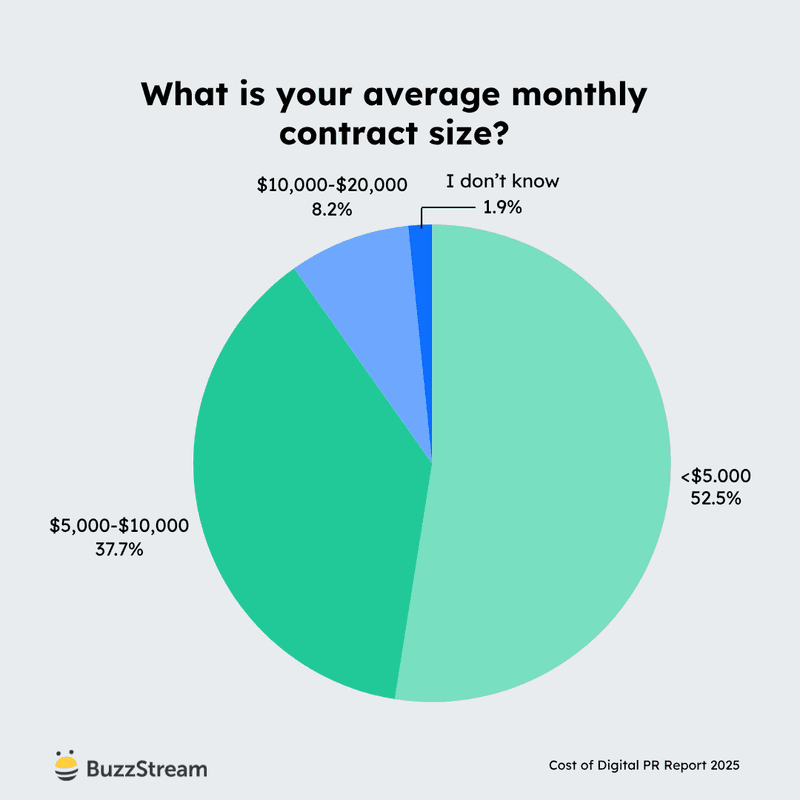
This helps put into perspective how much more value you can bring to the table as a digital PR service offering vs standard link building.
How to get started:
- Shift pricing away from cost-per-link toward story creation and data production.
- Adopt a retainer-based pricing model.
- Position digital PR as a premium, high-impact service—not a volume play.
You could also start charging for mentions…
10. Nofollow links and unlinked mentions mean more
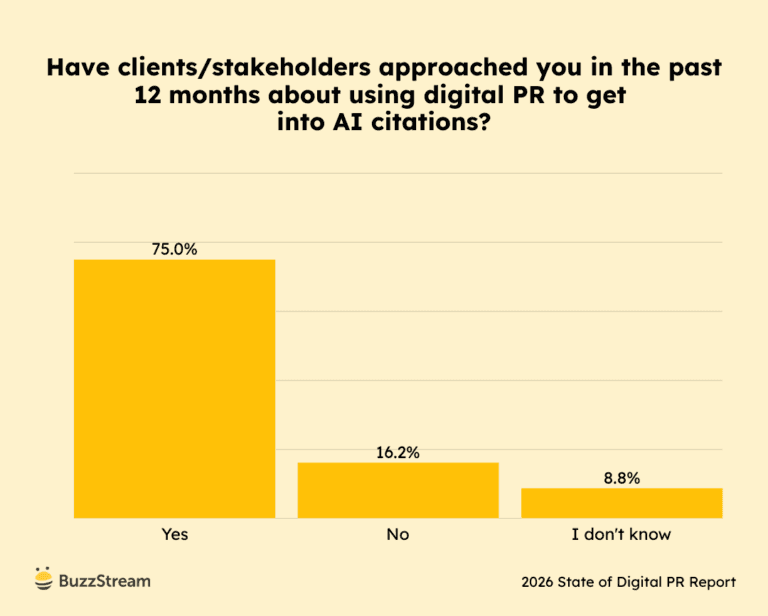
For digital PR, nofollow links and unlinked mentions can now factor into your reporting if your clients care about AI citations – which is about 75% of clients, according to our State of Digital PR Report.
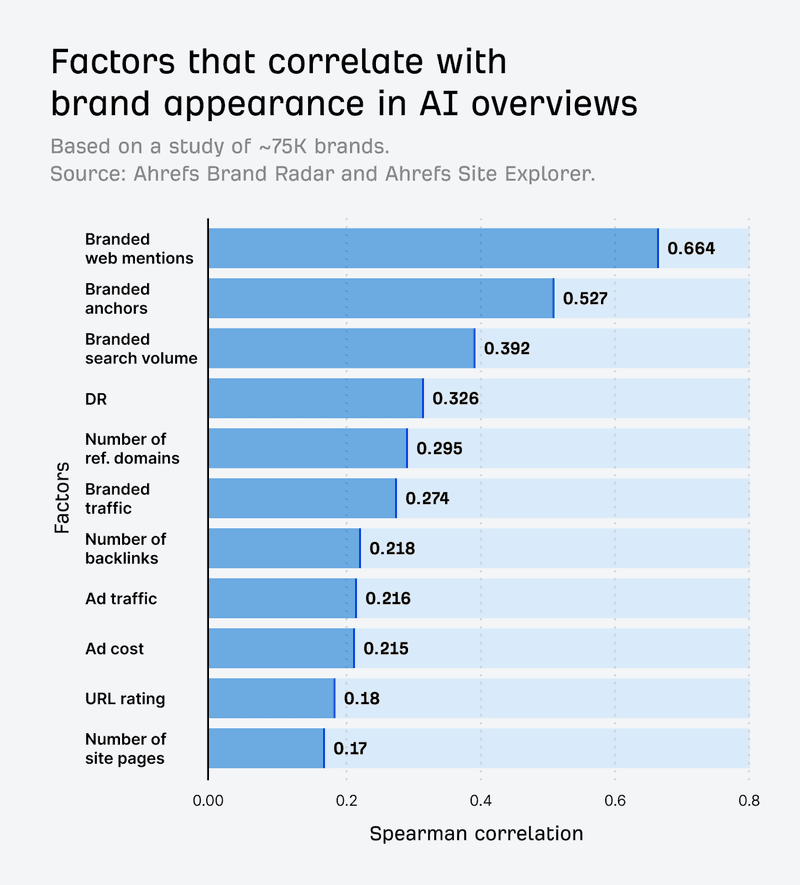
As mentioned in the intro, an Ahrefs study found that branded web mentions (not backlinks or DR) were most strongly correlated with brands appearing in AI answers.
This differs from standard link building, where many are on the fence about whether to include nofollow links or unlinked mentions.
But in the AI age, with digital PR, these unlinked mentions and nofollow links suddenly become more valuable.
Some even consider things like social media placements a win because of their strong correlation with AI mentions and their potential to strengthen “entity” relationships.
How to get started:
- Track brand mentions, nofollow links, and social placements.
- Emphasize visibility and AI citation value when reporting to clients.
- Don’t discount wins just because they don’t include a link.
Now Get Started With Your First Digital PR Campaign
If you’re coming from link building, don’t try to overhaul everything at once. Run one simple digital PR campaign end-to-end:
- Pick a timely topic in your niche (something already in the news)
- Find or create a data point that adds to that conversation
- Turn it into a clear story with 2–3 strong takeaways
- Build a targeted list of ~30 relevant journalists using ListIQ
- Send a tight, story-first pitch (not a link ask) through BuzzStream CRM
- Be ready to respond quickly if someone bites
That’s it.
Don’t worry about scale, tools, or perfection yet. Just focus on executing one campaign correctly.
If you can land even a few pieces of relevant coverage, you’re already doing real digital PR—not just link building with a new label.
And one of the best mindset shifts I’ve heard, repeated a few times on our podcast, is that digital PR’s goal should be a good story, not a link.
If you create a good story, the links and coverage will come.

Vince Nero
Vince is the Director of Content Marketing at Buzzstream. He thinks content marketers should solve for users, not just Google. He also loves finding creative content online.
His previous work includes content marketing agency Siege Media for six years, Homebuyer.com, and The Grit Group. Outside of work, you can catch Vince running, playing with his 2 kids, enjoying some video games, or watching Phillies baseball.
[ad_2]
Source link