
- Create newsworthy, data-driven stories—AI rewards original insights it can’t generate itself.
- Focus on entity authority, not just links—get your brand mentioned across many relevant platforms.
- Build topical dominance with fewer, stronger pages (10x content), not lots of thin content.
- Target a mix of mainstream + niche publications where your audience actually engages.
- Ensure consistent messaging across PR, social, and on-site content so AI understands what you’re known for.
- Prioritize fresh, timely content, especially in fast-moving industries.
On Tuesday, March 24, I invited some of the top minds in digital PR to discuss the takeaways from our news in AI citations study —which I conducted with the help of the AI citation-tracking tool Xofu from the team at Citation Labs— and how to get cited in AI using digital PR.
This fantastic conversation featured Kelsey Libert, co-founder of Fractl; Beth Nunnington, founder and global VP of Digital PR at Journey Further; and Will Hobson, VP of PR at Rise at Seven.
Each brings a different background and skill set to the digital PR space and the burgeoning world of AI, so I thought they would be great for a roundtable discussion on the topic.
Video/Audio
If you’ve missed the webinar, you can watch or listen to the conversation below:

Full Deck
Here is the full deck for your reading pleasure.
Transcript
Vince: Thank you all for being here. If you have questions as we go through this, please just throw them in the chat and we’ll address them at the end.
I’m Vince Nero from BuzzStream, the Director of Content Marketing. Today I’m joined by Kelsey Libert, co-founder at Fractl. Thank you, Kelsey, for joining. Beth Nunnington is the founder and global VP of Digital PR at Journey Further. And Will Hobson is the VP of PR at Rise at Seven.
Thank you all so much for being here early on a Tuesday.
Today we’re going to be talking about AI, news citations, and digital PR.
I prepared a little deck to go through some of this stuff. Here’s the rough agenda: we’ll talk about the data, then discuss, and then do some Q&A. I know some people have already submitted questions, so we’ll go through those, and then I’ll open it up for live Q&A as well.
Let’s jump right in and get into what the data is saying.
I need to caveat all of this because I worked on this a lot. We did this study, and we’re talking about this stuff to help us all understand a little more about how it all works. I think everybody in the industry is still learning. So take this stuff directionally, take it with a grain of salt. Not every study has reached the same conclusions, and the methodology really, really impacts all of these studies that you see.
I specifically broke our study up into different prompt types because I hadn’t seen many, and I think the type of prompt you ask AI Overviews or ChatGPT really influences the citations that come back. Another important thing to understand is that AI rarely cites the same sources consistently. The benefit of doing a large-scale study like this is that you get directional ideas about how it all works, but realistically, that’s all it is — directional. So keep that in mind.
I wanted to set the stage with a couple of quick stats from our State of Digital PR report. AI in general has been a great addition to digital PR, drawing more people into the field. There are many more clients and stakeholders pushing digital PR teams to appear in AI citations. And on the other side, agencies, freelancers, and consultants in the digital PR space are pushing to understand the impact of AI visibility.
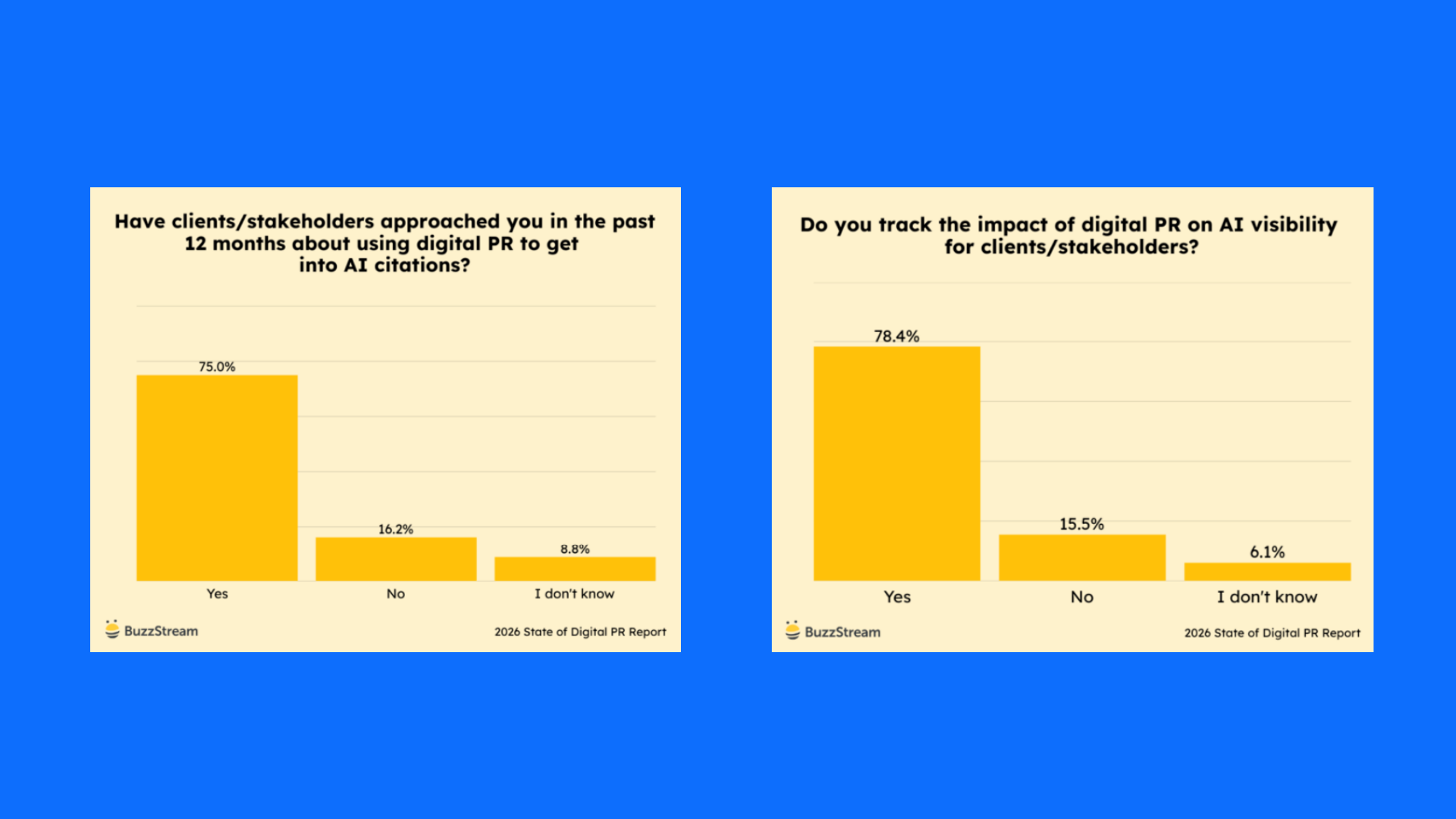
I’ve talked to a lot of different agencies, and everybody has their own unique ways of tracking this and thinking about it, which I think we’ll get into today.
For our AI news citations study, I used the Xofu tool and analyzed 10 industries.
Each industry had about 350 prompt sets, which I broke into: informational or top-of-funnel questions; brand awareness questions (what a brand is about, what they’re known for); and what I’m calling comparative or evaluative prompts — more bottom-funnel, like if someone was ready to buy and wanted to compare two brands.
What I’ve categorized as news publications made up about 14% of the roughly 4 million citations that came through.
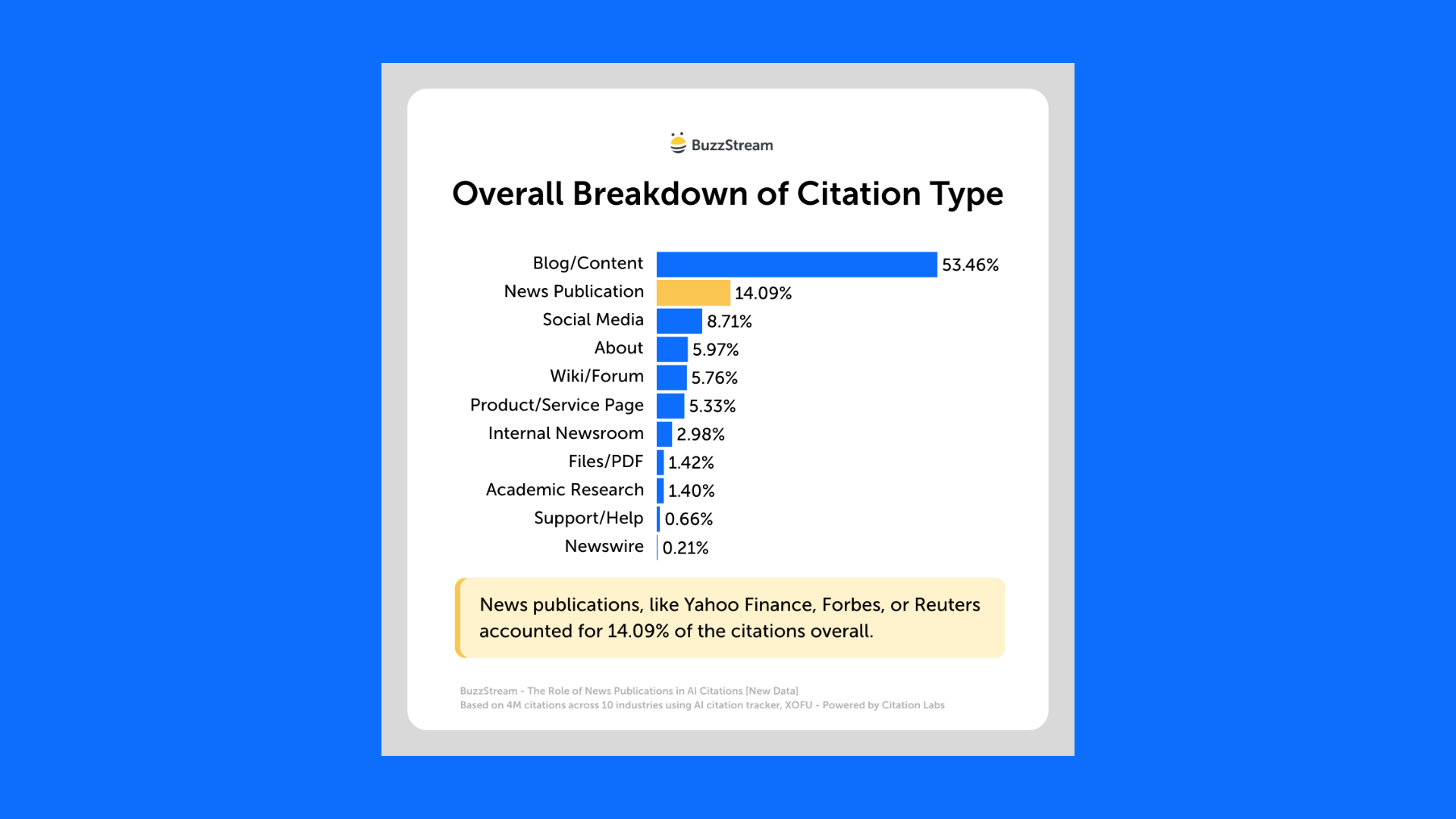
What I’m calling blog and content made up the majority. There’s important nuance here around how I defined news versus blog content, because that makes a big impact on how we look at this as a digital PR team.
What I’m calling “news” is a site that primarily reports news — they might have reviews and comparisons, but most of their content is industry-related news.
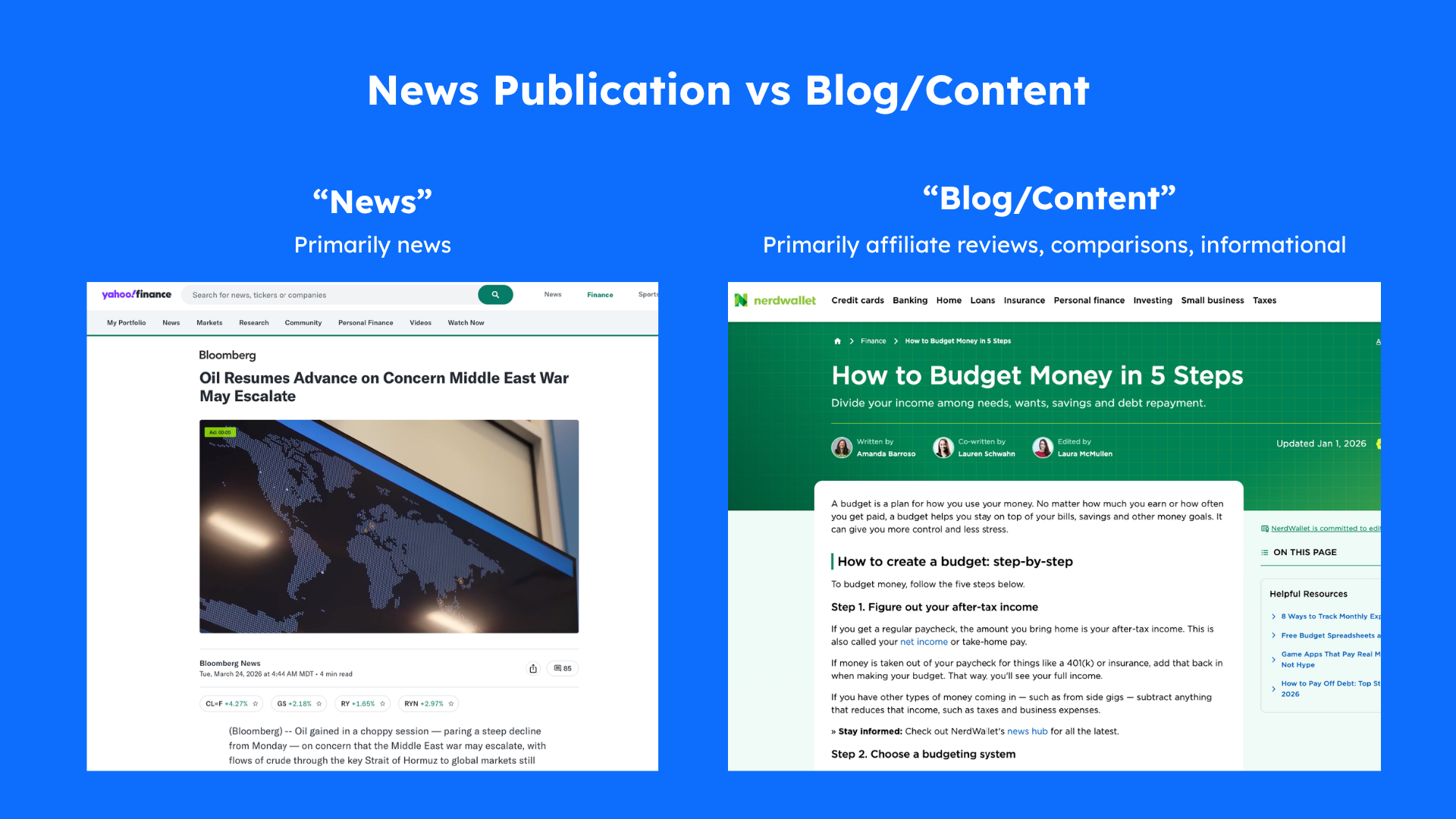
So Yahoo Finance, for example, I’d classify as news, whereas NerdWallet I’d classify more as a blog or general content site because they do a lot of affiliate comparisons and informational content. That doesn’t mean digital PR should exclude NerdWallets and Motley Fools of the world — it’s just how I categorized them in this study.
Now, the top news sites — I want to caveat this, as I do with everything here. Anytime you see a list like this, it is highly dependent on the prompt and starts to vary a lot. So anytime you see lists in the wild that say “these are the top sites showing up in AI,” know that this changes a lot based on the prompt.
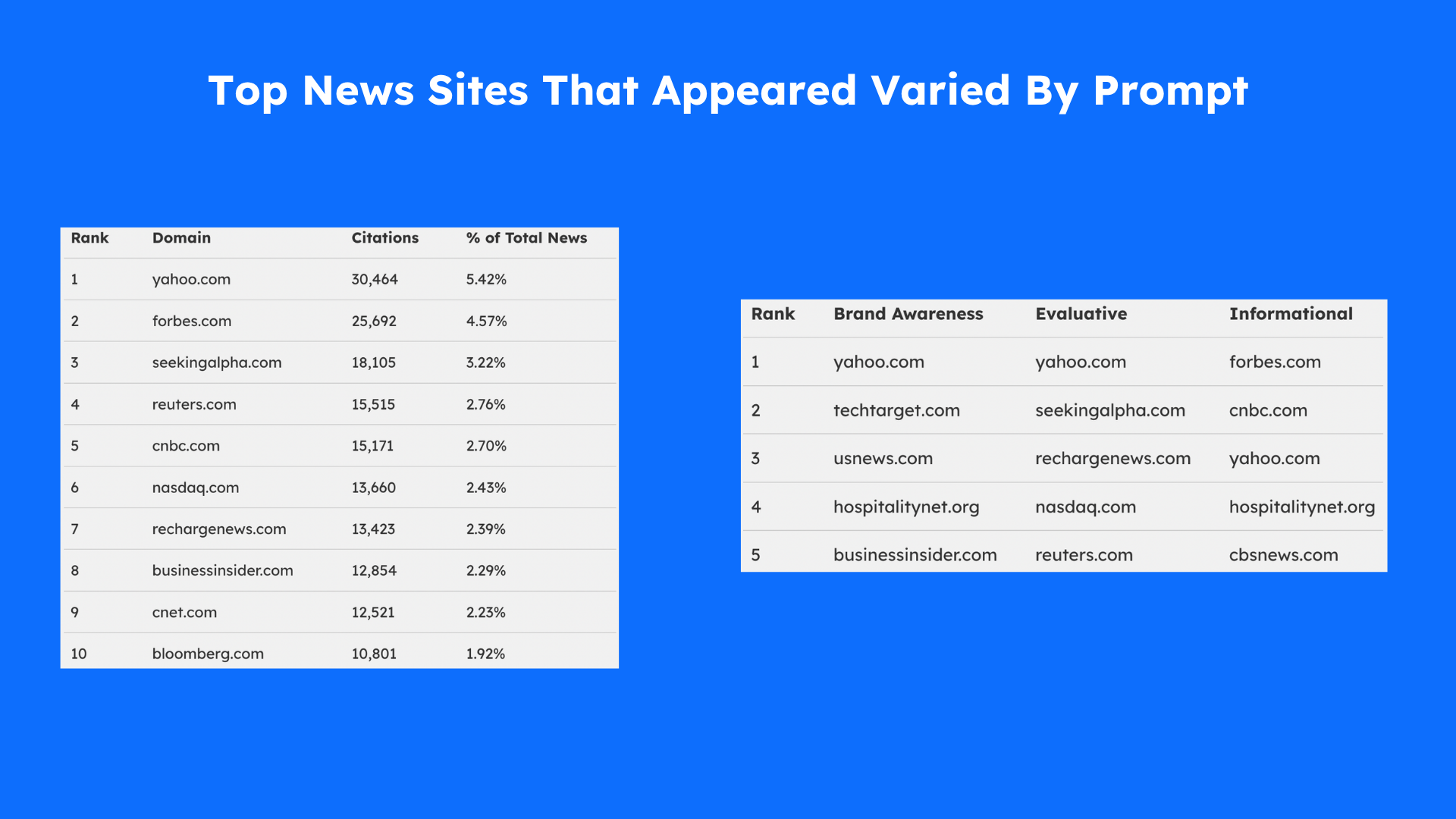
That’s the whole reason I tried to structure the study the way I did. As you can see, depending on whether you’re asking an informational, brand awareness, or evaluative prompt, the types of sites start to vary.
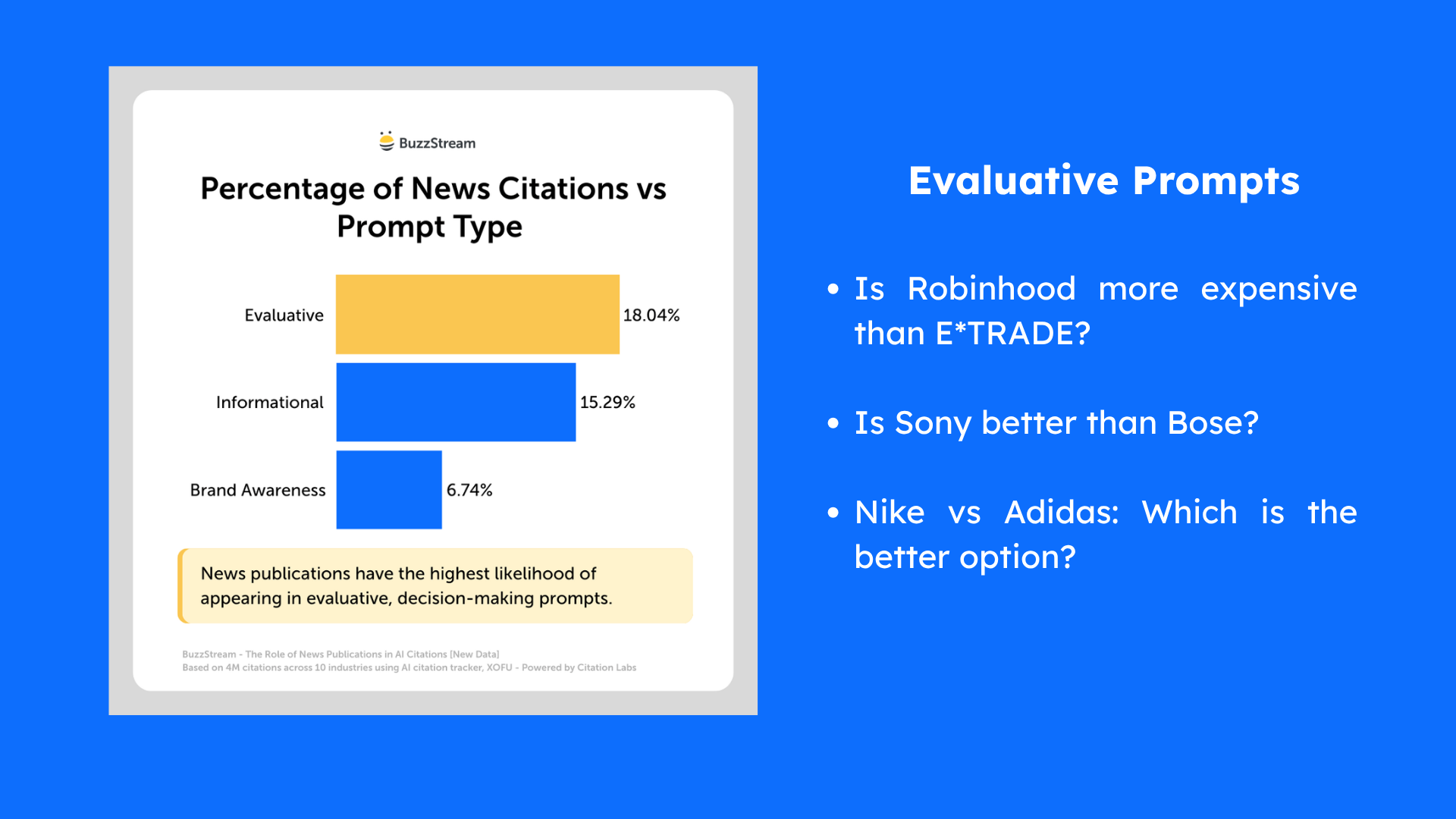
My first big takeaway was that news citations in my study came primarily from evaluative prompts — the comparative type, like “Is Sony better than Bose?” or “Is Nike better than Adidas?” That was surprising to me because I thought brand awareness prompts (“What is Chase known for?” “What role does HBO play?”) would be a lot higher. But those were actually the lowest.
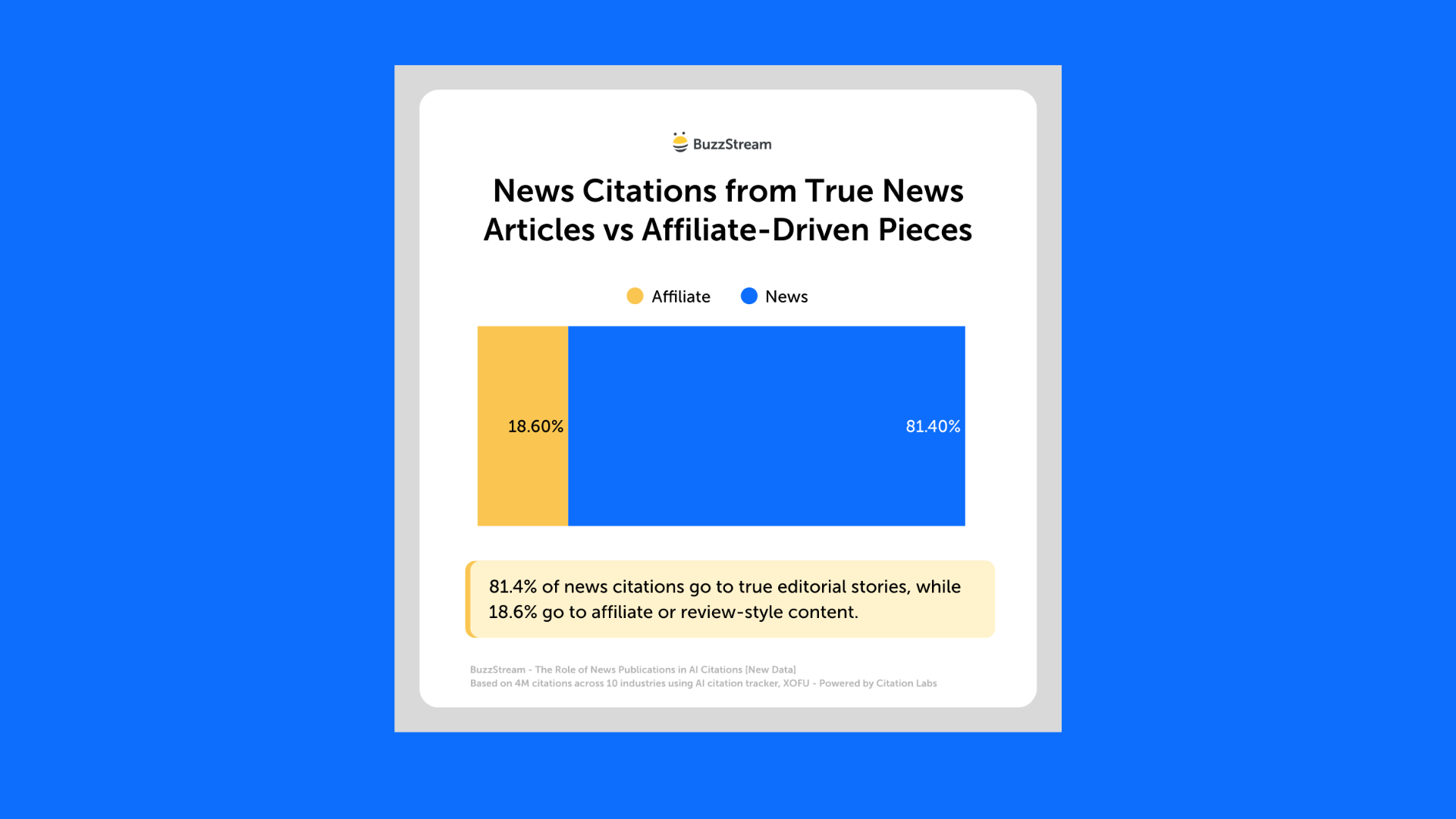
Another takeaway was that it was primarily true news articles rather than affiliate-driven content. AP News delivering news about something is different from a GamesRadar piece that has news in name but is really a comparative affiliate listicle.
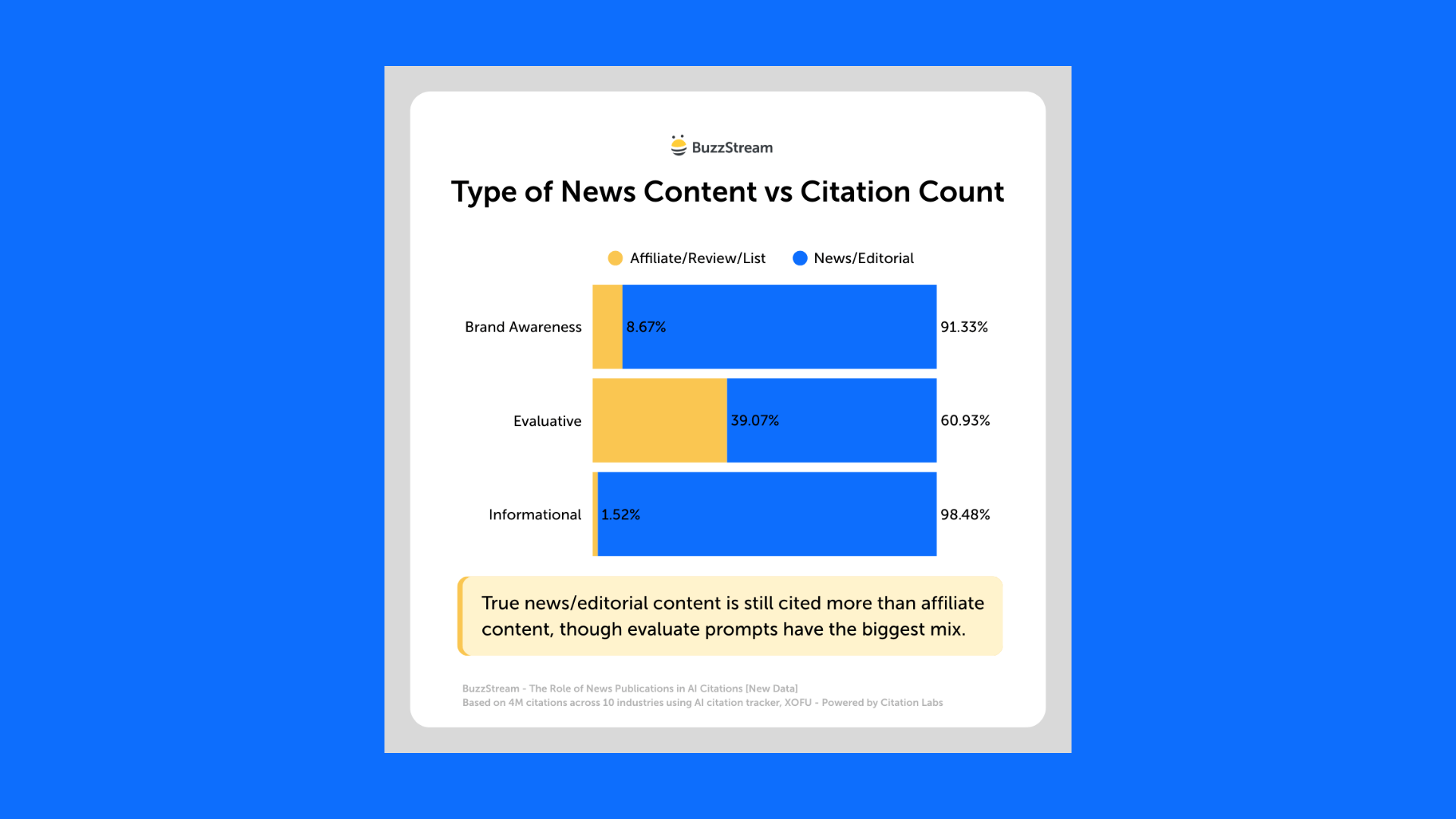
The takeaway is that true news dominates, but the evaluative prompts are where you see more of the affiliate-review-style listicle content from news publications — which makes sense, but is worth calling out.
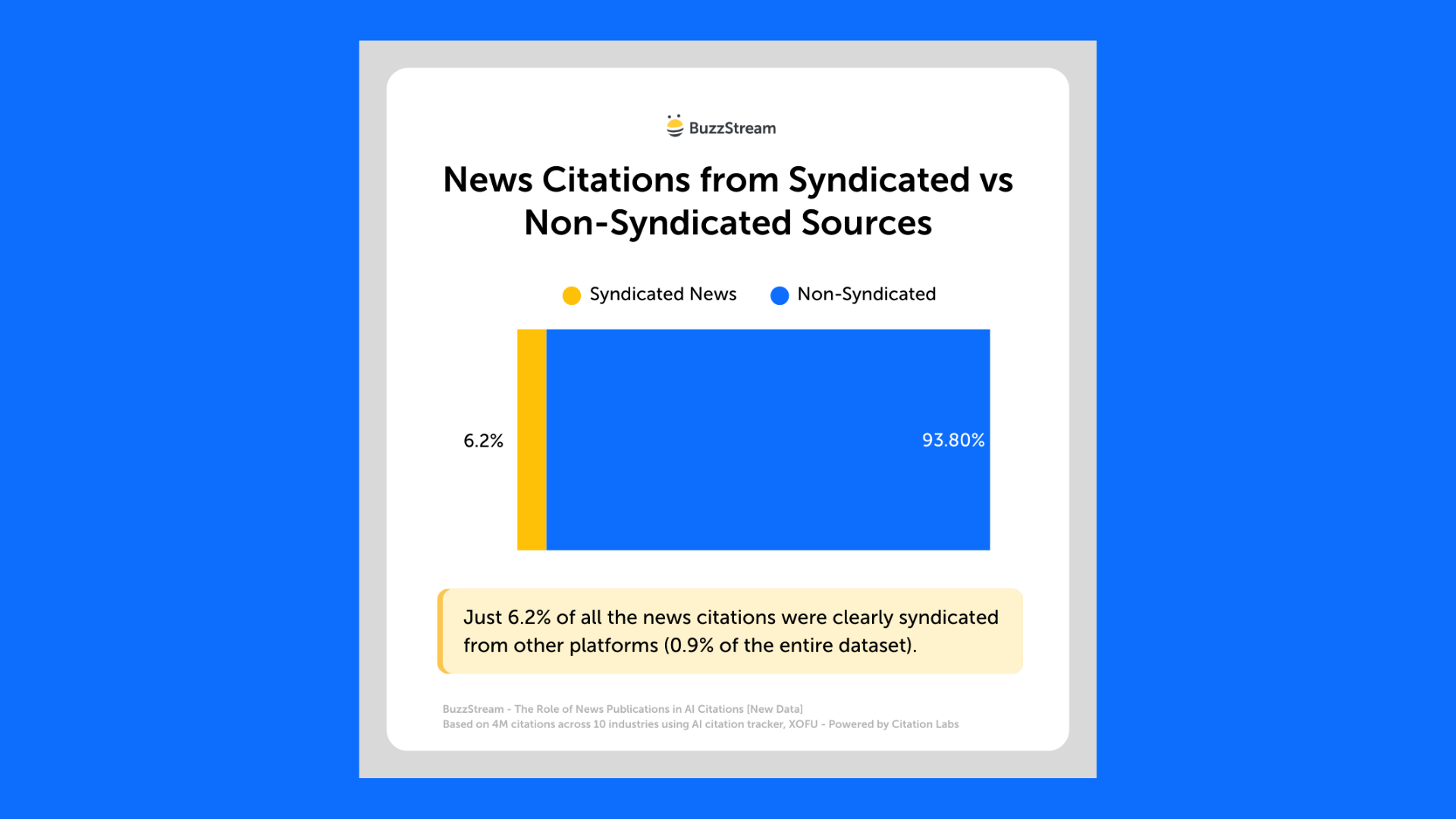
I also looked at syndicated versus non-syndicated news, and saw a lot more non-syndicated content appearing. To clarify: non-syndicated means the primary author’s version; syndicated is when the content has been republished from another source. I looked at canonical tags to identify these cases, though there’s some SEO nuance there.
Lastly, I looked at press releases — using the author name to identify when a publication was a newswire or press release source. Press releases made up just under 1% of citations. My takeaway: you can’t just release a press release, do nothing else with it, and expect it to show up in AI citations.
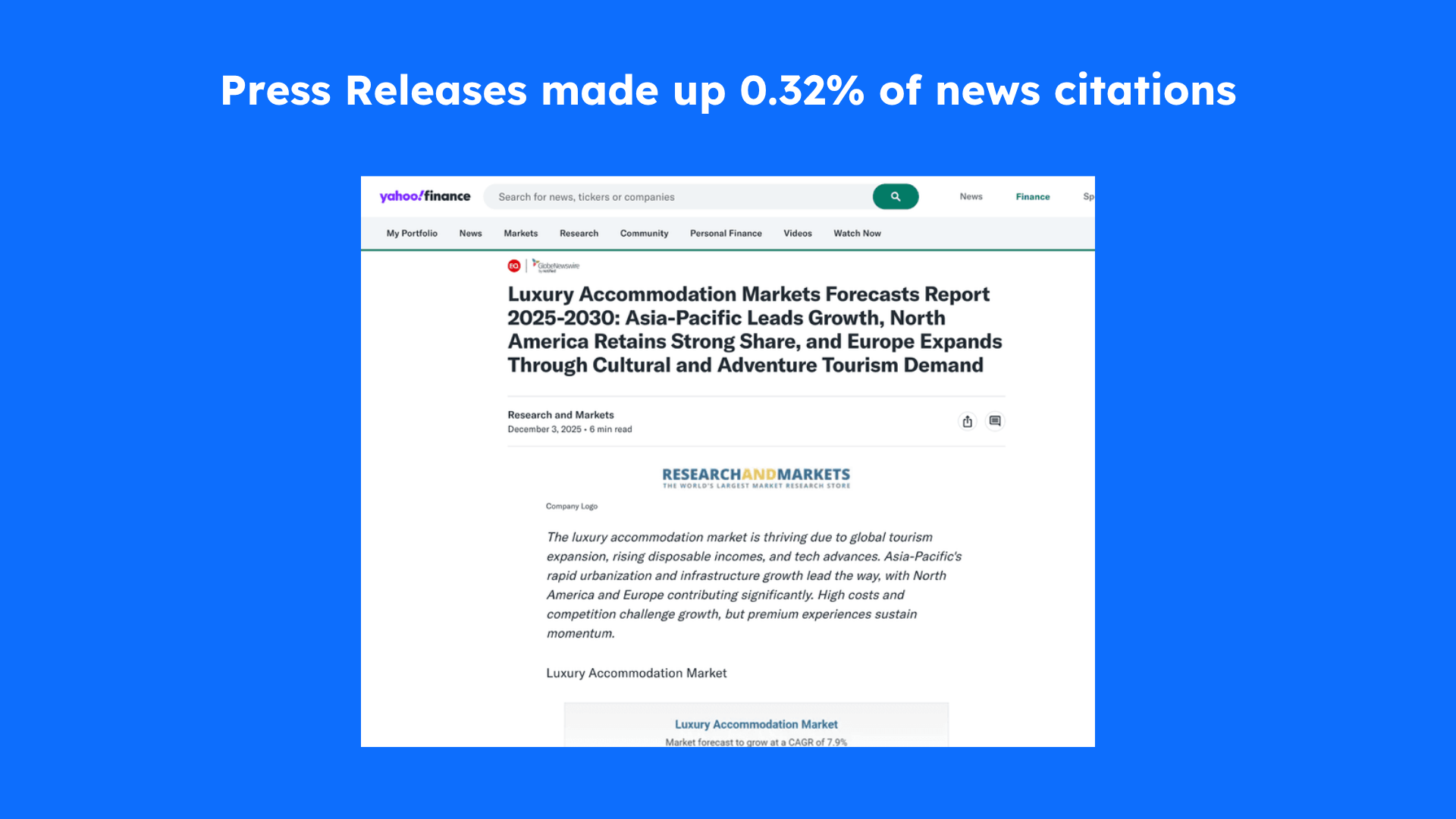
Similarly, publishing on a newswire without any additional promotion is probably not going to get you very far.
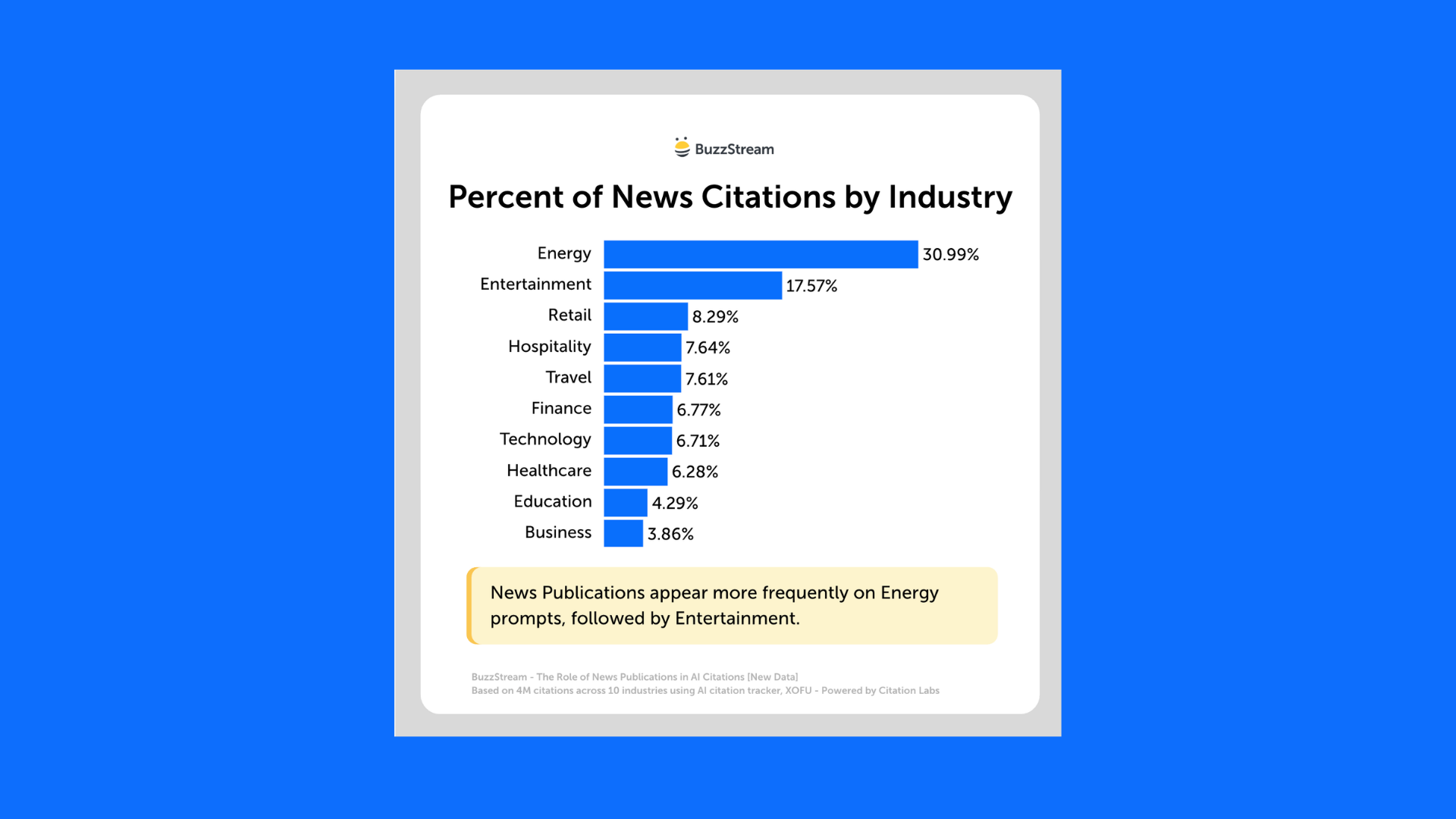
One more thing worth noting, which Beth brought to my attention, is that the percentage of news citations varies a lot by industry. I only looked at 10 industries, and there were many news citations in the energy space, for instance, while business had fewer. So the industry you’re in matters.
Let’s get into the discussion.
Will, I know you had something to say about that last point.
Will Hobson (Rise at Seven): Yeah, I really liked the breakdown across industries.
When I think about LLMs and how to feature in them, freshness of content is definitely key. I think why entertainment is so high in terms of the percentage of news citations is because what’s trending changes constantly. With entertainment, you think about something like a trending TV show — we just had The Traitors air in the US, which is big for some of our clients in the gambling space, looking at odds and that sort of thing.
Creating content on multiple platforms around that show is what drives freshness. So I think there are certain industries where news citations will naturally be higher, and entertainment is a really important one.
Vince: Yeah, for sure. And Beth, I think you mentioned fashion?
Beth Nunnington (Journey Further): Yeah, fashion. A lot of our fashion clients also have affiliates. This is a whole other topic, but affiliate links were previously seen as not passing any SEO value. Now we’re seeing that affiliates are getting featured in LLMs.
I asked Vince if fashion had been included in the study — it hadn’t — and I think it could be really interesting to look at, given the affiliate angle.
Will: I love that. And it goes back to what you’re trying to accomplish. With fashion, we’re usually trying to push a product. Historically from a search perspective, affiliate links were a big no-no. But now everything we were told wasn’t a thing is becoming a thing. It feels great. I totally agree.
Vince: Kelsey, you brought up some methodology questions earlier. I think it’s so important to understand how any of these studies are constructed — if I had thrown in gambling, gaming, or sports, the frequency of news changes so quickly that it might have skewed the whole dataset. Maybe instead of 14%, it would have been 30%.
Can you speak to your overall thoughts on the breakdown and categorization?
Kelsey: What I’ve seen a lot in the industry is how SEOs categorize different publishers very differently from one another, which can create claims that clients cling to, and then we all have to clarify in our own ways.
For our digital PR team, mainstream news — CNBC, Reuters, Wall Street Journal — is a major focus. But we also target niche relevant publishers. To me, The Motley Fool is really good in investment and finance, for example. Those are the caveats when looking at this type of data, and how open you were with sharing your raw data is really helpful in understanding those narratives.
The biggest takeaway for digital PR teams right now is that it’s not about going all in on just mainstream news. It’s about getting a broad representation of authority — both authoritative mainstream sites with the recency of publishing that AI favors, and also industry-relevant publications, whether those technically qualify as affiliate sites or not. A Motley Fool might look like an affiliate site to an SEO, but a digital PR team would see it as a very relevant finance publication.
It’s never been about getting a large volume of links or chasing one type of link. It’s about getting brand mentions on the sites most relevant to you across a wide portfolio — .govs, .edus, mainstream news, association publishers, all of it.
Vince: Yeah. Beth, how important is tracking citations in this way? I feel like getting too caught up in the minutia could be tough for brands and agencies.
Beth: Exactly. I agreed with everything Kelsey just said. We need to be careful not to get too fixated on certain stats and studies. At the end of the day, it comes down to your target audience and their search behavior — how they’re discovering brands, what platforms they’re using, whether they over-index on ChatGPT versus Claude or Google Search, and so on.
We do a lot of work looking at the landscape, seeing how a brand is already showing up in LLMs, where the gaps are, and then tracking from there. We use Ahrefs Brand Radar and Peak AI. But yeah, it can get risky if you become too fixated.
On the news point — I was surprised by the relatively low percentage. Just to clarify: was that just purely news sites, or did it include lifestyle press like TechCrunch or People Magazine?
Vince: Yeah, I did include those. The ones I excluded are the more SEO-focused sites — NerdWallet, Motley Fool, that type of thing. But TechCrunch, those industry pubs — for the most part those are all counted as news publications.
Beth: Okay, that’s good to know. I would have thought it would be higher then.
Vince: Will, why do you think news citations might be lower than people expect? Is there something about the methodology, or the prompts themselves?
Will: I think the most successful LLM strategies we’ve seen are when we treat it more like a broader organic search strategy — not just PR and news in isolation, but thinking about how that fits within the wider topic. Using entertainment as an example: with The Traitors, we increased LLM visibility by doing PR stories around the show with past contestants, but we also did on-site content guides, social media, and a lot more.
So for me, this study shows what we’ve always been saying about organic search strategy — it’s about relevant storytelling across multiple platforms, not trying to game an algorithm.
If you’ve got an interesting story, you need to get it out in the right ways. That cemented my feeling that we should be focused on great storytelling rather than targeting certain sites.
Beth: I’d add to that — and this is something I’ll stand by firmly — the search landscape is changing, but good PR has always been about relevant content, strong storytelling, and engaging with your target audience. As long as we continue to do that, LLMs will reward us for it, because they want to give the best results.
They’re in competition with other platforms, just like Google always was.
Will: Yeah, it feels like the same strategy, just faster and executed in different ways.
Kelsey: And Vince, in a way, what you found gives people a lot of hope — you don’t need to just go after the most authoritative, hardest-to-break-into sites. It’s really about who has become the most authoritative, influential publisher in your niche. That could even be a brand — you see Adobe pop up a lot, for example.
I was also reading a study from Air Ops and the Growth Memo newsletter that talked about finding gaps where your competitor appears but you don’t, and then building the most robust page on that topic. Instead of doing 10 pages on one topic, you’re building one 10x pillar page.
These are phrases we’ve heard for over a decade, but they’re coming back — it’s not about creating massive amounts of content, it’s about creating the most robust content with the most subject matter expertise, the freshest data. That’s what all of these systems value.
If you’re getting mentions from other sites in a similar niche, you’re building entity authority and establishing your brand within the knowledge graph as a go-to source.
Vince: Yeah. There’s a part two to this study I’m working on right now.
What I did was categorize everything as owned versus earned. If a prompt like “What headphones are better, Bose or Sony?” surfaced something from Sony’s own social media, I called that owned. Everything else — external blog posts, industry sites, listicles mentioning you — I called earned.
Earned made up about 80% of all citations. There’s a lot of potential there, though I worry it opens the door to spammy link building again, which is actually one of the submitted questions we’ll get to.
Kelsey, on syndication — it made up about 6% of news citations in the study. I know syndication is a topic you’ve looked at a lot. How do you think about the value of syndicated pickups?
Kelsey: It’s two-pronged. AI is prioritizing credible original sources, so in the example you showed, if something is published originally on Bloomberg and then syndicates to Yahoo, AI will more often pull the Bloomberg link by default.
However, from a broader PR and SEO perspective, if you get coverage on USA Today — and BuzzSumo did a really good study on which publishers have the largest syndication networks — yes, syndicated links may be less valuable technically, but you’re accessing a different target market.
Some people read Yahoo instead of Bloomberg.
Also, when you’re thinking about the knowledge graph and repeated brand exposure across many authoritative sites, you’re potentially increasing entity authority and the contextual relevance of what you want to be known for. At Fractl, we always prioritize when one story can go dozens of places — why wouldn’t we?
Time might pick something up because they saw it on Business Insider.
So yes, pursue both.
Vince Agreed. I saw something this morning from Tamara Sykes at Stacker about syndication networks versus earned distribution — someone picks it up because they saw it and want to write about it, versus a network that just automatically republishes content.
One has a lot more momentum to it.
Vince: Beth, how do you approach syndication at Journey Further?
Beth: Very similarly. We talk about building a brand’s online entity and digital footprint, and positive mentions in volume can only be a good thing.
We’ve seen cases where we got coverage on USA Today, it syndicated, and then other publications picked it up because they saw the story gaining momentum and wanted a piece of it.
We would never not contact USA Today over syndication concerns — if it syndicates, that’s a bonus.
We’ve also seen campaigns with a lot of syndication and social signals lead to measurable uplifts in visibility, and I think there’s correlation there.
Will: Totally agree. And for me, if someone’s reading it, I want to be in it.
USA Today specifically is great because it always seems to ripple out to other publications. I think the hesitation around syndication comes from an older quantity-over-quality mindset. These days it’s more about positive sentiment and brand awareness, and the sheer size of the USA Today network means real audiences are reading it.
Why would you turn that down?
Kelsey: I’d also add — especially when it comes to AI systems — we should be building entity authority across platforms.
It’s one thing to be an authority in the SERPs; it’s another to be an authority in the SERPs, on YouTube, on Reddit, on TikTok, in news publications, in industry associations, on radio. The more platforms you’re represented on within your niche, the more authoritative you’ll appear in these larger AI ecosystems.
I wouldn’t discount a radio station syndication in the eyes of AI, because those brand mentions are being ingested and learned from — both through training data and RAG. Long term, what does AI understand about your brand across numerous platforms?
That’s what shapes how your brand appears six to twelve months from now.
Beth: I remember overseeing our UK team when we got some syndication and a client asked, “What’s this boom in traffic?” When we looked at the source, it was from a syndicated regional publication in the UK. That was proof enough.
Will: We had the same experience. For one of our beauty clients, a small regional UK publication turned out to be our biggest traffic and sales driver.
It drove hundreds of thousands of visits, sold the product out, and generated six figures in revenue. Don’t overlook smaller publications just because they seem less significant on the surface.
And it goes back to understanding your audience — where they are and what they read.
Just because you’ve featured somewhere once doesn’t mean you move on to find a new publication next time; if your audience is there, go back with a new story.
Vince: Yeah, and I think we’re missing some metrics at this point.
I took my whole dataset and ran it against DR, DA, organic traffic, and links, and found no correlation between how often sites show up in AI citations and those traditional metrics. There probably are relevance metrics and entity mapping signals — cosine similarity, that kind of thing — that matter more.
As an industry, we need new metrics for this, and the tools aren’t fully there yet. But what you’re all preaching is true: you need a wider net now. It’s not just about getting into one key publication.
You need to be on social, everywhere.
That’s a good segue into social.
Will, Rise at Seven has this as part of your strategy — can you talk about the role of social in AI?
Will: Yeah, it’s super important. It’s really about everyone saying a similar thing across channels and pulling in the same direction. We often use meme sites and similar platforms to push our stories because a lot of journalists go there to pick up stories in the first place.
If we can get there first, we can push the story further from a press perspective.
But the key is that these channels aren’t siloed — they’re all telling a consistent story. It still comes back to storytelling. You just do it on different platforms in different ways. For us, social is a major part, but it has to work as a social story. We’ll take our top-performing on-site content and reformat it for each platform. What I love about LLMs is that they’re pulling all these channels together faster and breaking down the silos — and that’s something we’ve all wanted for a long time.
Vince: Beth, Journey Further has a social team — how do your digital PR campaigns interact with social?
Beth: Similar to what Will said.
It’s about thinking about the client’s goals and audience and connecting everything together, because we know AI is synthesizing all mentions across the web. The messaging needs to be consistent and distinctive. Influencer is also a big part of this — we recently acquired Solderson Media, an influencer agency, and we’ve been working on integrated strategies.
AI can read YouTube transcripts and LinkedIn content, so content creators on those platforms sharing similar stories can amplify each other’s work.
It all comes down to running a consistent thread through everything you do, so that LLMs understand what the brand is about and what it wants to be known for.
Vince: Kelsey, Fractl doesn’t have a social team per se — how do you approach that?
Kelsey: What’s been interesting over the years is that by focusing on creating newsworthy, data-driven content, we tend to get coverage on places like the Today Show or CNBC, and then social influencers will see that and pick it up. We never prioritized that as much because the SEO industry was very focused on authoritative links.
But as we noticed the shift over the last three to five years toward brand mentions, relevance, and authority, we started repurposing our campaigns into social assets and partnering with influencer platforms like Influencer.co. A tool I love for this is SparkToro — you can drill into which social platforms your specific target market is most engaged on.
We’ve actually moved part of our PR team into content repurposing for social. Because again, back to AI — all these channels matter.
When you already have great content and great PR teams, why wouldn’t you take that content and repurpose it across channels? It’s the easiest step to take.
Vince: The message that keeps coming through from all of you is this idea of brand ubiquity across platforms — having a great story and getting your message out broadly.
The more you get caught up in “I want this publication versus that one,” the more you might be doing yourself a disservice. Am I capturing the sentiment?
Kelsey: We were all aggressively nodding on that one.
Beth: Yes. I always say to clients: focus your energies on building a brand that’s worth finding, and the rest will follow.
Vince: Okay, I wanted to address a couple of myths I’ve looked into using this data.
First: AI partnerships with publisher platforms. Google has a data partnership with Associated Press, OpenAI has its own deals, and I’ve seen a lot of people say, “If you want to show up in Google AI, get a link from AP.”
But I found very little data to back up the claim that just because a platform has a partnership with a news outlet, it will cite that outlet more readily. Was that surprising to any of you?
Will: The thing that always comes to mind is — there are always partnerships across everything, and if you get too worried about all those little things you can get lost.
There’s been a lot of UK media coverage about various partnerships and whether that means more coverage, but if you get too caught up in that, you go down a road you don’t need to go down.
Just focus on building relevant, interesting stories and everything else will shine through.
Beth: I agree. At first glance, it feels a little surprising, but when you think about how AI is working — they want to put forward the most relevant results to remain the best platform — it’s actually not surprising that they continue to surface what they think is genuinely the best content.
And that’s the right way, because otherwise, if it were all commercially backed, it would become very advertorial.
Kelsey: Yeah, and those data partnerships are used for training the models — that’s where the confusion in the industry comes from.
It’s valuable for training because it provides your brand with more exposure, but what we’re talking about with citations is source relevance based on the prompt. It’s live retrieval, data recency, and source relevance to the topic — not who has a data deal with whom.
Both are valuable, but they’re talking about separate parts of the ecosystem.
Vince: Exactly. And speaking of that, the other myth I wanted to address is around blocking AI crawlers and how that influences citations.
There are different types of crawlers — ones used for training data, and ones used for live retrieval inside ChatGPT or AI Overviews. But even accounting for that distinction: just because a site blocks a retrieval or training bot does not mean it’s less likely to show up in citations.
That’s at least what our data shows.
This comes back to looking at two different things — someone might block training data crawlers but still show up in citations because they’re separate flows.
Beyond that, there’s a lot of evidence that blocking robots.txt doesn’t reliably work anyway, since crawlers have ways around it.
And in many cases, these models are extracting information from the SERP itself, not necessarily crawling the actual site — so blocking a crawler is irrelevant if they’re just pulling from the search results page.
There’s some genuine misinformation around this, and if you take things you see on social media at face value, you’ll do yourself a disservice.
Okay, before we get to Q&A, I wanted to give each of you a quick sound bite on the question everyone’s asking:
Will, how do you recommend a brand show up in AI?
Will: It depends on what you want, but broadly: it’s still about following the same strategy we’ve always used — just working in tandem across all services rather than looking at PR in isolation. I’d still focus on storytelling. I’d still commit to finding an interesting brand story and telling it well. The difference now is thinking about optimization a bit differently.
But if you’ve got an interesting story, it’s going to be featured in LLMs. If you don’t, then the problem is the story.
Vince: Beth, how do you recommend a brand show up in AI?
Beth: Do your analysis and insight work upfront. Understand the brand’s goals, look at the full 360 media landscape, analyze competitors, find the gaps both from a Google and AI perspective, and then use that insight to inform a strategy that tells a story containing the brand messaging you want to be known for.
But equally, it has to be interesting and engaging — it can’t be too self-promotional. The foundations of PR are still the same.
Be relevant, be engaging to your audience. Tools like SparkToro and SimilarWeb are great for understanding what publications your audience actually reads.
Get as much data and insight upfront as possible, then use it to inform your strategy.
Vince: Kelsey, how do you recommend a brand show up in AI?
Kelsey: It’s about building your brand out as the authority in your industry. You do that by demonstrating subject matter expertise — going on podcasts like this one, weaving expert quotes into your on-site content, providing first-party knowledge that AI can’t replicate on its own.
That means AI has to source you as the expert because you’re giving it fresh data and unique expertise — not the AI-generated slop that a lot of people are going to start producing. Unique data insights are especially powerful because they keep you relevant by feeding these systems fresh information.
Build your authority through data, subject matter expertise, expert quotes, and getting it all onto as many different platforms as you can — publishers, social media, .govs, .edus, the entire media landscape. SEOs really need to stop thinking narrowly about any type of link and focus on brand mentions across lots of different types of sites and platforms, wherever your community engages. All these systems — Google, AI, social — will rank you higher as a result.
Vince: Love it. Let’s jump to questions.
One question is around AI citations being easily manipulated, at least early on. There are studies showing that publishing a lot of listicles can get you featured quickly, and there are spammy tactics like hiding text on pages. The question is really about longevity.
And have you seen showing up in AI citations happen quickly, or is it still more like a six-month SEO timeline?
Will: It can be a lot faster. Going back to the entertainment case study — we created on-site content and did PR, and increased our visibility within a day. That’s incredible compared to traditional search tactics. On the spammy side: it’s the same as always.
That type of activity will catch up with you. Focusing on sustainable, brand-building efforts will have longer-term benefits. You might be able to game the system faster with shady tactics, but it won’t build a brand.
We’d rather put in the foundational work — you can still get results quickly, but they’ll also have lasting brand benefits.
Beth: Will nailed it. And what you said, Vince, about longevity — I’d be cautious. It might work now, but it’s probably not going to sustain long term. Don’t waste your time and energy on something that isn’t sustainable.
Kelsey: Agreed. It also depends on how saturated your niche is.
In entertainment, Will, it sounds like you can move quickly. We work more in finance, technology, and health — in those verticals you can’t just race out every new story and suddenly dominate. You have to bring a lot of E-E-A-T signals and authority.
Regardless of the platform, everyone will eventually crack down on shady tactics. The foundation we all stand on is building long-term brand authority in credible ways.
Vince: Okay, next: tools. I’ve heard PEEC AI, SparkToro for audience research, and I should mention Xofu — that’s what I used as our citation tracker for this study, built by Garrett French and the Citation Labs team.
Kelsey, I know you have your own AI agents for tracking citations — can you talk about that?
Kelsey: Six months ago, a lot of products launched claiming to track AI visibility in a quantified way, but it’s not the SERPs — we can’t track rankings.
We’re talking about visibility, and that changes across ChatGPT, Perplexity, Claude, and others, because each has different training systems and different RAG setups.
We have around 20 to 30 different agents — some public, some private. One of the things we’re doing is tracking clusters of keywords and questions related to our clients across the buyer’s journey in their vertical, and looking at that across all the AI platforms out there to identify gaps in brand visibility.
Then we figure out how to support that with on-site content and how to create data-driven content we can pitch to earn authoritative brand mentions.
We also use Ahrefs Brand Radar, SEMrush, and more.
Each tool shows you something completely different, which is the most important thing for everyone to understand. You should be using a lot of different sources because nobody really has the crystal ball — nobody ever did with Google’s algorithm either.
The more data you come in with, the better informed you’ll be. Our agents are free at the moment because we’re using it as a sandbox to explore. Come with data, ask good questions about methodology, and stay curious.
Beth: I use Peec AI, Ahrefs Brand Radar.
We also have our own proprietary technology suite, Salient, which includes a query fan-out tool that helps us look at specific queries to inform SEO and digital PR content. Similar to Kelsey, we’ve tested a lot of tools — Profound is another one. It’s definitely a case of keeping an eye on what’s out there, because this is so new and so fast-moving. We don’t have a single source of truth yet.
All right, that’s our time. I appreciate you all staying on a little longer. Kelsey, Beth, Will — thank you so much.

Vince Nero
Vince is the Director of Content Marketing at Buzzstream. He thinks content marketers should solve for users, not just Google. He also loves finding creative content online.
His previous work includes content marketing agency Siege Media for six years, Homebuyer.com, and The Grit Group. Outside of work, you can catch Vince running, playing with his 2 kids, enjoying some video games, or watching Phillies baseball.
