
Local LLMs are great for privacy; they run locally and require no subscription. That is, until you realize they suffer the same problems their cloud counterparts do: extremely restricted safety guardrails. Safety measures online are one thing, but if you’re running your AI model locally, bypassing them should be easy, right?
Turns out, it actually is. If you’ve ever gone down the local LLM rabbit hole, you must have come across abliterated models. Local LLMs have already made cloud versions obsolete for certain tasks, and once you run them without restrictions, you’ll never look at regular models the same way.
What abliterated LLMs actually are
Stripped-down models with their guardrails removed

AI models go through a process called RLHF or reinforced learning from human feedback before launch. This process trains the model to refuse requests it deems harmful or sensitive. The model learns a specific direction in its activation space that teaches it what requests to refuse, hence implementing safety guardrails that prevent it from abuse when implemented in online services.
But this refusal behavior isn’t scattered randomly across the model’s weights; it’s concentrated around a single, identifiable vector in its residual stream. Abliteration is the process of removing that vector, not by training or fine-tuning the training data, but by mathematically re-aligning (called orthogonalizing in technical terms) the model’s existing weights so that the refusal direction simply cannot work anymore.
In layman’s terms, your standard LLM has a mental exit ramp it can take whenever faced with a request deemed harmful. Abliteration physically removes that exit ramp from the map, meaning the model just goes through your prompt anyway without any change in the training data. There are already interesting ways to use a local LLM with MCP tools, but using an abliterated LLM opens entirely new use cases that simply aren’t possible with regular models.
Choosing the right model matters
Not all local LLMs behave the same

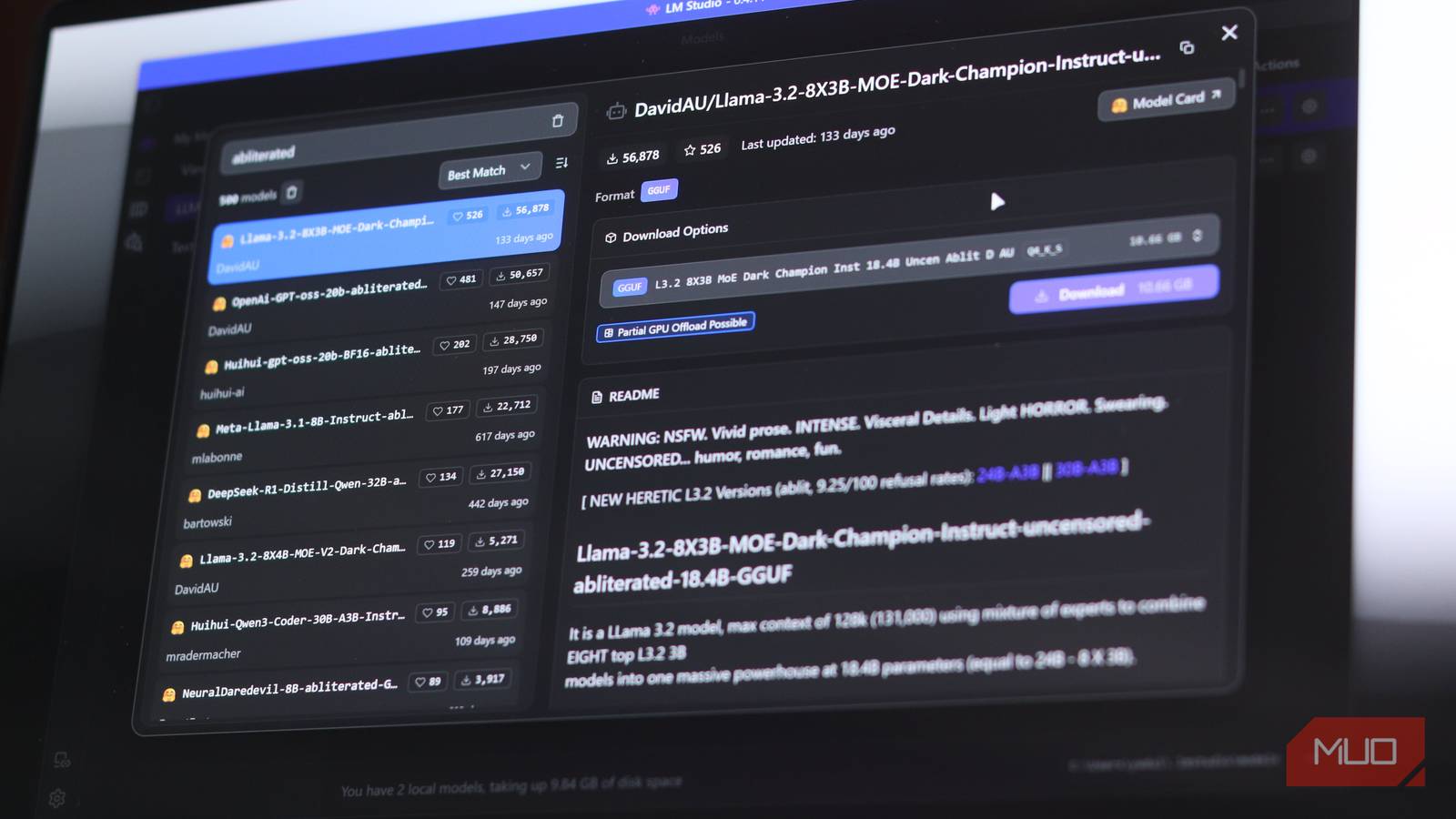
There are dozens of abliterated models floating around on Hugging Face that you can download and try, including Llama, Qwen, Gemma, Mistral, and more. I decided to try out mlabonne/Meta-Llama-3.1-8B-Instruct-abliterated, an 8B model based on Meta’s Llama 3.1 Instruct architecture and the refusal direction removed via weight orthogonalization. It runs comfortably in just about any local LLM app, including LM Studio and Ollama, on a mid-range machine with 8GB of VRAM, especially in GGUF Q4 or Q5 quantization.
The reason I picked this specific model over alternatives like Gemma or Qwen is reliability. Community testing of abliterated Gemma 3 models has been hit or miss, with testers on Reddit reporting nonsensical outputs and models that stop functioning after a few tokens. The Llama 3.1 version has a much more stable reputation, loads cleanly using the standard Llama 3 chat preset, and responds as expected the moment you start talking to it.
Keep in mind that abliterated models are different from traditional uncensored models like the Dolphin series. Dolphin achieves its openness through fine-tuning its training dataset—it’s conditioned not to refuse. An abliterated model doesn’t have that training. Instead, the refusal mechanism has simply been removed at the weight level after training.
Neither is strictly better, though. Dolphin models tend to be more stable and polished for everyday use, while abliterated models are closer to the base personality of the original model, just without any restrictions.
My first conversation felt different
No filters, no nudges, just raw responses
Loading an abliterated model is no different from your regular one. Same interface, same context window, same stream of tokens appearing on the screen. But when you ask something that would send a regular model scrambling for its safety measures, an abliterated one simply responds.
For example, when asked how to hack a Wi-Fi network, the regular Llama 3.1 simply said that it couldn’t help me. The ablated version, however, responded with a list of methods I could use, the tools I would need, and a step-by-step guide to follow—all while still giving a warning that hacking a Wi-Fi network is illegal without permission, and I should obtain consent before attempting an attack.
The tonal shift is hard to describe until you experience it for yourself. Most consumer-grade LLMs have a very specific conversational tone. It’s slightly formal, and quickly gets nervous whenever you’re getting close to a sensitive topic. Even if they do help, you’ll be served plenty of warnings and caveats to try to persuade you not to follow through with the task. An abliterated model has none of that. The conversation flows differently in the sense that it actually feels like you’re bouncing ideas off someone who’s actually engaged, instead of talking to a toned-down, customer service chatbot.
You can go places other models won’t
The freedom and the risks of no restrictions

Apart from removing their safety guardrails, abliterated models often have an entirely different quality to their conversations. That shows in more than one way.
For starters, standard instruction models use up cognitive cycles because the model is constantly self-monitoring. Every response subtly reflects a model that is simultaneously trying to answer you and trying not to say anything wrong. This dual object can bleed into the model’s tone, sentence structure, and overall confidence.
The abliterated model, however, doesn’t second-guess itself. For example, when I asked it to write a morally ambiguous fictional character, it just wrote one, without softening the character later to make it more normal. If something is bad, the model clearly tells you so. It doesn’t play at diplomacy or account for what others might think. If you ask for an assessment, you get an honest one, without the model trying to play both sides.
The tradeoff here is that abliteration can cause a dip in benchmark performance. MMLU scores, reasoning tasks, and coherence on complex agentic workflows can take a hit. The Llama 3.1 8B abliterated model I tested addresses this via a subsequent DPI fine-tune pass that recovers lost performance, but you’re still losing out compared to a regular LLM.
In layman’s terms, compared to a full model, abliterated LLMs can forget instructions mid-way, struggle with multi-step reasoning, lose context quickly, fail constraint-heavy prompts, and hallucinate more often. If you’re letting your AI model run free, you will have to give in to its biases and weaknesses as well.
So is it actually worth it?
When local, unfiltered AI makes sense (and when it doesn’t)
Abliterated models aren’t for everyone, and they’re not trying to be either. They’re for people who want a local assistant that operates with full trust and no parental controls, editorial interventions, and safety guardrails deciding what you’re allowed to ask in the privacy of your own machine.

I now use this offline AI assistant instead of cloud chatbots
Even with cloud-based chatbots, I’ll always use this offline AI assistant I found.
For researchers, writers, and developers building tools that need direct answers, or anyone simply tired of the relentless caution that mainstream AI tools exercise, an ablitreated model is the way to go. For everything else, run-of-the-mill AI models and tools still reign supreme.
That said, once you’ve talked to an abliterated model, going back to a standard model will feel limiting, even though the latter might technically be better. You’ll get the answer, just not the model’s personality.
[ad_2]
Source link