

When we launched our first State of Digital PR last year, digital PR was entering a resurgence.
This year, many say digital PR is even more effective than last year (driven in part by AI), yet it’s reportedly becoming more challenging.
We interviewed 150+ digital PR professionals to understand how they were addressing challenges and capitalizing on new opportunities.
Feel free to use any/all of the data in the report below, but please link and attribute to BuzzStream.
Section 1
Defining Digital PR
It’s always important to define the term “digital PR” as more people enter the space.
That’s a great place to start our 2026 report.
1
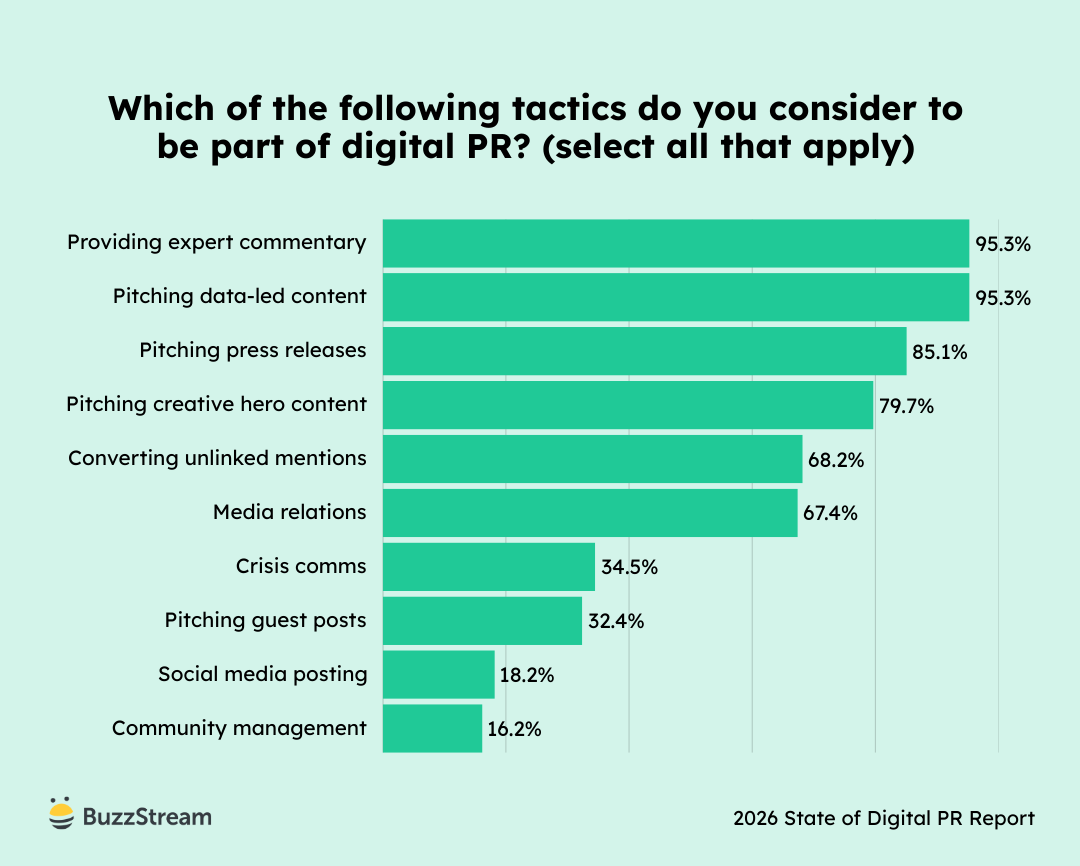
The same tactics dominate digital PR this year as they did previously, albeit in a slightly different order.
According to this year’s study, digital PR primarily involves providing expert commentary, pitching data-driven content, pitching press releases, and creating creative hero content.
We saw a growth in pitching press releases from 72.8% to 85.1% this year.
We also saw mentions of new tactics, such as crisis comms (34.5%) and community management (16.2%).
2
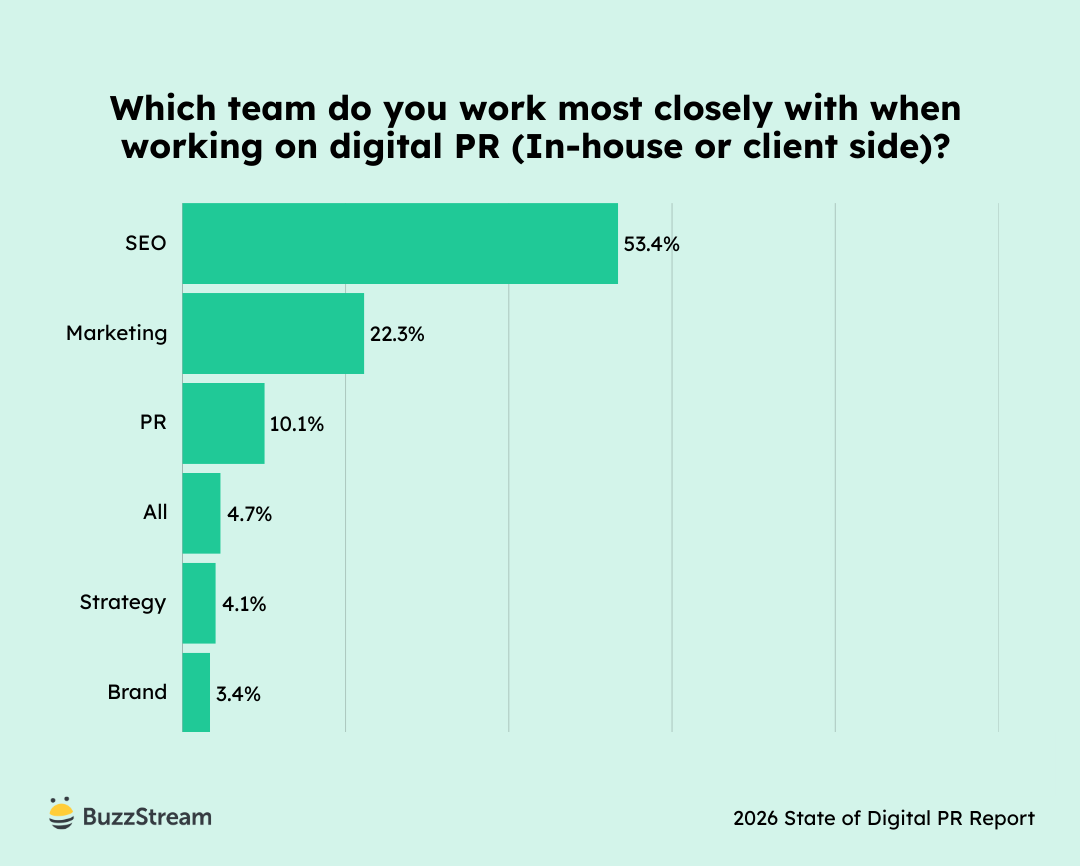
Just over half of the digital PRs that responded work most closely with SEO (53.4%).
This is a slight increase over last year of 50.9%.
We saw fewer digital PR teams reportedly working more closely with PR teams, with the share dropping from 14.5% in 2025 to 10.1% in 2026.
This siloed approach is a concerning trend that we’ve covered numerous times on our podcast. Folks like Gini Dietrich have long pushed for unity amongst teams to really achieve goals that help the business.
EXPERT OPINIONS
Press releases jumped again this year—why do you think more people are associating them with digital PR in 2026?
Press releases are on the increase because AI and LLMs have fundamentally changed how SEOs and digital marketers view digital PR. It’s no longer a shiny, expensive toy reserved for big brands only to play with. It has become a vital part of your digital toolset.
If you want your brand’s narrative to exist inside AI answers, you need it embedded in trusted, reputable media. Press releases provide a scalable, authoritative way to seed that narrative into the ecosystem that LLMs train on and reference.
In 2026, digital PR isn’t just about getting any coverage you can anymore; it’s about communicating your brand’s story effectively, so machines can understand it and repeat it to users.
Although PR tactics have varied over the years, and many people have different approaches to the right way of achieving success in digital PR, it all comes down to choosing the tactic that is going to have the biggest influence on a brand’s customer journey.
There are many methods we instantly think of as PR—expert commentary, reactive work, bigger hero campaigns—but aligning your output with the core relevancies of the brand, the products, the audience, and the platforms that will have the biggest impact on conversion is what really matters.
This approach tailors PR tactics to each challenge and, most importantly, delivers organic progression and business growth.
In the past, success in digital PR was synonymous with successful link-building, which press releases weren’t all that good at.
In the GEO world, brands are realizing how valuable authority-building beyond links can be, and press releases look and feel authoritative—one reason we’ve seen press release content appear in GEO results relatively quickly.
For reactive campaigns or anything without a landing page, press releases can also create a digital footprint without having to make graphics or write a full article, scaling campaigns in a way that wasn’t possible before.
EXPERT OPINIONS
New tactics like crisis comms and community management showed up—do you think those belong under “digital PR”? Why or why not?
I’m not surprised to see crisis comms showing up as a digital PR tactic. This is further proof that digital PR is maturing into PR, full stop.
The continued separation of digital PR, PR, and SEO is becoming increasingly artificial at a time when brand, reputation, and performance are more interconnected than ever.
Community management and social media posting also make sense due to the insight they provide around sentiment, emerging issues, and audience expectations—inputs that should absolutely feed into digital PR.
At its core, digital PR is about building and sharing authority, and any way you do that counts as DPR to me.
The ways we show authority to readers, customers, and search engines have become more diverse and interesting.
You don’t hit DPR goals with one swing—it takes lots of small wins adding up over time.
EXPERT OPINIONS
Digital PR teams are working less with PR teams than last year—what’s driving the silos, and what needs to change?
Defining how digital PR fits into a brand’s earned media and comms strategy is becoming a creeping scope as brands experiment with traditional PR, digital PR, GEO, and AiPR.
While SEO and digital PR teams have long been aligned, the need for a unified earned media message across PR, digital PR, and AiPR is becoming more important than ever.
Siloed efforts won’t cut it.
The silos between PR and digital PR are less about disagreement and more about leadership pressure.
PR teams are measured on relationships and narrative, while digital PR teams are measured on performance and attribution.
What needs to change is shared ownership—aligned goals, clearer handoffs, and leadership that rewards collaboration.
Section 2
Budget and Costs
Although we conducted a separate digital PR cost survey, we also examined it in our State of Digital PR.
3
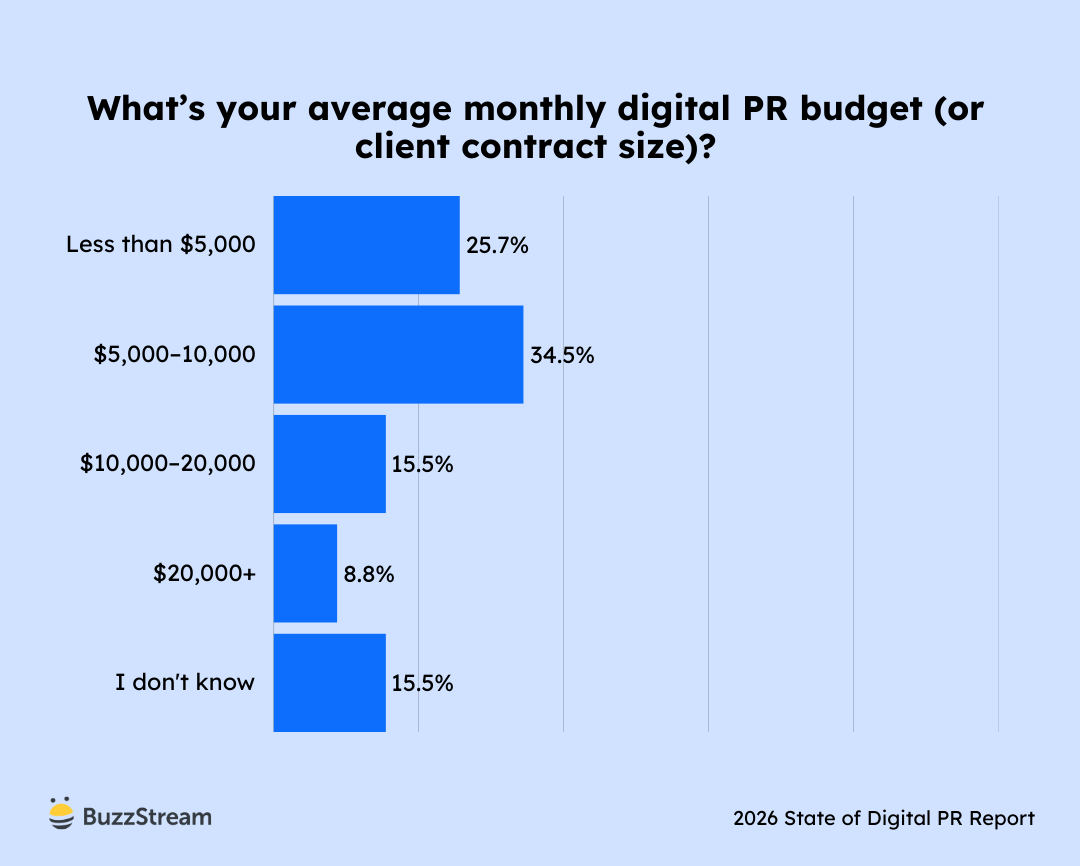
About 60% our respondents report that their monthly digital PR budget is less than $10,000, with 25.7% reporting less than $5,000.
Compared to last year, we saw an increase in higher-end digital PR budgets ($20,000+; 4% to 8.8% in 2026) and a decrease at the lower end (less than $5,000; from 34.1% to 25.7% in 2026). This tracks with our digital PR costs report.
As we’ll see, there’s a marked increase in interest in digital PR, which should hopefully raise some rates.
4
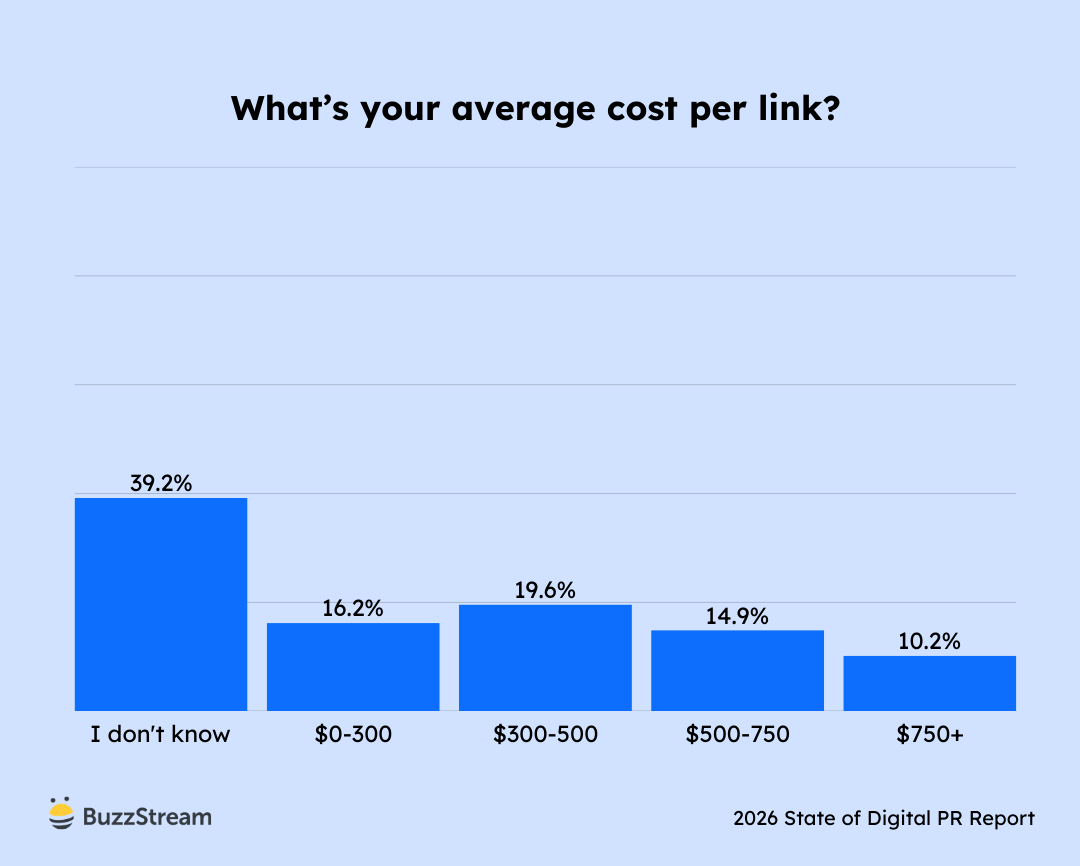
The most common range for known average cost per link is $300-500 (19.6%).
The share of teams reporting cost per link of $750+ has surged from 3% to 10.2% in 2026.
The other storyline is that fewer people report not knowing their cost per link (39.2% this year, down from 51.4% last year). This is probably a good thing, as I don’t think too many SEOs have abandoned the CPL metric altogether.
EXPERT OPINIONS
Higher-end digital PR budgets increased this year. What’s driving that investment?
The increase in budgets clearly marks a shift from digital PR being a tactic to a core strategic pillar. AI Search Visibility—through Google’s AI Overviews and tools like ChatGPT—is becoming a primary discovery method.
Brands are investing more to ensure they’re the authoritative sources that AI systems learn from and cite.
Higher-end digital PR budgets are increasing because the value is clearer than ever. Digital PR now directly contributes to brand fame, reputation, online visibility, and AI-powered search discovery.
With shrinking newsrooms and more competition, brands are being pushed to invest in stronger insights, braver creative, and higher production values.
Budgets are rising as more brands recognize that digital PR is one of the few channels that can build brand and backlinks at the same time as AI-led discovery takes off.
Earning coverage is harder, everything costs more, and success is now judged holistically—link quality, rankings, organic traffic, and brand performance.
Links are getting more expensive because quality, expertise, and credibility matter more than ever. AI has flooded the web with low-quality content.
That increases the value of long-standing, authoritative websites and the equity their links provide.
EXPERT OPINIONS
Why are links getting more expensive?
Digital PR budgets are increasing because the field is more competitive than ever. Standing out now requires bigger surveys, better tools, and stronger ideas.
Whether budgets go toward research, campaigns, or more traditional PR initiatives, brands need to invest if they want to break through the noise.
Section 3
Tactics & Strategies
This section covers how digital PR professionals use their expertise to secure coverage in 2026.
5
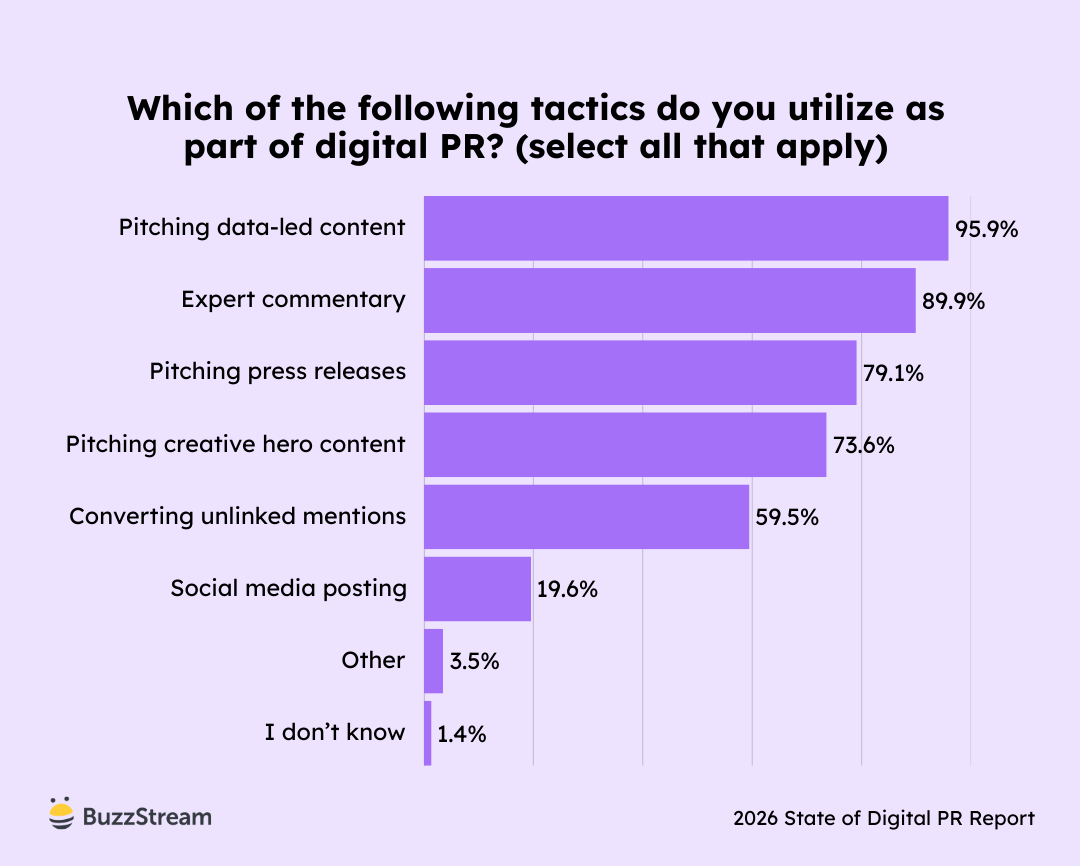
Pitching data-led content is the most common tactic employed by digital PR practitioners in 2026.
These all coincide with the defined role of digital PR that we asked about in the first question.
The only notable change in 2026 is a higher share of press releases submitted, up from 68.8% to 79.1%.
This may be because many have seen press releases cited by AI, though in the most recent Muck Rack study, press releases appear in only about 1% of citations. It’s still unclear how they influence AI models.
6
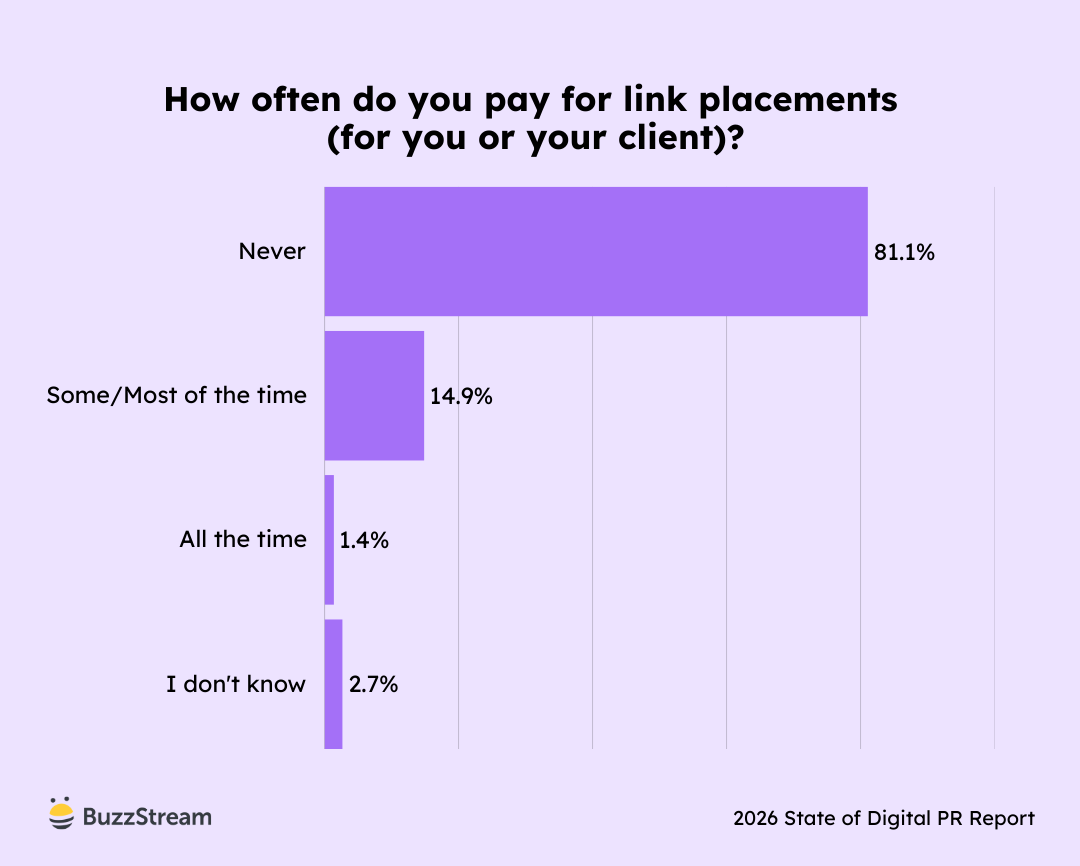
One of the main questions that always comes up is whether to buy links. It looks like about 80% never buy links.
This is down from 2025 (87.3%), suggesting digital PRs may be more open to buying in 2026, though the difference is slight.
EXPERT OPINIONS
Data-led content is still the #1 tactic—why do you think it continues to dominate year after year?
Data that’s genuinely ownable to a brand is gold dust. It positions the brand as an authority and from a PR perspective, gives journalists something they can’t get anywhere else – which instantly increases the chances of coverage as you’ve got a competitive edge.
Every campaign we run is underpinned by data or insight in some form. The real challenge isn’t having the data – it’s presenting it in a way that’s interesting, accessible and actually enjoyable to engage with, rather than just publishing another index. The best creative campaigns treat data as the supporting act, not the star of the show. Advertising agencies have done this brilliantly for years: insight and data strengthens the idea, but it isn’t where the campaign ends. When data is used to elevate a strong creative concept, that’s when it really earns its place.
Data-led content remains a key driver of media coverage, mainly because it provides credible insights into topics that genuinely matter to consumers. This enables journalists to develop strong angles and stories that resonate with their audiences and drive engagement.
Alongside this, expert commentary continues to deliver significant coverage for our clients. Providing credible, insightful expertise not only positions brands as trusted authorities within the media but also helps build long-term relationships with key journalists, a vital factor in today’s ever-changing industry.
Data-led content is a great way to establish authority in your industry and provide meaningful insights to journalists covering the trends. However, as digital PR becomes more popular, and data-driven content becomes easier to create, it will be critical for brands to break through the noise with data storytelling that is meaningful and trusted.
Data-led content continues to dominate because it solves a core problem in today’s media landscape: trust. With “fake news,” AI-generated content, and algorithm fatigue everywhere, credible, well-sourced data cuts through the noise; most sane people still trust the numbers when the methodology checks out, and that credibility transfers directly to the brand.
From a DPR standpoint, data also gives you something solid to anchor to. It is far easier to attach a brand, product, or value prop to a stat or trendline than to sell outright, because audiences can see themselves in the data. And frankly, when you are not in breaking news, data is the easiest “in” since it turns evergreen stories into timely, relevant narratives that feel real right now.
When it comes to digital PR tactics, data led content and expert commentary are leading the way, and that largely comes down to budgets, speed and trust. In this crowded and sceptical media landscape journalists are putting their trust in first hand data and REAL expert insight that brings credibility and authority to their pieces.
But are we also seeing investment into creative campaigns at the same time? Data and expert commentary may form consistent coverage foundations but we still need that bold brand creativity to cut through too. Hopefully 2026 brings back the balance where trusted insight fuels campaigns that are as imaginative as they are credible.
Data-led content continues to dominate because, in practice, it gives journalists something they can’t create themselves or they don’t have the time to create. Whilst expert commentary is still important, there’s less trust due to the rise of fake experts, or real experts’ names being added to AI-assisted commentary, or commentary pulled together from a quick Google search.
This is why original data will continue to cut through the noise in 2026, especially when it’s based on real client or internal datasets, has a clear source and methodology, and hasn’t been inflated to force a headline.
I’m not surprised that data-led stories are dominating. There’s been a culmination of factors over the past few years which have led to a drop in confidence around the legitimacy of things we read in the news. With things like the rise of fake news and AI experts, journalists are striving for higher-quality stories which are backed by things they can trust. Hard cold data really plugs that gap, but I do think an expert voice is always needed to unpick that data and marrying those two together is where PRs can add value.
Section 4
Media List Building
We’ve seen the growing importance of building relevant media lists in 2026 (which is why we built ListIQ).
7
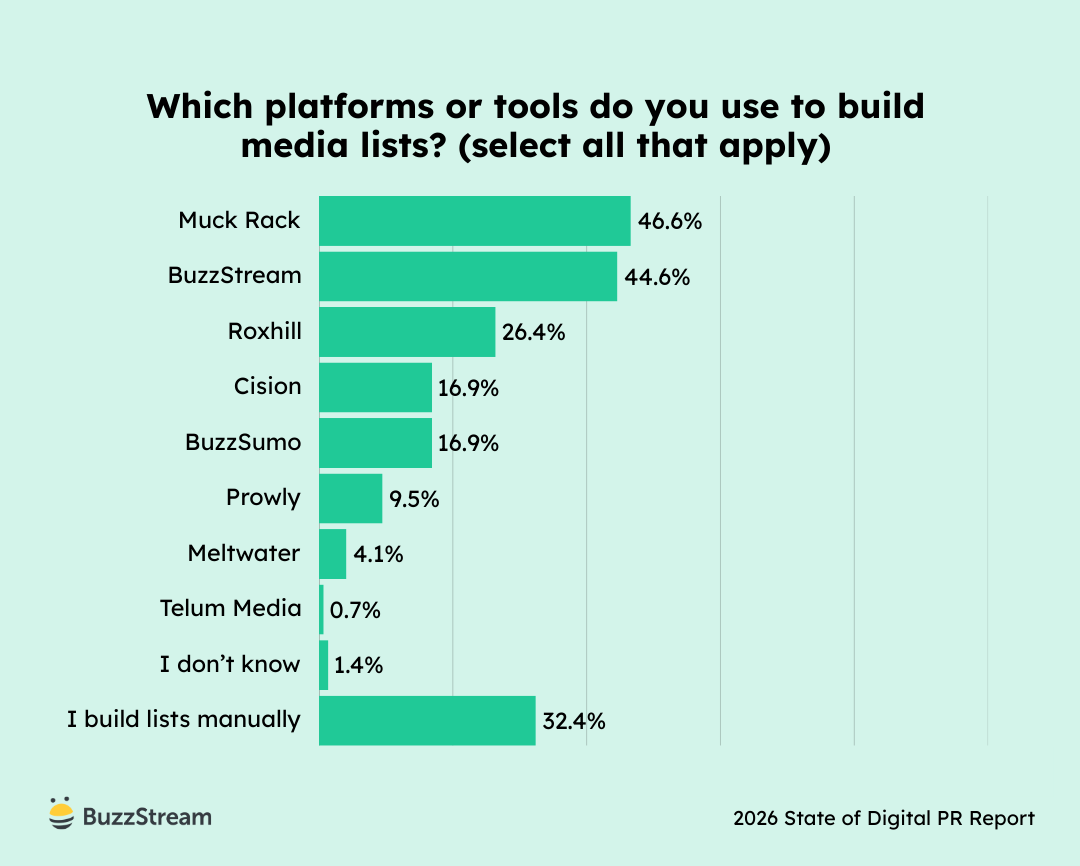
Muck Rack is the platform used to build media lists (46.6%), followed by BuzzStream (44.6%), which are both up from the previous year.
All other tools saw usage decline compared to 2025.
The standout is that those building lists manually, without a tool, has risen to 32.4%, up from 25% in 2025.
This increase in manual list-building may reflect a lack of trust in media databases. We dig into it in the next questions.
8
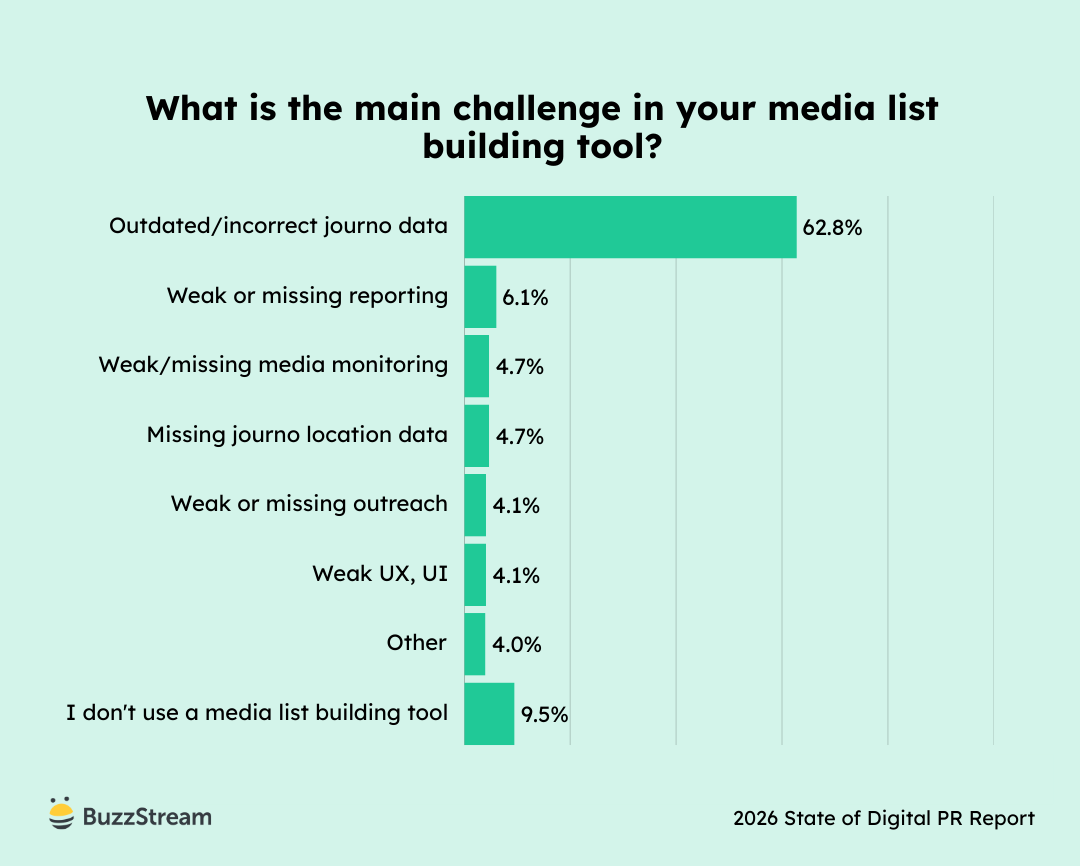
The main challenge, by far, with media list-building tools in 2026 is outdated or incorrect journalist information (62.8%), up only 1% from last year.
Other issues, such as missing reporting or media monitoring functionality, barely register.
9
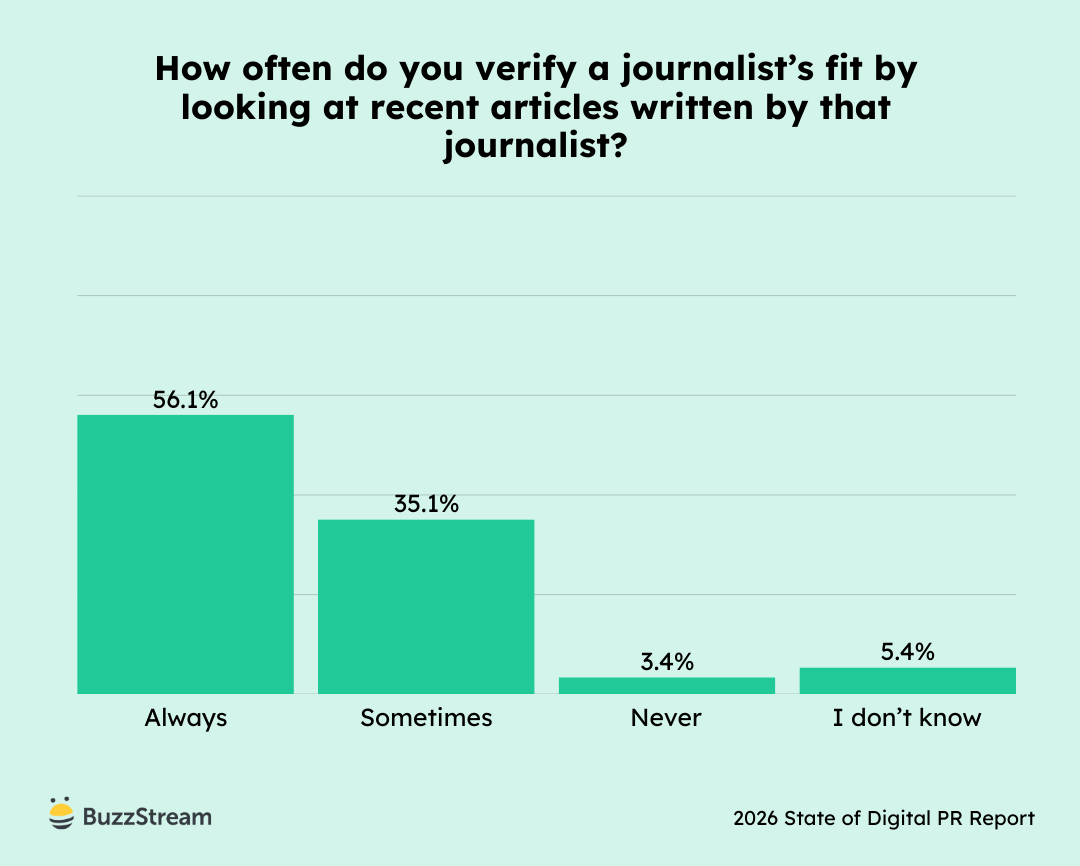
About 56% say they always verify a journalist’s fit by reviewing recently published articles.
Unfortunately, this is about 8% lower than last year, which is concerning.
But there are other factors, so let’s keep digging…
10
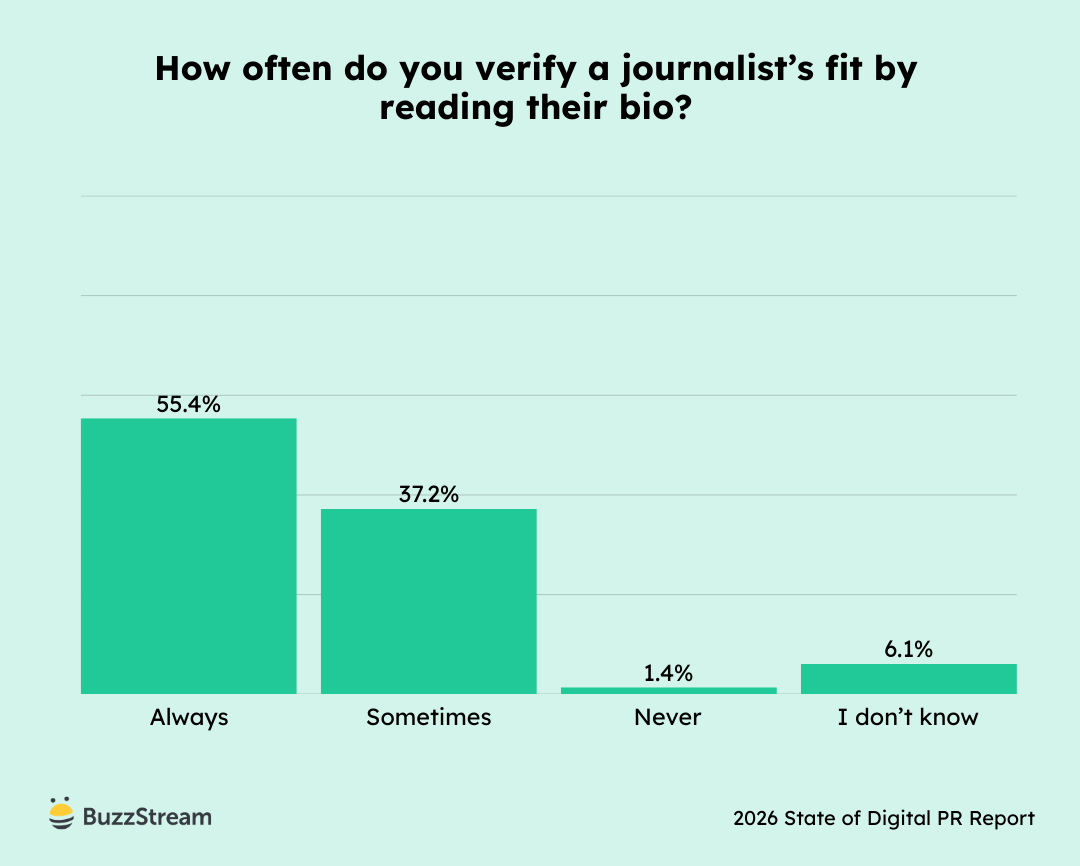
In 2026, just over half (55.4%) say they always read a journalist’s bio to determine their fit for a pitch—a 4% drop from 2025.
11
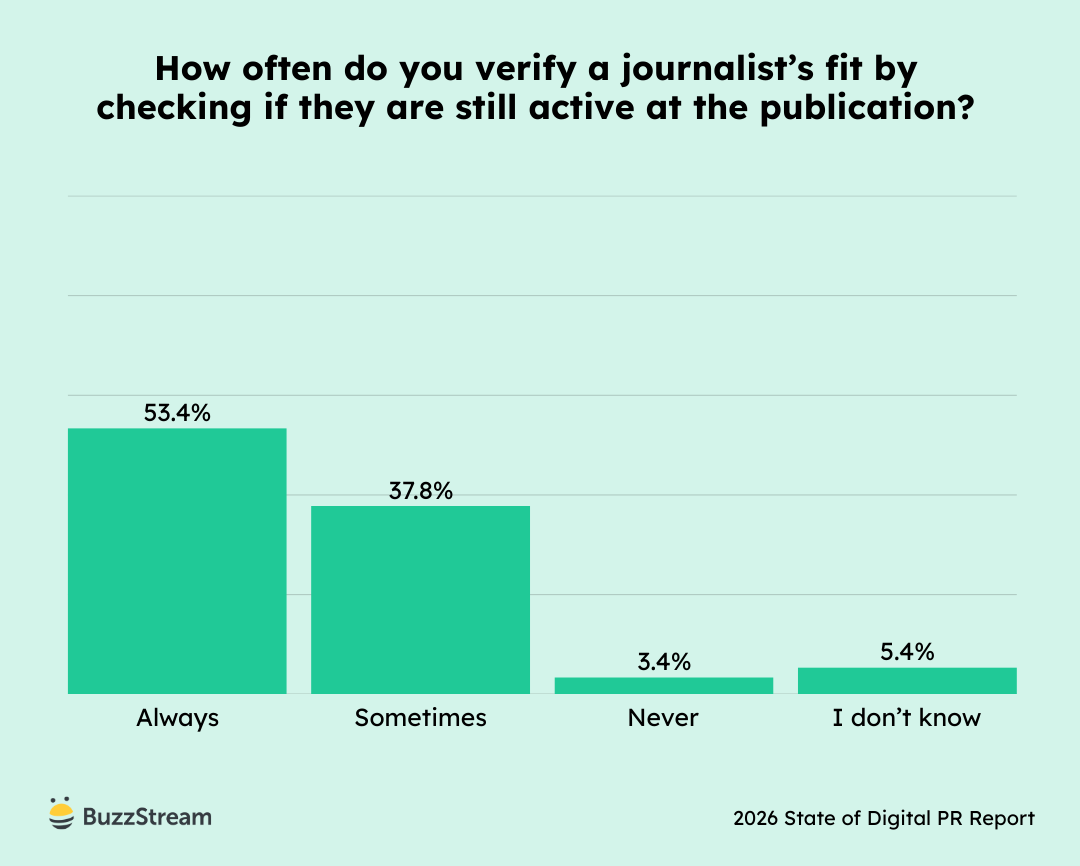
53.4% say they always verify a journalist’s fit by checking if they are still active at the publication before pitching.
This is a 5% drop compared to 2025.
We saw about 3,000 journalist layoffs in 2025, according to Press Gazette, so this feels like a missed step from many respondents.
12
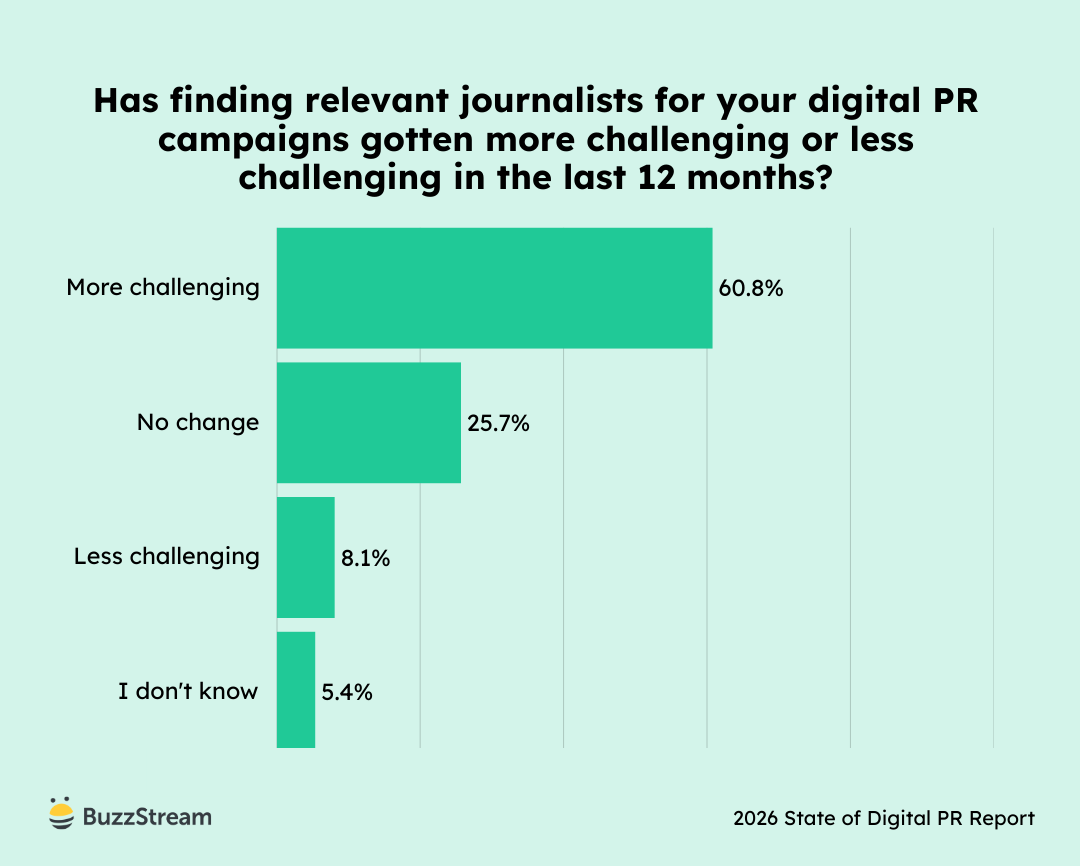
60.8% of digital PR professionals report that finding relevant journalists for campaigns has become more challenging in the last 12 months.
Last year, 60.7% said it was more challenging, so all signs point to identifying relevant journalists as getting increasingly difficult.
EXPERT OPINIONS
Manual list-building increased again this year—do you think that’s mostly a trust issue, budget issue, or quality issue?
Landing coverage is harder than ever, in part due to the shrinking number of journalists, so PRs need to make sure that their pitches are actually landing in the inboxes of the journalists they’re trying to reach.
It’s therefore not a surprise that manual list building has increased, given the fact many tools need to be supplemented with manual checks anyway, which to me suggests this is mostly because of trust and quality issues. If a PR is consistently finding that journalists have moved on from a publication by getting bouncebacks, they’ll naturally increase the number of manual checks they do when building a list.
Another point to add is that PRs are under increasing pressure to deliver month on month, due to higher-than-ever scrutiny over marketing budgets and how effective spending on certain channels is as a whole. PRs need to get bigger and faster results than they perhaps did in the past, meaning they need to use the most effective process to make that happen. And that doesn’t always mean the fastest or more efficient, which to me is why manual list building is on the up.
I think it’s ultimately a trust issue. Most databases are riddled with outdated info, so you end up verifying a lot manually anyway. They can’t be aware of EVERY journalist’s movement that happens at any given time. At that point, you might be thinking, why pay for the tool?
I am a HUGE proponent of manual list-building. Each campaign has nuance that is best captured by up-to-date, manual research. I believe this is the surest way to have quality lists.
And, I think with the state of SEO/rise of LLMs and the way that websites receive traffic changing (or are struggling to receive it), that media websites are also re-assessing the types of content they cover and why.
So, with that in mind, I’m not surprised it’s getting harder to find relevant folks: newsrooms are careful about what they choose to cover and are becoming increasingly understaffed.
You know the old saying “Fool me once, shame on you; fool me twice, shame on me.” After paying for “quality” lists that still need hand-checking, I’ve asked myself why am I paying for this? At this point, it’s less of a trust, budget, or quality issue and more of a ‘fool me twice,’ shame on me and my lighter wallet problem.
Manual list-building is something we actively encourage at Prosperity Media, as I personally believe it’s the best way to create high-quality media lists. I think its use is increasing across the industry because highly relevant and personalised media targets are more important than ever.
While tools can help find contacts quickly, I don’t think they have the capability to be this specific. Even when we do use these tools, we always manually verify the contacts afterward, which adds time and often ends up taking about the same amount of time as manual list-building anyway.
The increase in manual list-building is a symptom of a highly volatile media landscape. It’s less about budget and more about the instability of modern newsrooms. Between consolidated editorial teams working across multiple beats, mass redundancies, and the exodus of experienced journalists, the ‘remit’ of an individual writer is now in a state of constant shift.
EXPERT OPINIONS
Verification of journalist information (bio, recent articles) dropped across the board—what’s causing people to vet less even as layoffs and beat changes increase?
This surprises me given the increase in manual list building, but the obvious reason for this is the pressure to do more in less time. Budgets are either shrinking, or under more scrutiny than ever, so everyone’s trying to work faster. It’d make sense that verification of journalist information is one of the things that’s given way this year to stay within budget (and therefore, time) constraints.
This concerns me a lot. As layoffs and beat changes increase, it’s important that digital PR’s take their time to verify that information is up to date. I find that Muckrack is a really nice tool for doing this in a time efficient way.
My guess is time is a constraint. It’s fastest to take an old, similar media list and repurpose it for what you’re pitching. While I understand that this could work, it’s important to verify that the list is still up-to-date.
While software can handle the heavy lifting of data aggregation, it struggles to capture the real-time shifts in editorial priorities and subtle nuances that years of experience in the industry can spot (and also when a story is breaking live for reactive opportunities).
As always, I would put this one down to deadline pressure and the fact that expectations of results are always growing in this industry. Everyone knows they should be checking recent articles and bios before hitting send, but when you’re juggling multiple campaigns, corners unfortunately get cut. That always proves to be a false economy though, and can ruin your reputation. The layoff numbers should be making PRs more careful, not less.
Demands from bosses, clients, and putting out the constant fires that PR’s are dealing with, make it easy to skip the work of verifying the ever-changing field. My question is, why devote so much time to making a well-researched, beautifully worded pitch, only to drop it into the inbox of someone who doesn’t cover your beat, or doesn’t work there anymore? It’s the equivalent of doing all that work and never hitting send. Hit send, but to the right person! Don’t let that work go to waste.
Section 5
Outreach Emails
We know that relevant, targeted lists are important in 2026, but how much do users personalize their emails?
To answer this, we needed to once again clarify what “personalization” means in 2026.
13
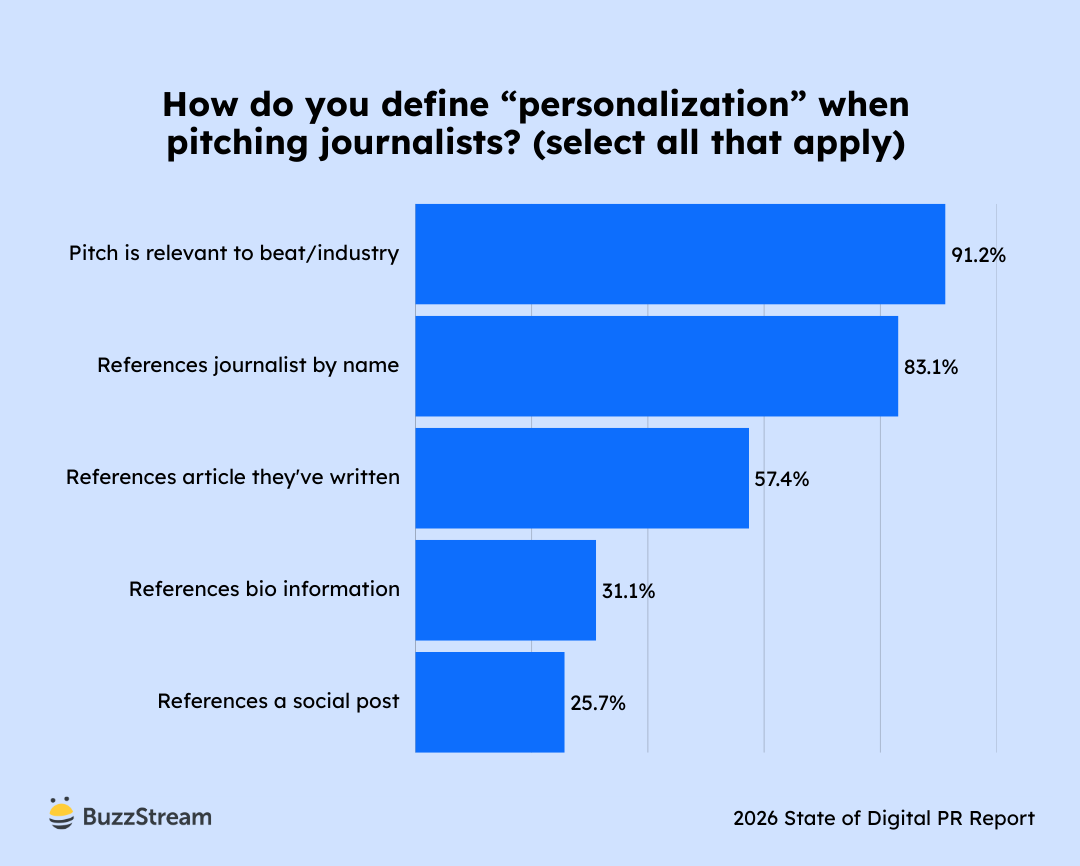
The overwhelming majority of users define “personalization” as ensuring beat/industry fit (91.2%), followed by referring to a journalist by their name (83.1%).
Compared with last year’s, these answers were largely similar.
We are all on the same page regarding what “personalizing” an email means.
Now let’s see how often people actually do it.
14
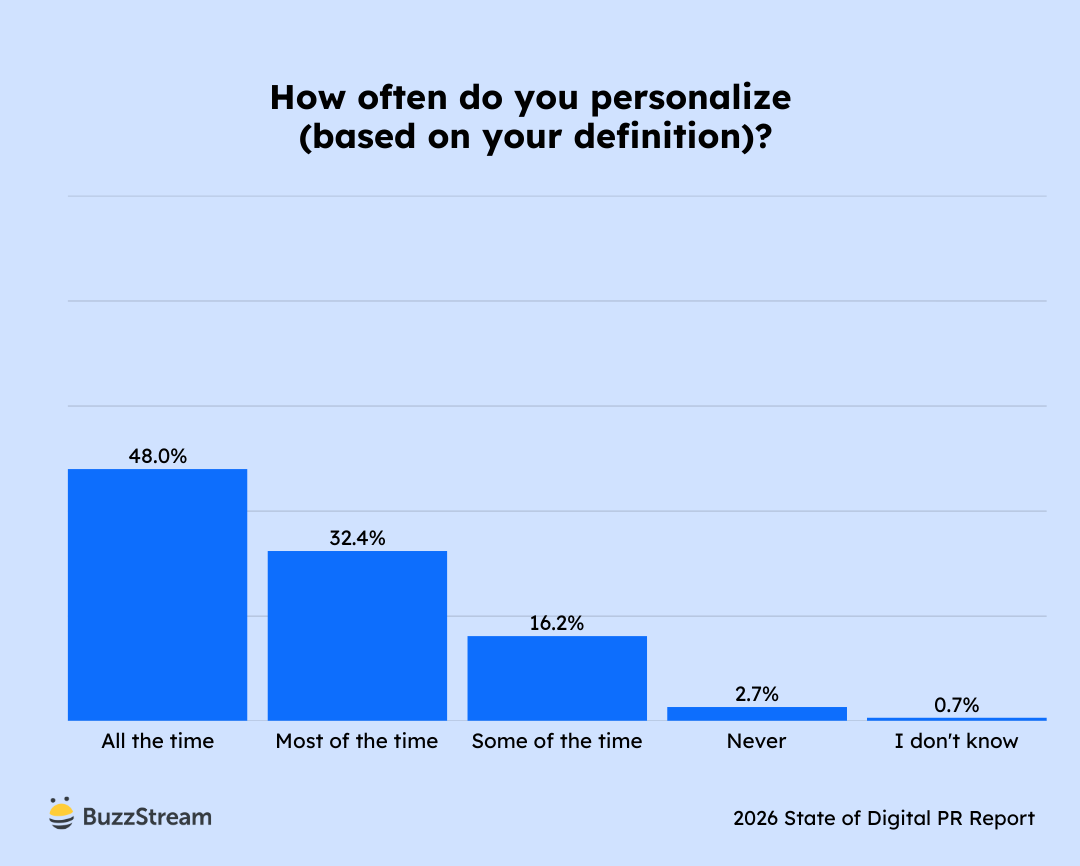
Just about half of the respondents (48%) always personalize their email pitches to journalists.
This does track: Muck Rack’s State of Journalism 2025 reported that just 48% of journalists seldom or never receive relevant email pitches.
Gladly, this is 7% higher than in 2025, at 41.6%, so it’s hopefully slowly getting better, but still a very dismal display.
15
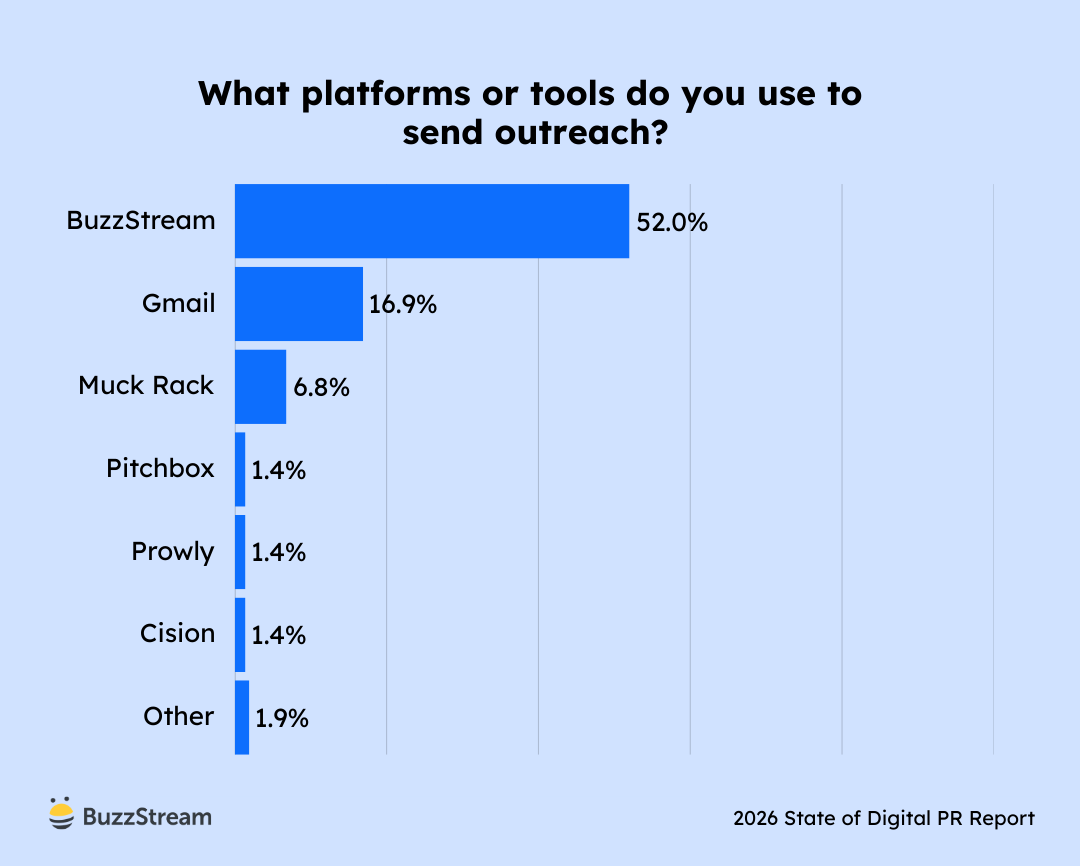
BuzzStream is still the most widely used platform for sending outreach emails at 52%.
The share of respondents who use Gmail rose from 13% to 16.9% in 2026.
16
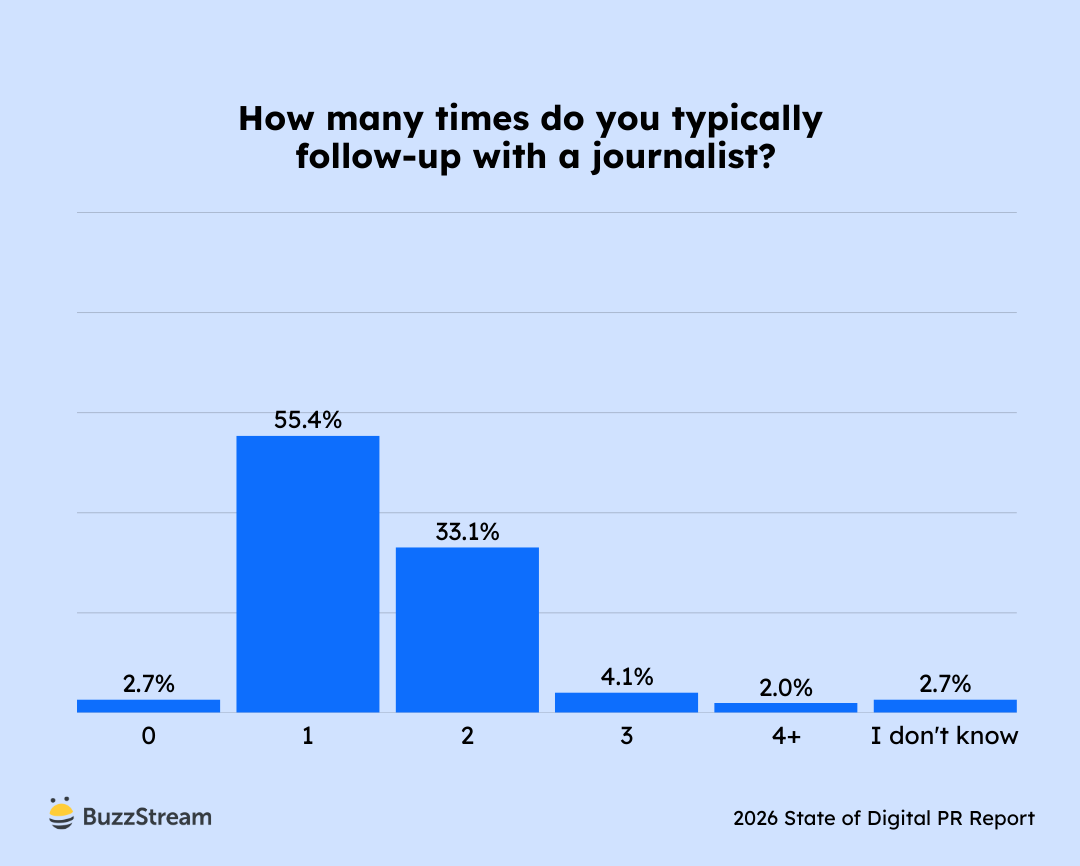
55.4% of users typically follow up with journalists only once. An additional 33.1% follow up twice.
The trend seems to be that more people are sending more follow-up emails. We saw a 9% increase in the number of people sending two follow-up emails in 2026.
Our follow-up email study showed that the reply rate drops sharply from one to two follow-ups, so we recommend using a single follow-up email.
17
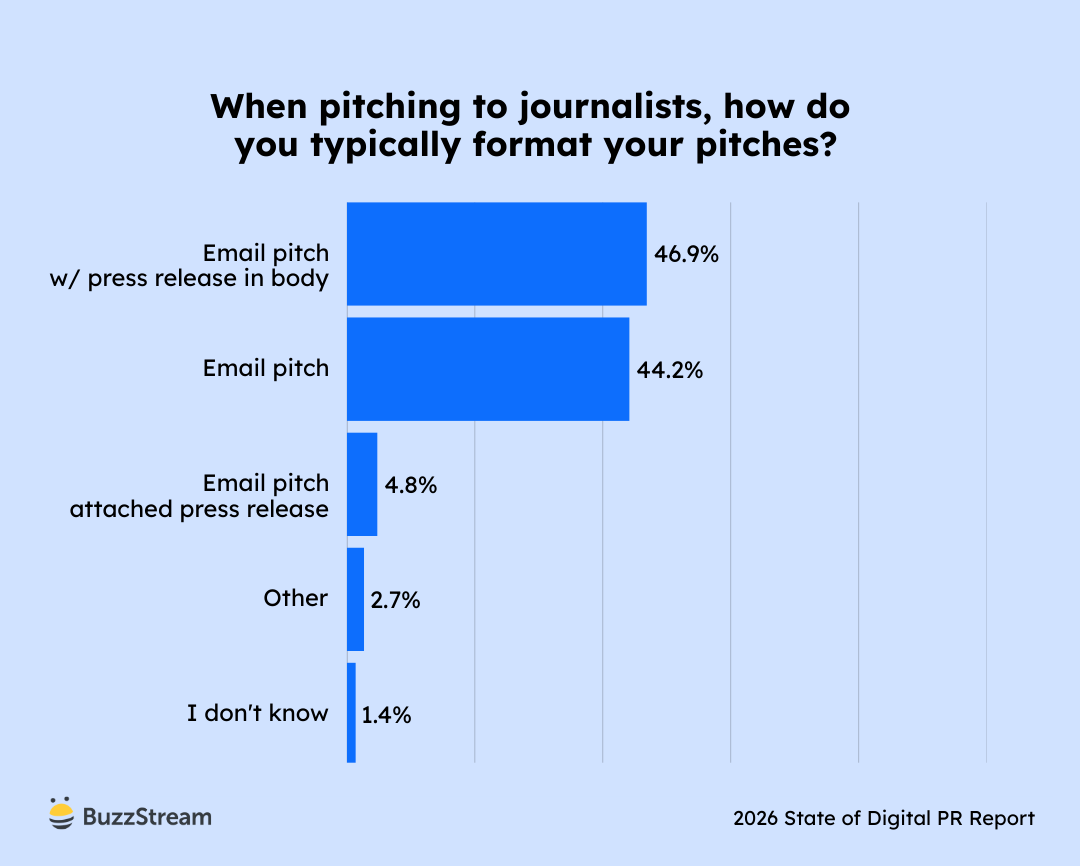
This was a new question for the 2026 report based on a trend I was seeing.
There appears to be a discrepancy about whether to include a press release in the body of the email: about 47% do, and 44% don’t.
Based on our study of email length, longer emails perform worse.
If you keep your email under 300 words, you will see the best results.
18
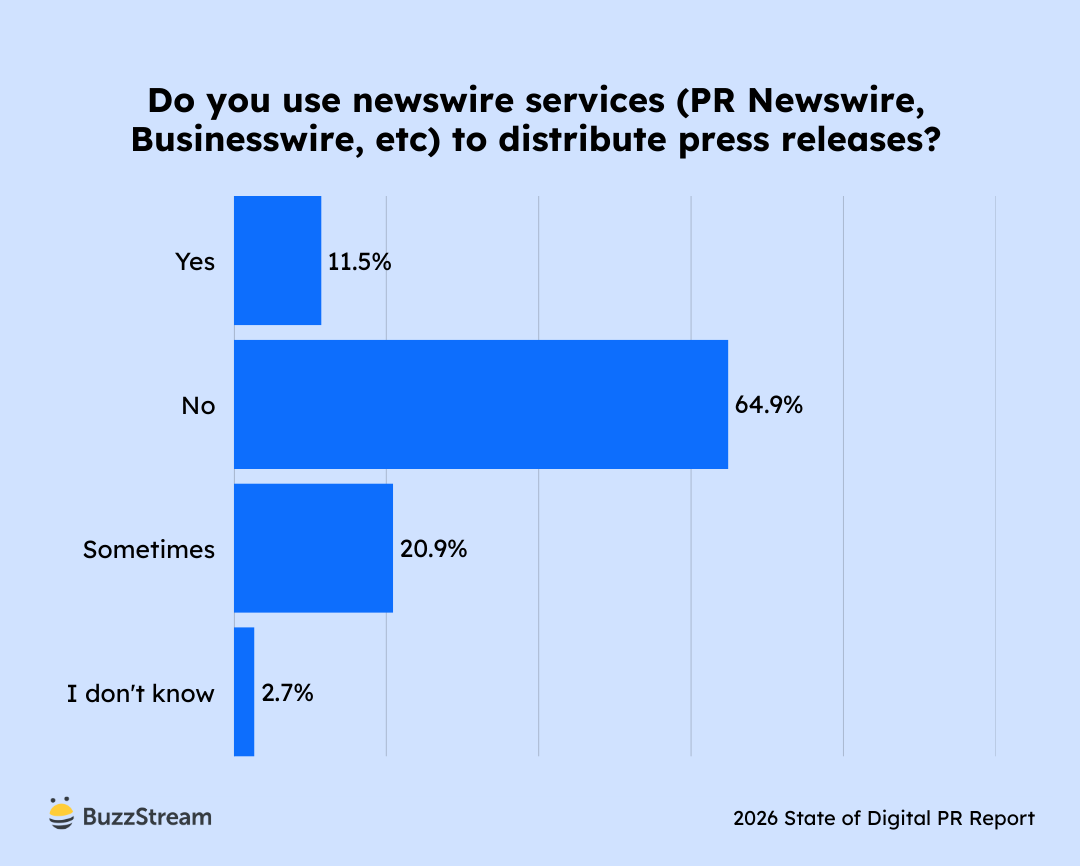
11.5% of digital PRs report using newswires to distribute press releases, a 5% increase from last year.
This may again be due in part to the circulating theory that press releases appear in AI citations.
EXPERT OPINIONS
If personalization is clearly defined, why do you think only about half always personalize pitches?
In many instances, personalisation has become synonymous with “extra effort” – but in reality, taking the extra time to target your approach can save much more time further down the line. Relevance is key here – is your story relevant to the journalist? Tell them how… In the same notion, follow up emails are only useful if the initial email was genuinely relevant, otherwise it just amplifies the wrong message – follow ups add value to a journalist who may be struggling to cut through a crowded inbox, but only if the story adds value to their readers.
While AI tools make it easier than ever to scrape a journalist’s name and recent headlines, this surface-level approach only gets you halfway there. True personalisation requires understanding the publication’s audience, the journalist’s actual coverage areas (not just their stated beat), and how your story fits their narrative style. Time poor teams often sacrifice this deeper research for speed of pitching, but that’s precisely when generic pitches tend to get ignored.
Personalisation is clearly defined, but it’s still inconsistently applied because it’s difficult to do well at scale. While digital PR has moved away from the outdated “spray and pray” approach, many teams are still operating under tight deadlines and volume-led KPIs, which naturally deprioritise deep personalisation.
It’s encouraging to see that 91% define personalisation as ensuring a pitch is relevant to a journalist’s beat or industry. That, to me, is the most important form of personalisation. While 57% believe personalisation means referencing an article a journalist has written, this is more nuanced. I’ve seen journalists openly push back against this approach, especially when it feels forced or insincere.
This creates a tricky balance: we’re often told to keep pitches short and concise, but also to “add personality.” If you reference an article, it has to be genuine – otherwise it risks coming across as filler or an attempt to flatter. Have you actually read the piece, or are you including it simply to sweeten the pitch?
In my view, true personalisation doesn’t require fluff. If the pitch is genuinely relevant to the journalist’s beat and their name is spelt correctly, that’s often enough. Once a journalist engages and replies, that’s the right moment to reference their work and build rapport in a more natural way.
EXPERT OPINIONS
More teams are sending two follow-ups now—when does a second follow-up help vs. hurt your chances?
A follow up helps when you’re offering a new way into the story, like a fresh data visualisation or a localised angle they might have missed. It becomes a burden the moment it’s just “checking in” without adding a single new piece of information. Treat your follow up as the journalist’s last opportunity to access something they can’t get elsewhere, then move on.
A second follow-up helps when it adds value and hurts when it adds noise.
It can be effective when there’s new relevance, such as fresh data, a new angle, breaking news, or a timely hook. It also works when the initial pitch was strong but poorly timed, for example, sent during a major news spike, while a journalist was out of office, or during a particularly deadline-heavy period.
The tone also matters. A short, respectful follow-up, such as “bumping this in case it got buried”, paired with one clear line of added value, can be well received.
On the other hand, a second follow-up hurts when nothing has changed since the original email, the pitch is generic, the journalist hasn’t covered anything related to the topic, or the message pushes a sense of urgency that isn’t genuine.
A simple rule applies: if you can’t clearly explain why the follow-up is better than the first pitch, it shouldn’t be sent.
For years, I never sent second follow-ups because of direct feedback from journalists saying they were unnecessary. However, with the noticeable increase in competition in digital PR, especially for localized/geo-specific coverage, I’ve occasionally tested incorporating second follow-ups when I feel the story is particularly valuable to certain contacts.
And since then, I’ve noticed some journalists thanking me for the reminder and end up covering it. I think with these times of journalists being swamped and more pitches in their inbox, it’s a nice way to sh
With that said, I do like to err on the side of caution. If you follow up twice, it may annoy a journalist. But that said, I do believe the second follow-up does help increase your odds of getting coverage and can help give the nudge a journalist needs to take action. It’s really hard to be 100% annoying-free with journalists, so just remember to always use best practices and provide value with both follow-ups. And of course, cut it out after follow-up #2. : )
EXPERT OPINIONS
Should digital PRs include press releases in the body of an email, link to them, or avoid them entirely? Why?
Press releases are a more traditional PR tactic, and the purpose of them was to help deliver the news to journalists in a format that they were able to quickly write their news stories, typically with the inverted pyramid style.
While I don’t go out of my way to write them myself, if I’m collaborating with a traditional PR team or if a client offers a press release, I always say yes and include it at the bottom of my email. The reason that press releases are nice, is that it helps a journalist save time from digging for or asking for more information.
If you don’t have a press release though, you could achieve a similar thing by having your pitch email follow a similar format to a press release and take a hybrid approach.
Press releases shouldn’t be THE pitch. I never lead with one, but I will use a release in a follow-up when a campaign has multiple angles and a journalist needs a clean way to see what’s most relevant to them. In that case, it’s less about announcing something and more about helping them orient quickly. The angle I think pertains most to the journalist is the body of the email, and the release just supports it.
The goal of any outreach email is simple: make covering your story as effortless as possible. Don’t force journalists to leave their inbox to evaluate your story’s newsworthiness. I like a ‘modular Pitch’ structure: open with a punchy 3-sentence hook, follow with bulleted key findings/imagery or video, then include the full release at the bottom if needed for reference and easy copy-pasting. The release is your safety net for details, but it shouldn’t dominate the email.
I believe press releases should be included in the body of the email. The key is to lead with the story: a clear headline, a strong pitch, and then the press release underneath for context.
Journalists are extremely time-poor and often don’t want to download files or click through multiple links. Including everything they need in one email makes it easier for them to assess the story quickly. If they need additional information, they’ll follow up.
That said, it’s never one-size-fits-all. A lifestyle journalist may prefer having both the pitch and press release in the email, while a finance journalist might prefer a concise pitch with a link to the release instead. Journalists have different preferences, and that’s okay.
Ultimately, good digital PRs understand their beat and their audience. Trust yourself and stick to what you know works for the journalists you’re pitching, rather than chasing conflicting advice or trends.
Section 6
Impact & Results
This section of the study examines how digital PR is impacting clients and stakeholders.
19
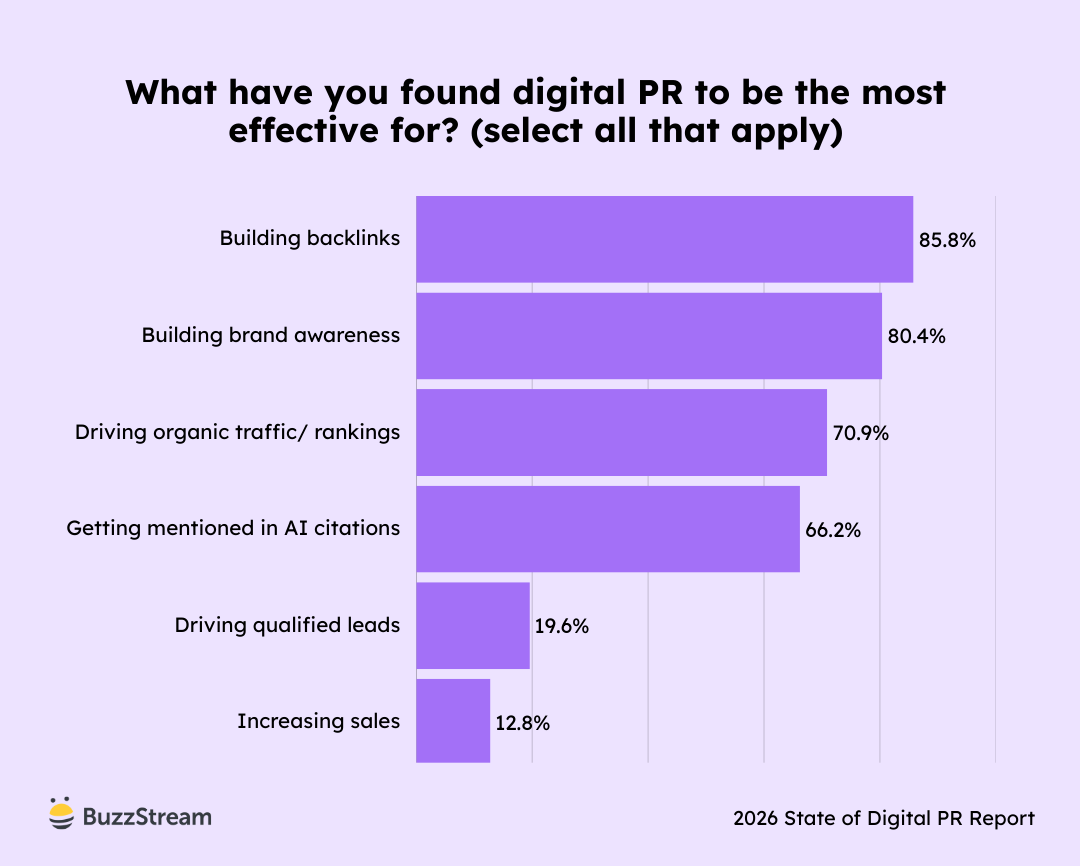
In 2026, building backlinks remains the most effective use of digital PR (85.8%), followed by building brand awareness and organic traffic, all on par with last year.
The newcomer to the list is “getting mentioned in AI citations,” at 66.2%. Obviously, this should come as no surprise to anyone reading this. Since Ahrefs reported that brand mentions correlate with AI Overview mentions, interest in digital PR has skyrocketed.
Sadly, we’ve found that increasing sales and driving qualified leads suffer most likely because of the newfound obsession with AI citations. Both saw about 5% declines from 2025.
20
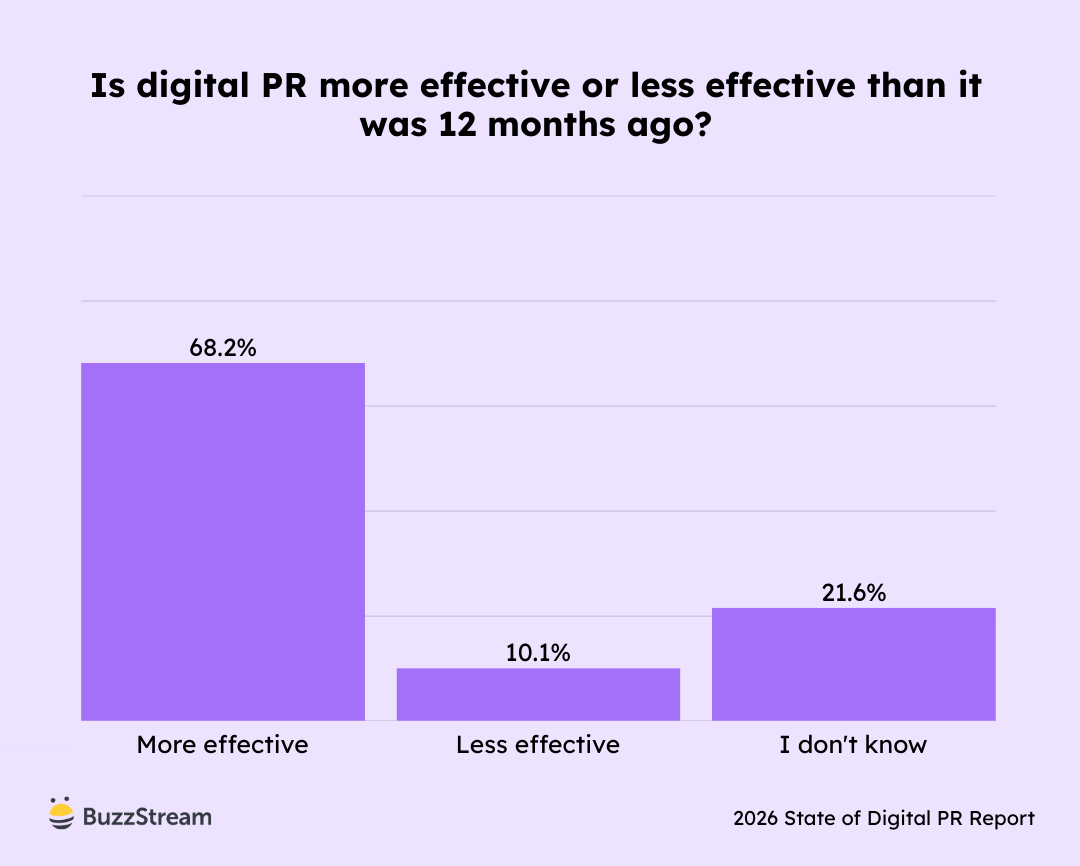
68.2% of digital PRs believe that it is more effective than it was 12 months ago—an increase of about 20%!
It’s safe to say that digital PR is in a strong position right now.
21
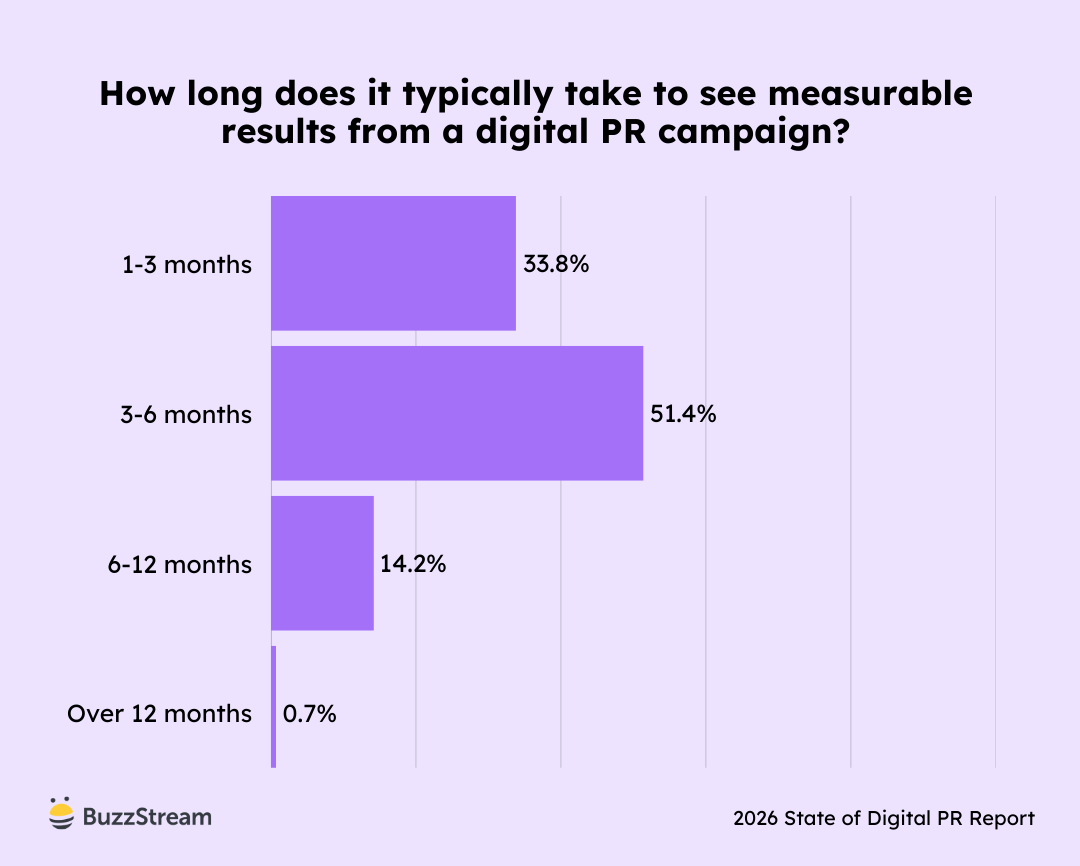
85.2% of respondents said that it takes no more than 6 months to see measurable results from a digital PR campaign.
51.4% report it takes just 3–6 months, which is a 5% increase from 2025.
22
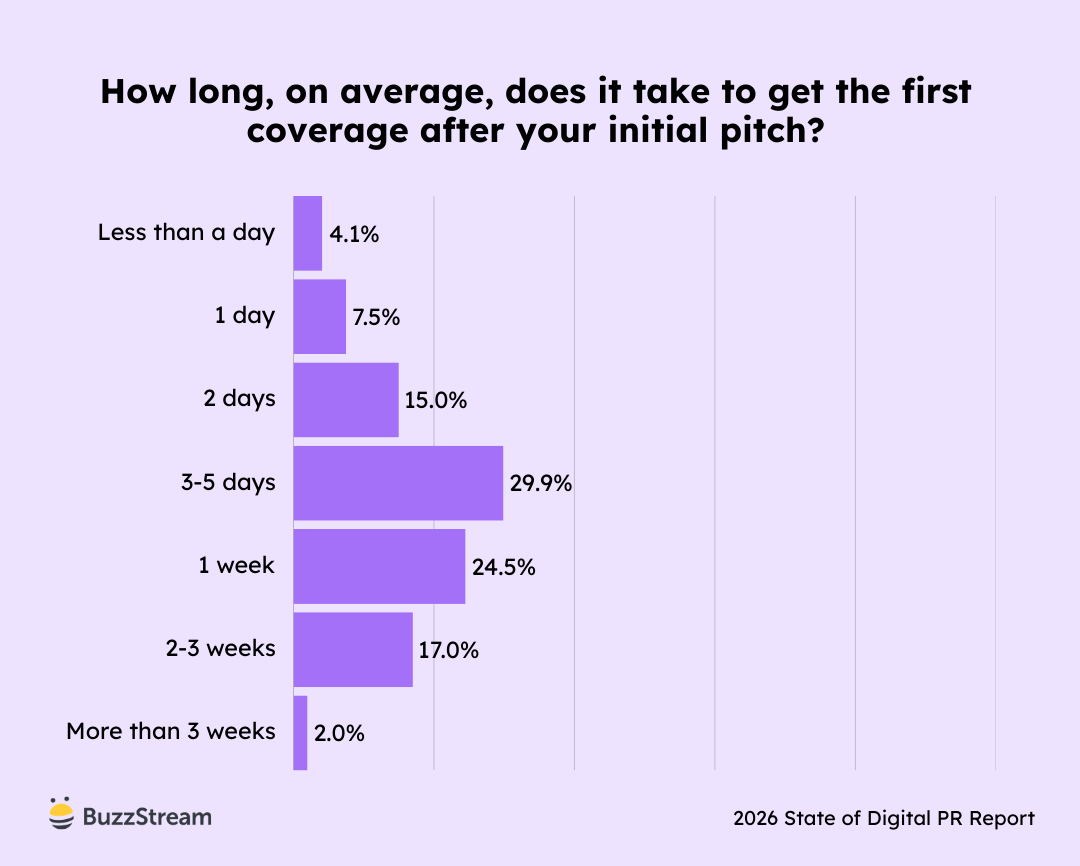
It typically takes 3–5 days to secure coverage after the initial pitch (29.9%).
But from a macro perspective, 81% of digital PR pros say they secure first coverage within the week.
23
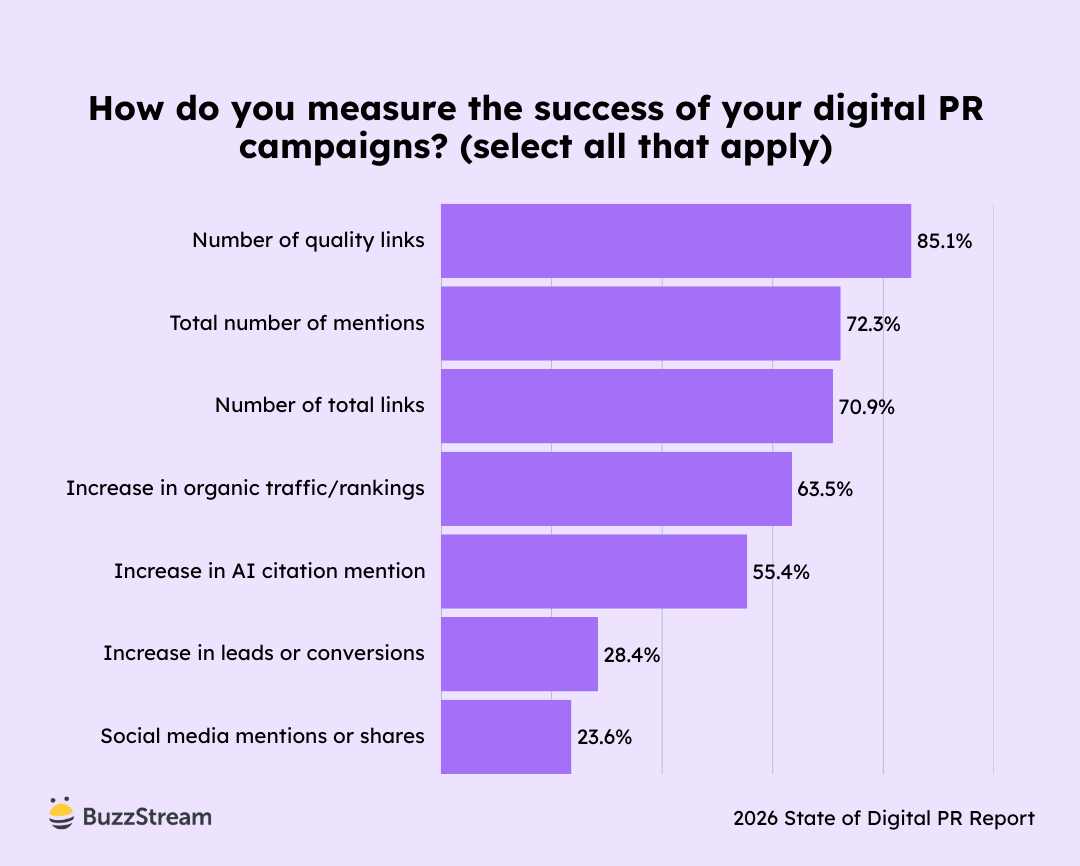
The top way respondents measure the success of a digital PR campaign is the number of quality links (85.1%), followed by total mentions (72.3%) and total links (70.9%).
There are two big differences we saw when comparing to last year’s study:
- The increase in organic traffic/rankings dropped from 78% in 2025 to 63.5% this year, suggesting rankings may be less important to clients and stakeholders.
- AI citation mentions are tracked at 55.4% in digital PR success metrics, a new metric this year.
24
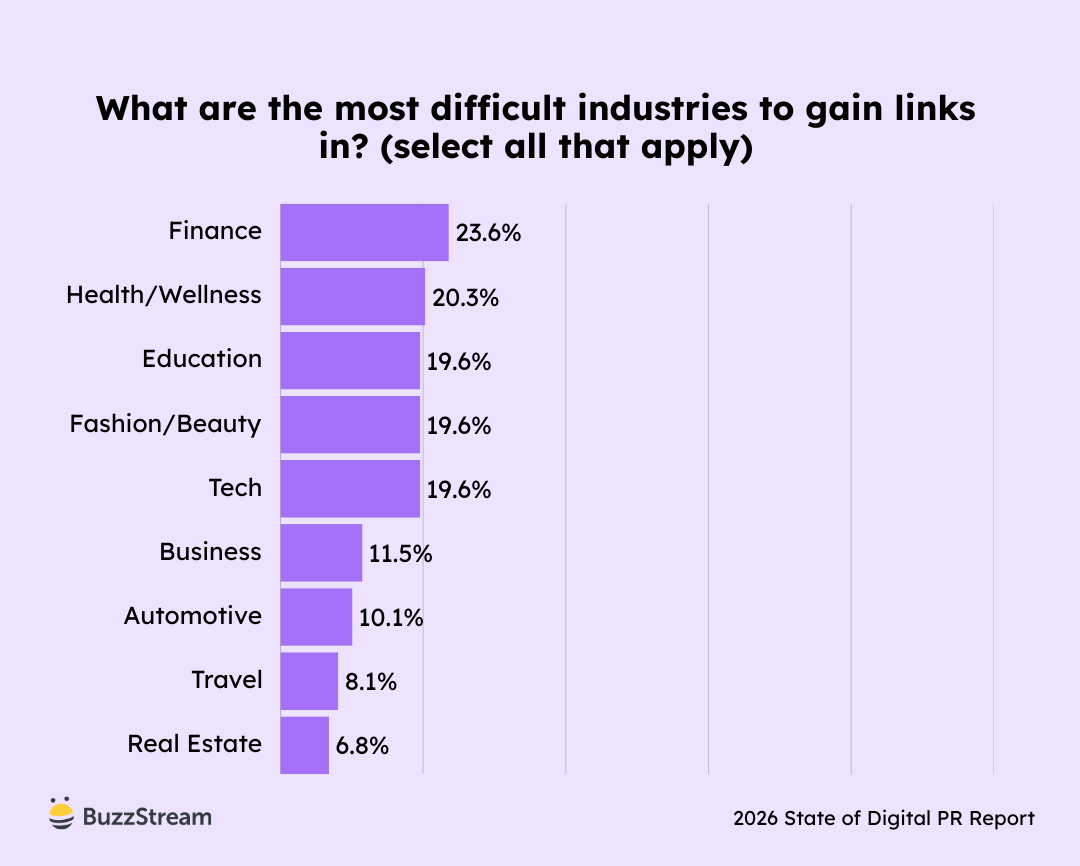
Finance is the toughest industry to build links in (23.6%), followed by Health/Wellness (20.3%) and Education (19.6%).
Compared to last year, Finance jumped from the 6th-most difficult industry in 2025 to the number one in 2026.
25
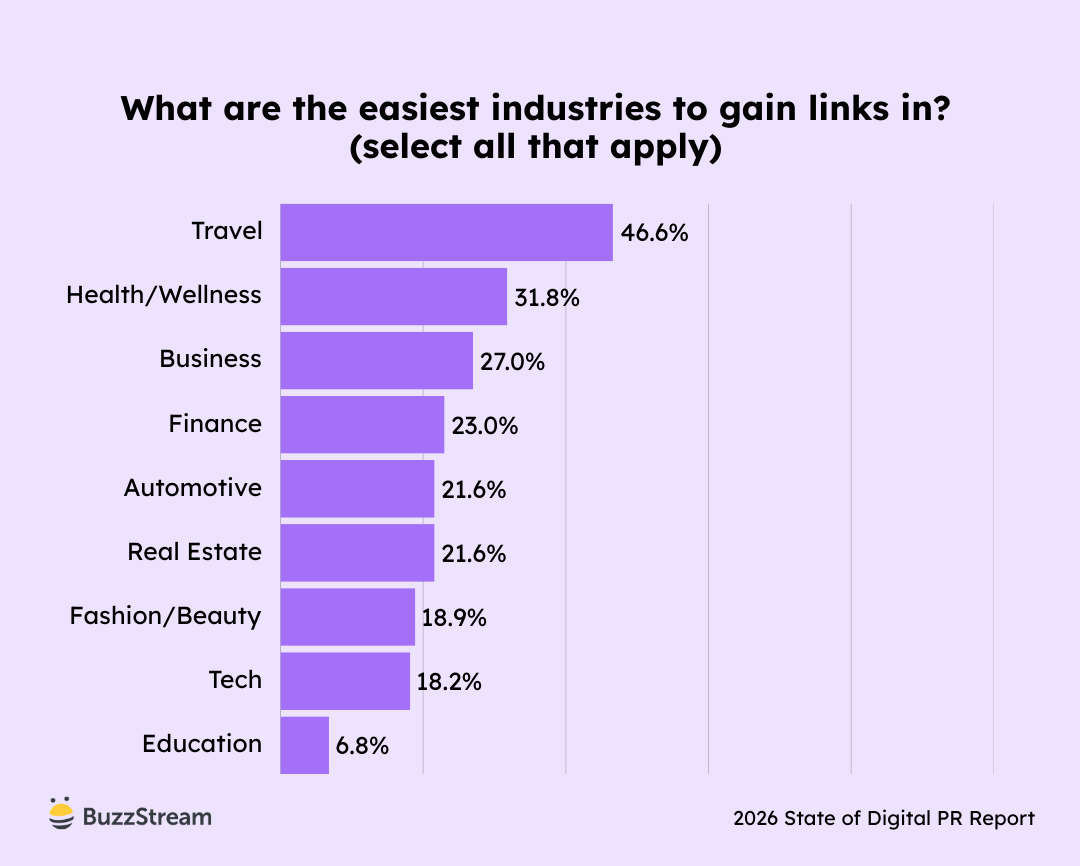
Travel is once again the easiest industry to gain links in at 46.6%.
The order is pretty much identical to last year, with just Tech dropping from 6th to 8th easiest.
26
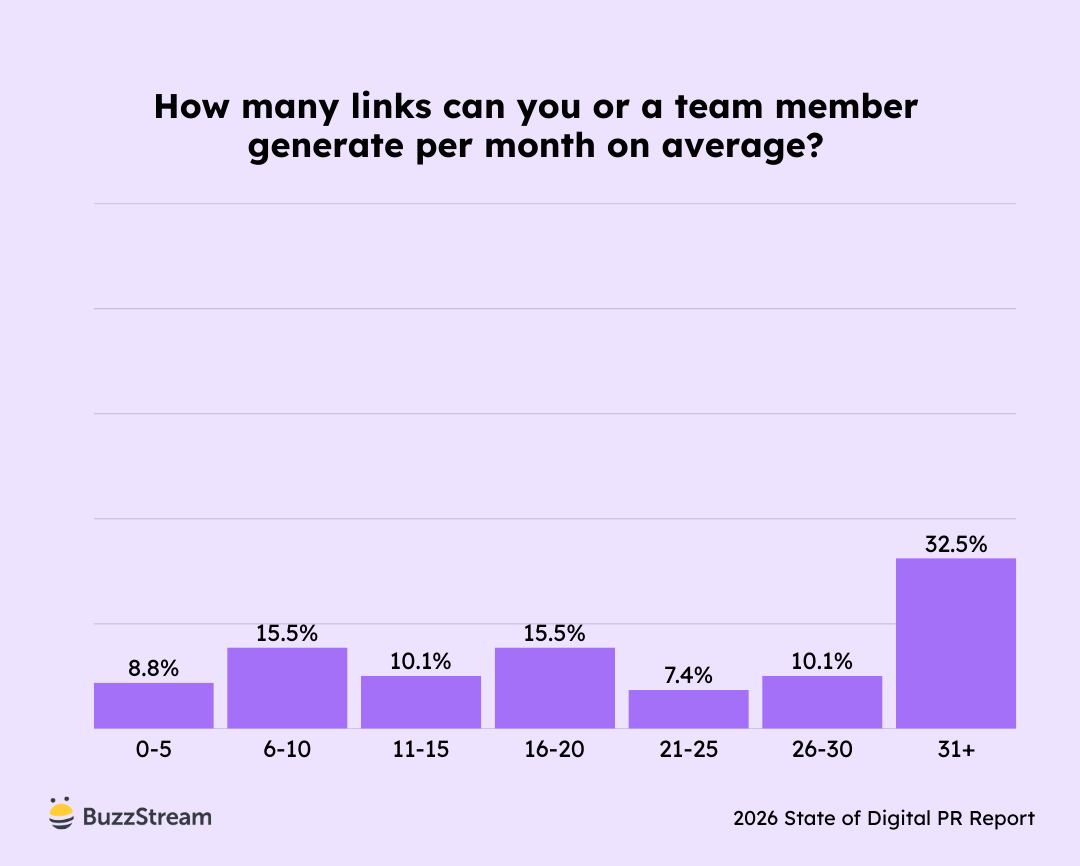
In 2026, 32.5% of respondents reported that a single team member could generate an average of 31+ links.
That’s one link per day – wowza!
This is an increase of about 3% from last year, and given that 81% reported being able to secure coverage within the week, it’s not super surprising.
Keep in mind that this doesn’t account for syndicated links, which we’ll cover in a subsequent section.
EXPERT OPINIONS
AI citations are now a major outcome for digital PR—should teams treat that as a core KPI or a secondary bonus metric?
AI as ever is a hot topic of conversation, however when it comes to Digital PR impacts and results, this highlights something interesting in my opinion. It’s highlighting the stronger need for a well-rounded search strategy. AI doesn’t just look at media coverage for citations; it takes into account onsite content and other trusted sources.
Therefore,our activity needs to really feed as part of that wider strategy so we have media mentions, social citations, onsite content and more all pulling in the same direction acting as a trusted source. finally a conversation that isn’t just how many links have you got.”
Backlinks continue to anchor digital PR value because they deliver lasting SEO impact and clear authority signals. AI citations at this stage work best as a bonus visibility metric, or ‘added value’ rather than a core KPI.
They can be personalised results and sit partly outside direct control, which limits their reliability for primary performance reporting. That said, tracking them closely is valuable.
When a brand appears consistently in AI-generated answers, it usually reflects strong fundamentals such as credible data, authoritative coverage, and good PR execution.
As AI visibility gains attention, teams need to stay disciplined, ensuring emerging metrics complement rather than distract from outcomes that still underpin revenue, including sales value and lead growth.
With increasing AI citations clearly becoming something that digital PRs see as an important outcome of their work, it does make sense for them to start treating this as a core KPI, particularly at the strategy level. However, at the campaign level, this shouldn’t replace more direct measures of success like the number and quality of backlinks and brand mentions earned from a campaign.
This also relates to the increasing confidence shown in the data surrounding the effectiveness of digital PR. The shift of focus to AI search platforms brings an entirely new area that digital PR influences, contributes to, and can be leveraged for, which perhaps explains why digital PRs feel that the tactic is more effective and important than it was last year.
Finally, it is interesting to see finance now being ranked top in terms of the hardest industries to earn links in. Being such a regulated space, it is to be expected that digital PRs find it challenging to earn coverage here. Also, given the fact that both journalists and digital PR teams are now leveraging AI to create and share their own stories that much quicker, it is becoming increasingly difficult to cut through the noise and put out a story which grabs attention. Outside of that, there has also been a lot for journalists to report on in this industry in recent months, which means they can be much more selective with what stories they select and run. Creativity, credible data, and compelling storytelling has never been more important to cut through and achieve results.
AI citations should be treated as a lagging indicator, not a core KPI. You don’t get cited by AI systems by trying to optimize for them directly. You get there by earning credible coverage, trusted brand mentions, and high-quality links over time. When teams chase AI citations as the goal, they usually weaken the fundamentals that actually drive visibility.
EXPERT OPINIONS
More respondents say digital PR is more effective than 12 months ago—what’s driving that jump in confidence?
This jump in confidence reflects clearer strategic positioning and stronger proof of impact. AI-led search has finally elevated the importance of brand authority, mentions, and trust signals, giving digital PR greater visibility and relevance in performance discussions.
At the same time, reporting has matured. Both agencies and in-house teams are increasingly able to connect digital PR activity to specific outcomes, with more consistent examples of measurable ROI.
That combination of heightened visibility and improved attribution has strengthened confidence internally and reinforced digital PR’s role as a credible revenue-driving channel.
Digital PR feels more effective right now because its impact aligns with how search is changing. Links still matter for rankings, but authority signals that influence AI visibility, like brand co-citations, are also critical. On top of that, OpenAI’s countless partnerships with publishers means that if your brand is being talked about by a whitelisted outlet, it’s more likely to surface in ChatGPT responses. In 2026, Digital PR helps brands kill two birds with one stone by improving rankings while also strengthening the signals that help them get cited by LLMs.
EXPERT OPINIONS
Finance became the hardest industry for links this year, why do you think it climbed to #1?
Finance didn’t just get harder, it got more demanding. Publishers are scrutinizing sources, methodology, and intent much more closely, which filters out surface-level or recycled campaigns fast. To earn links today, finance PR has to be built on sound methodology and defensible insights. If the work can’t stand up to editorial review, it won’t earn coverage.
Heightened regulation, stricter compliance requirements, and increased editorial caution mean journalists are far more selective about the financial brands they cover and link to. At the same time, the market has become saturated with similar datasets, commentary, and reactive insights, which makes it harder for campaigns to stand out.
Success in this space now depends on genuinely distinctive data, clear audience relevance on the publication side, and spokespeople with credible expertise who can add meaningful insight.
Link acquisition is still achievable, but it requires more investment, deeper subject knowledge, and a stronger strategy than in less regulated sectors.
Section 7
Overall Challenges
Digital PR has its challenges, from list building to ideation to securing coverage. In this section, we aim to understand the major hurdles faced by digital PR professionals.
27
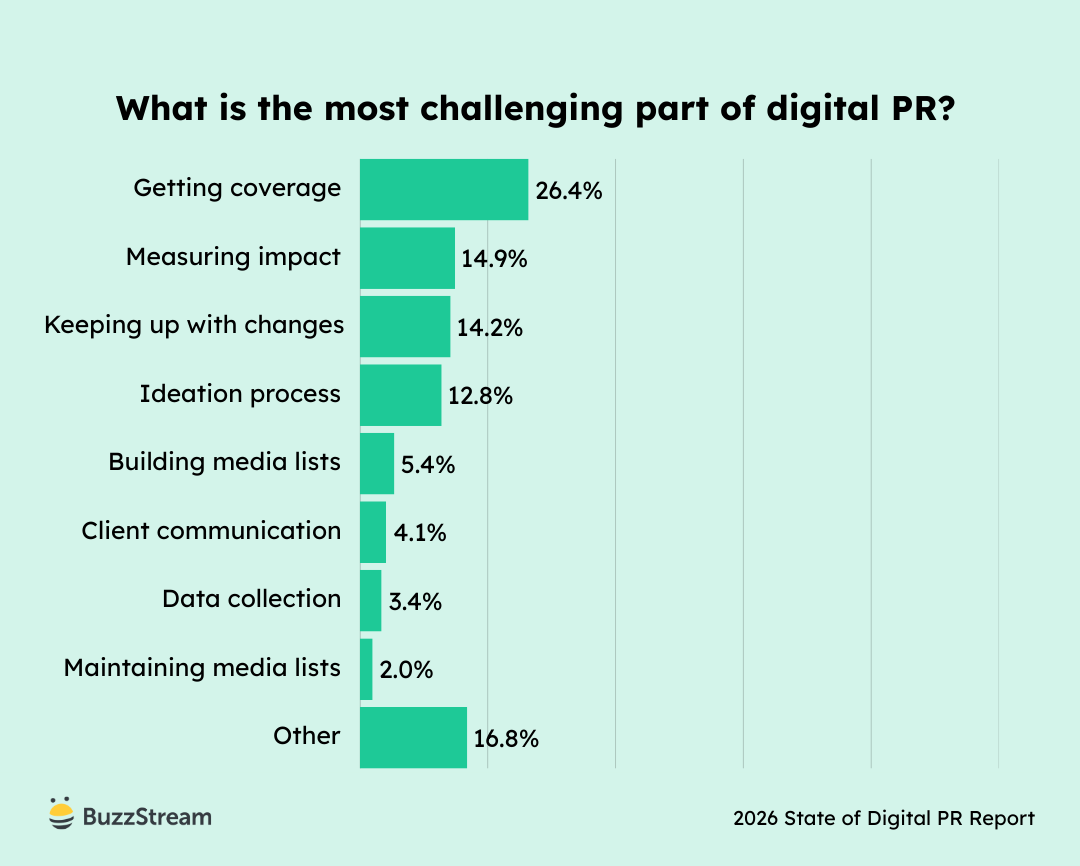
Getting coverage is the number one challenge for digital PR pros (26.4%), followed by measuring impact (14.9%) and keeping up with the changes (14.2%).
We added “getting coverage” and “staying current with changes” to this year’s report based on feedback from last year’s.
It’s unsurprising to see those at the top of the list, given how much is changing in the world of journalism, AI, and SEO/GEO.
(A reminder, we have a list of PR newsletters to check out, which can help you stay on top of major changes.)
28
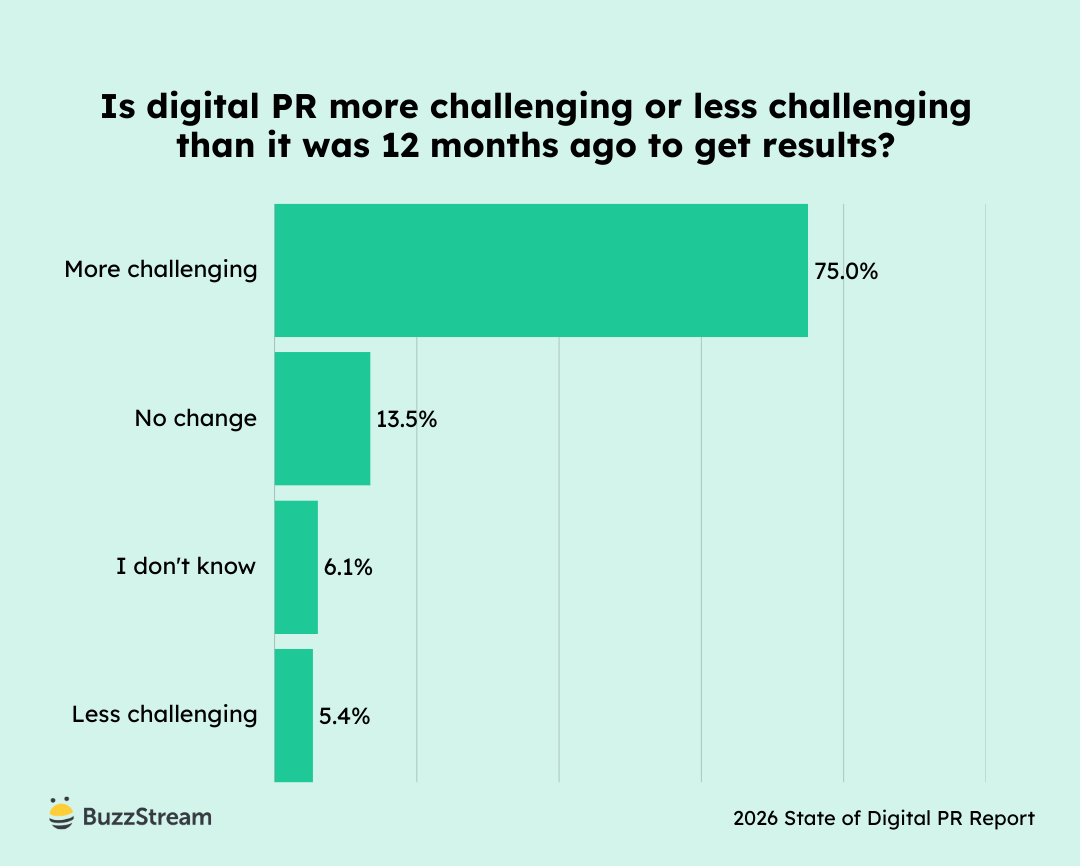
Although we learned that digital PR is more effective in question 20, digital PR is also more challenging this year for 75% of respondents—a 4% increase since last year’s report.
29
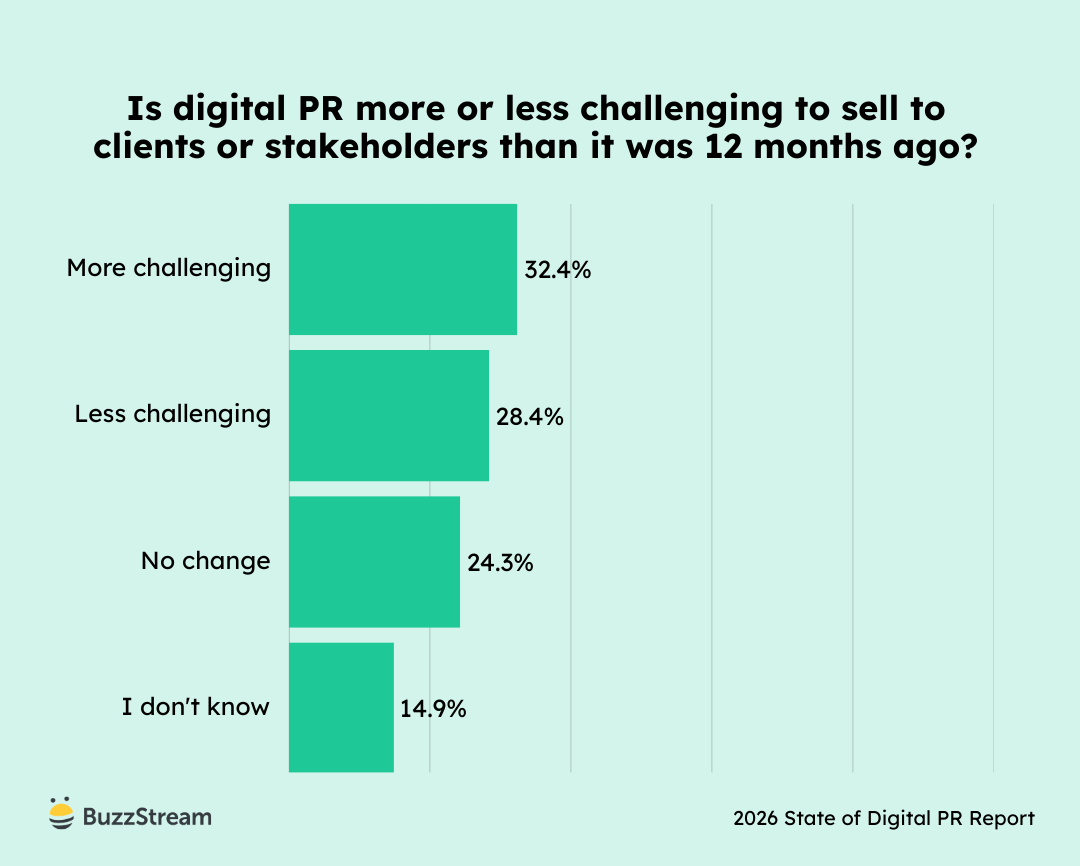
Almost one-third (28.4%) said digital PR was less challenging to sell to clients and stakeholders than 15% last year.
This once again suggests that digital PR is better positioned to succeed.
EXPERT OPINIONS
“Keeping up with changes” is now a top challenge. What changes are actually worth paying attention to, and what’s just noise?
The changes worth paying attention to are the ones that truly impact trust, discovery and decision making, particularly how audiences find information, how journalists assess credibility and how brands show up in AI. Things like shifts in newsroom behaviour, AI citation signals, and audience sentiment genuinely change how effective digital PR can be. The noise is the constant rebranding of tactics, job roles, tools and “hacks” that promise shortcuts without changing the fundamentals. At its core, digital PR is still about insight, relevance, relationships and reputation. If a change doesn’t meaningfully impact those, it’s probably not worth exhausting yourself over. Having said that, it’s entirely natural to feel both energised and fatigued by the pace of change right now (as I do!), but the industry doesn’t need more “over-reaction” and “hype”, it needs discernment. If you were doing Digital PR well before, the chances are you will continue to win in 2026.
There’s no quick fix for digital PR. Yet, we’re seeing an influx of fake experts, AI-generated pitches, and shortcuts that promise scale but sacrifice credibility. As a former journalist, I can say with confidence that most journalists can sniff out these types of bad practices. Yes, AI can absolutely assist your workflow, but it can’t replace the fundamentals: research, creativity, timeliness, and relevance. As the digital PR space becomes more competitive and oversaturated with low-effort content, the human-centered, quality campaigns will rise to the top.
A change worth paying attention to is the raised bar that PRs and our clients are facing – something that should be expected as journalists become more vigilant (and rightly so) about fake, AI-generated experts that bad actors in our industry have been pedalling.
PR needs to play a bigger role in everything your brand does – for example, your clients’ digital footprints need to help journalists verify they’re a relevant and credible source.
This means updated LinkedIn profiles, with REAL (not AI-generated, or even AI-enhanced) quality headshots of your expert’s actual face, and coaching them about how important their authentic, expert insights are for earning good quality coverage (while steering them away from relying on AI as a crutch to write comments for them).
The frustrating reality many PRs will recognise is that some genuinely qualified experts might consider these steps and speaking to a journalist as a ‘hassle’, but it’s those brands who will lose out – the ones who actively collaborate on PR and understand journalists’ verification needs will do better.
Right now, the SEO industry is rife with research that contradicts itself, mostly due to weak methodologies and a lack of stat testing, as people scramble to establish thought leadership during times of change. Instead of sinking time into the echo chamber, I’d urge Digital PR pros to invest their time learning how to build agentic workflows that can 10x their impact and job security. In just the past year, I’ve seen Digital PR teams use AI to qualify and fulfill Qwoted opportunities end-to-end, build targeted media lists, and personalize pitches in seconds. The people and agencies that learn how to operationalize this technology will shape the future of our industry, and you’re at a critical threshold to be one of them.
EXPERT OPINIONS
What is the number one way you recommend measuring impact of digital PR?
Digital PR isn’t just about earning backlinks anymore. It’s about earning authority. AI Overviews, AI Mode, and LLMs are shifting how content is discovered, which means digital PR campaigns and digital PR education need to evolve. It’s not just about Page 1 rankings. It’s about being cited, mentioned, and trusted in an AI-curated world. Today, brand mentions matter (finally), along with understanding AI prompt psychology. And, of course, telling engaging, data-driven, newsworthy stories still matters more than ever.
The number of unique, high-authority brand mentions earned across the entire engagement; generally, anything above a Domain Authority of 60 is an authoritative, reputable site across niche-industry leaders and mainstream media, though some sites in the 40s can also be considered mid-tier, and niche-relevant in smaller industries. Beyond that, the subsequent impact Fractl reports on and is measured by includes increased site authority, qualified traffic, brand visibility, and leads.
EXPERT OPINIONS
What’s one digital PR tactic or “best practice” that used to work a year or two ago—but is noticeably less effective in 2026? Why?
Spray-and-pray pitching to generic catch-all emails doesn’t convert as well as it used to, since newsroom inboxes are saturated by hundreds to thousands of pitches per day, especially at mainstream publications. Highly targeted, timely, and personalized pitches sent to the truly best-fit writer are no longer a “nice-to-have,” they’re table stakes as AI floods inboxes and long-term relationship building becomes essential for both personal and brand success.
Fluff is out, context is in. Surface-level data without context just doesn’t really cut it anymore. In 2026, the most effective digital PR campaigns are the ones that go beyonda the stat and explain the story behind the data. That might mean including a clear methodology, offering a (real) subject-matter expert for commentary, or pairing your dataset with a survey that helps explain why the trend matters. Context builds trust, and reporters are more likely to engage with campaigns that make their job easier, not harder.
Section 8
Quality and Relevance
We don’t have a direct link between link quality and relevance and AI citations, but we can still rely on the fact that quality and relevance impact rankings, which appear to correlate with AI visibility.
In this section, we examine what quality and relevance mean to respondents.
30
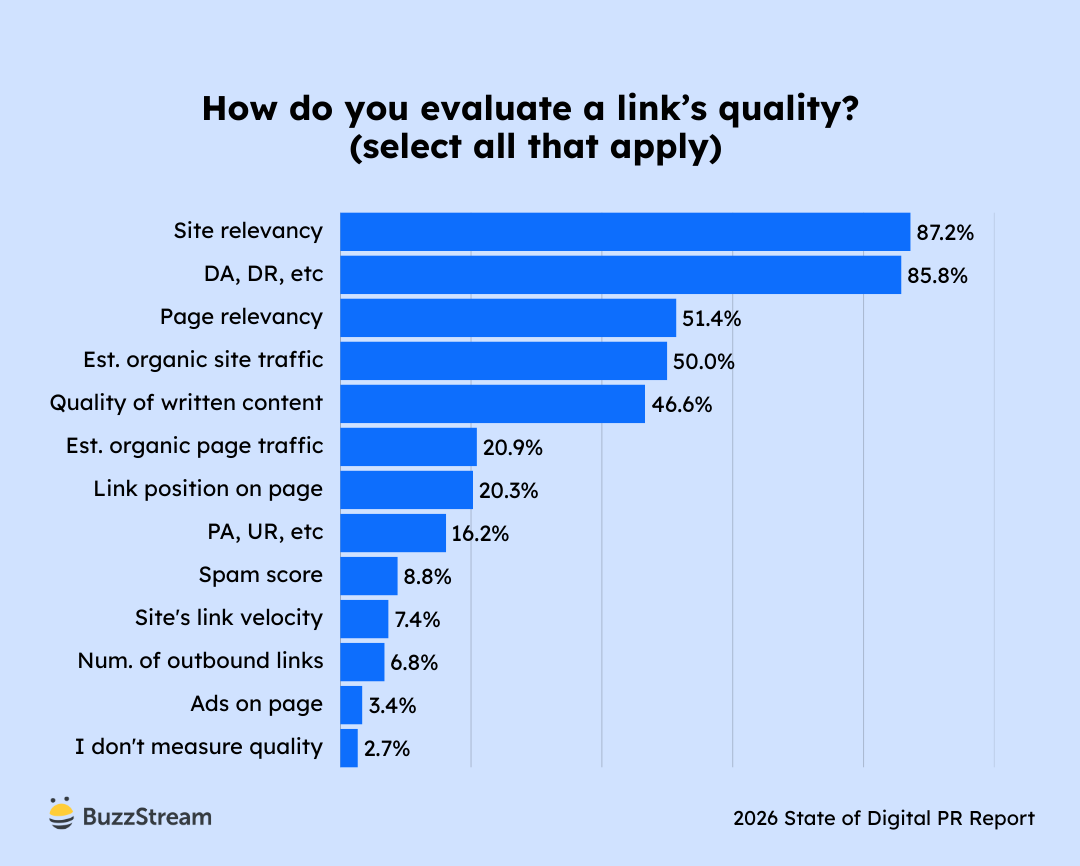
Site relevance (87.2%) and third-party page authority metrics such as DA/DR (85.8%) are the top two evaluation criteria for determining a link’s quality in 2026.
Page relevance is important to only about half of respondents (which I find to be a big miss for those ignoring it).
All of this is fairly similar to last year.
31
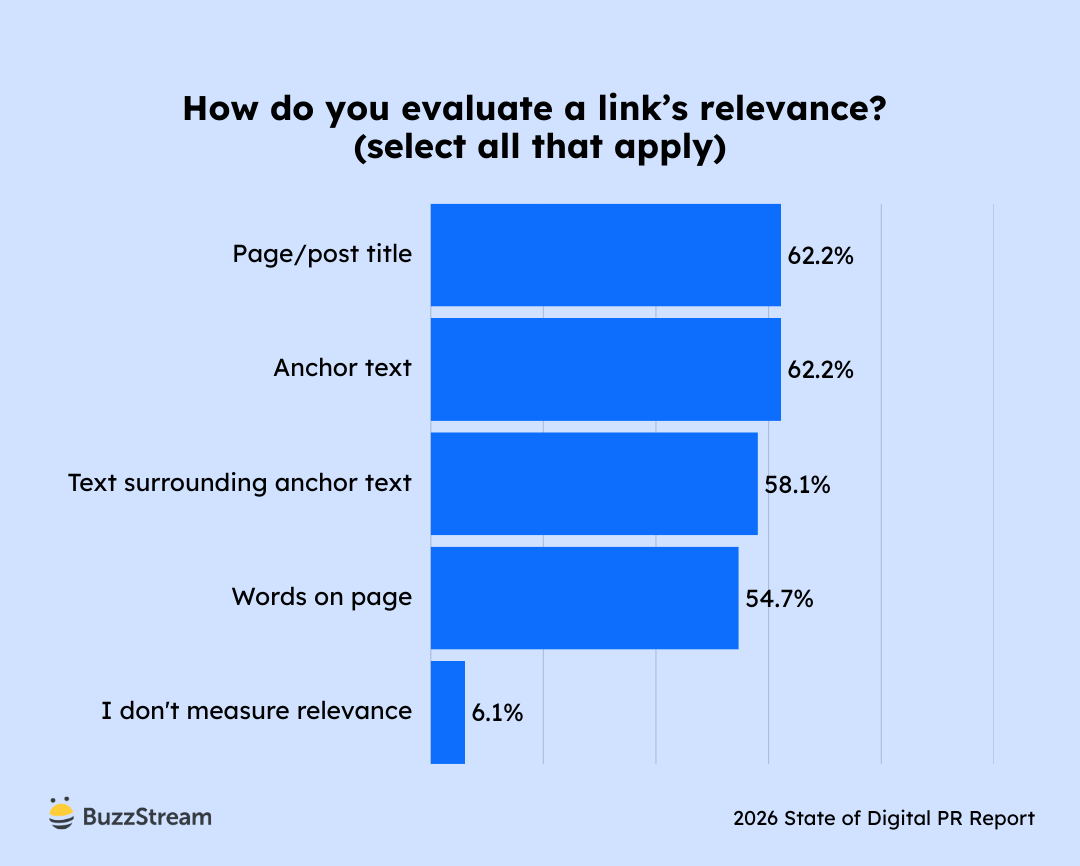
When it comes to evaluating a link’s relevance, the title of the page/post and anchor text are equally important (62.2%).
These are also similar to last year’s results.
32
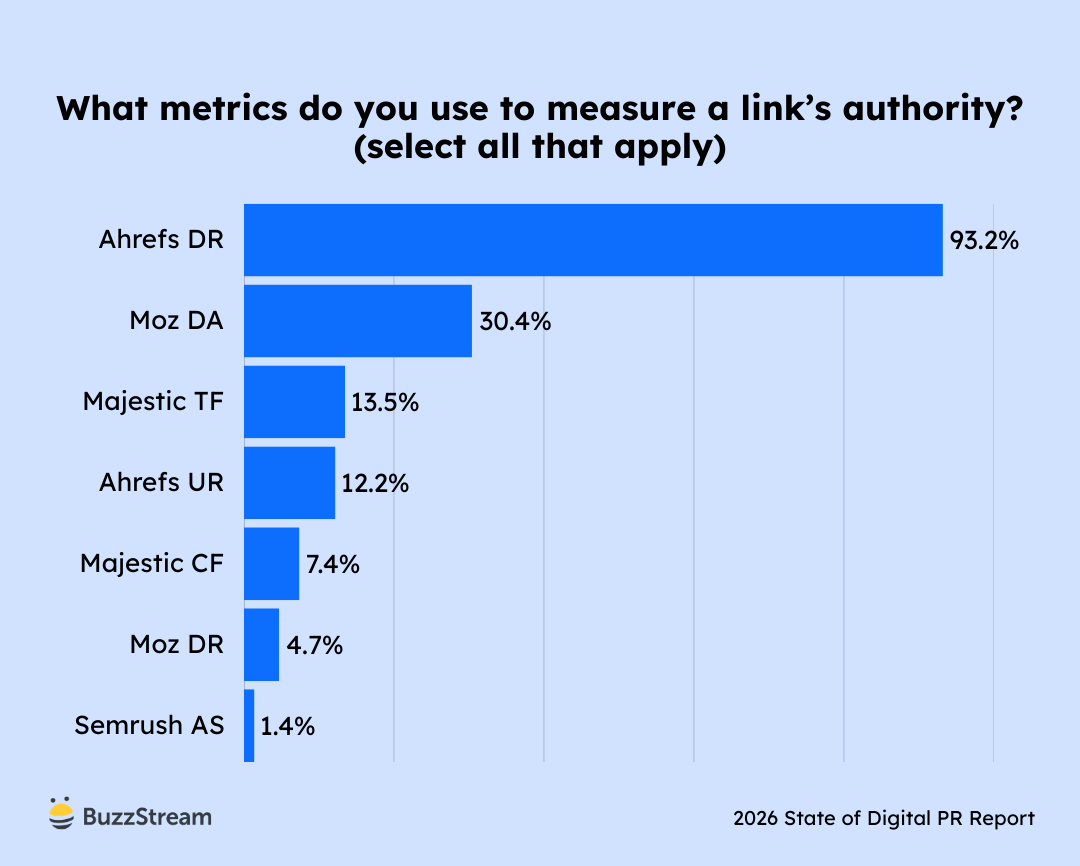
Ahrefs DR is the number one metric used by digital PRs to measure link authority at 93.2%, up from 83.3% last year.
Moz DA fell about 15 percent.
EXPERT OPINIONS
Page relevance still isn’t prioritized by many teams—why do you think it gets overlooked?
I honestly think it’s a legacy of Pagerank. For years, SEOs depended on PR (pagerank) as a way to measure link quality. When that was no longer available they moved on to Domain Authority…. Since then Google’s ability to determine what a link from a certain site says about the site it’s pointing to has changed but for many SEOs that view hasn’t changed. This is why many are still stuck buying high DA/DR guest posts from what are otherwise useless sites.
Evaluating the ‘quality’ of a link or placement happens at different stages within Digital PR, and I think that explains why metrics like page relevance are lower here than expected.
For example, when someone is actively outreaching a campaign, the page relevance doesn’t really exist yet as we’re trying to become the story and have a new page published by a journalist featuring our campaign. During that part of the process the entire focus is on site relevancy, which makes complete sense on why it’s the highest valued metric.
On the other hand, ‘quality’ is also then measured retrospectively, which is a different stage of the campaign. It’s of course important once a journalist has written about your campaign that the page is entirely relevant, and by extension relevant to your client/business, but that only really becomes clear once the page is live.
EXPERT OPINIONS
What’s the biggest misconception digital PRs have about what makes a link valuable in 2026?
Similarly to the question above the obsession with DA/DR at face value. These can be helpful indicators of how much value Google places in a site but will only really matter if other factors like: Relevance, Human Value, Linking Neighborhoods, etc. are taken into consideration.
I used to give the analogy of if I wanted an endorsement for my SEO/Digital PR agency. And I had the choice between Lebron James or John Mueller. Lebron James would be like a DA/DR 90+…. everyone knows him, he’s huge. But he is NOT an authority in my space. John Mueller is a DR/DA ~20-30 probably but he IS an authority in my space. I’d take the latter endorsement everytime.
This is less of a misconception but something I think is overvalued in digital PR and link building in general – and that’s unlinked mentions.
For many years, a quick win has been to find dated mentions of a brand, person, asset, etc. and then have it converted into a link. However, a large majority of the time, these are mentions on pages that have been live for 2+ years and generate zero traffic today. We now know, through leaks analysed by legends like Rand Fishkin and Mike King, that traffic to a page is a big deal, and therefore, converting a link – even if it’s on Forbes – from page published years ago but now buried and confined to the history of the internet, won’t actually provide the value a ‘link on Forbes’ would usually feel like it does.
That being said, chasing unlinked mentions whilst you’re in the throws of outreaching a live campaign is absolutely worth doing. It’s all about getting a link whilst the buzz is active. Once that dies, so does the value.
Digital PRs should stop solely judging if a link is relevant according to arbitrary numbers from third party tools. The focus should be on getting coverage in well-read websites that cover their topics. These placements will influence further coverage on newsletters, podcasts, and YouTube. Links that lead to compounding success in the content economy are the ones that are most valuable.
It doesn’t surprise me that the vast majority of people use DA/DR to evaluate the quality of a link. It’s a nice simple and concise metric that I use too. But I do think it’s important that we’re not placing too much emphasis on DA/DR to determine if a link is low quality, or if it’s a site that you shouldn’t pitch your campaign to. DA/DR can be a very flawed metric sometimes. If you ever look at the backlink profile for any website you’ll see linking domains that have a high DA/DR, but when you click on them they’re absolutely not sites you’d tell a client or your boss that you’re going to target. Likewise, just because a site has a low DA/DR doesn’t mean it wouldn’t be a good site to get a link from, especially if it’s a site that your target audience visits (a far better measure than DA/DR). Very relevant sites can sometimes have a low DA/DR if for example it’s a new domain or a small but niche publication that doesn’t have much of a backlink profile themselves (which is what DA/DR is primarily based on).
EXPERT OPINIONS
Do things like page relevance and anchor text play a role in AI citations?
I would say they do. Again, things are a lot more sophisticated than writing an article about “The Best PI Attorney in Dallas” and then linking to your site with an anchor text of “Personal Injury Attorney Dallas”. Instead it’s about how does your page/link contextually fit into the page, what value does it provide to the article itself, and what value would a user who clicks that link derive when they get to your site. If those things are in place then, yes the additional contextual clues of the article and anchor text can provide additional help to AI on what your page is about.
Section 9
AI in Digital PR
We’ve had a few questions about this, but this section focuses on how digital PR professionals are tackling AI in their work.
33
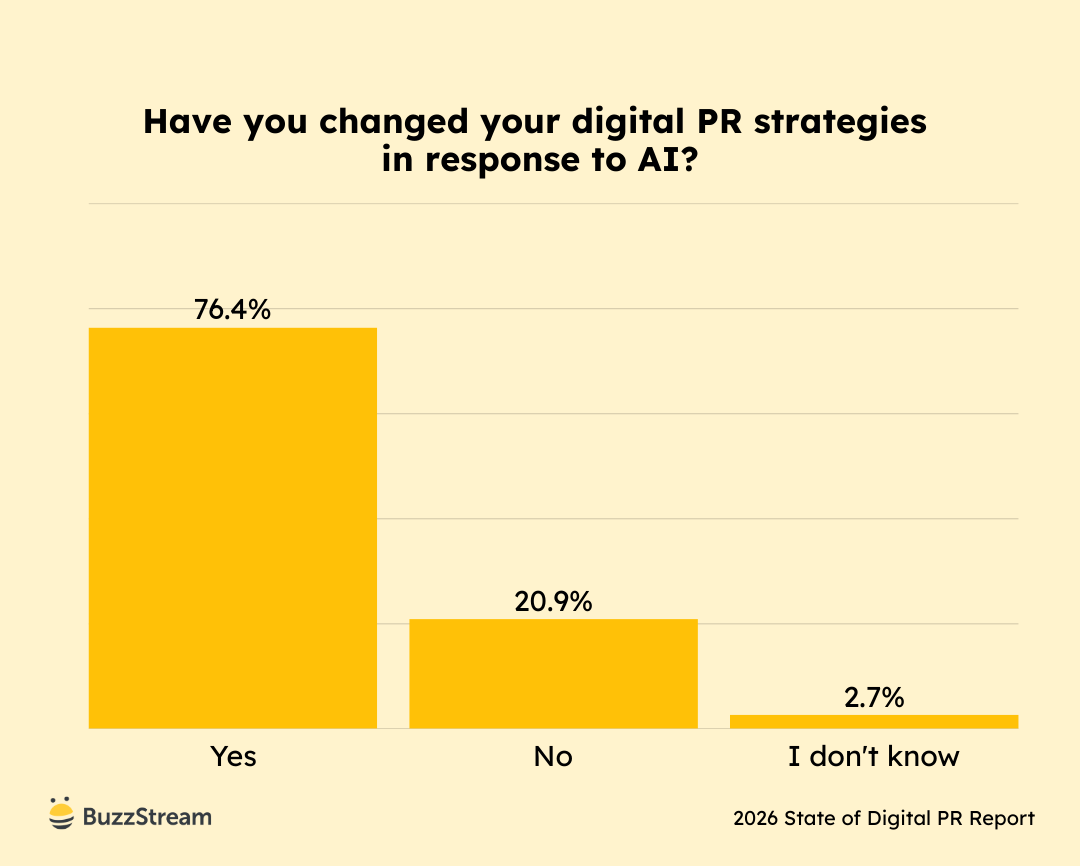
For three-quarters of digital PRs (76.4%), AI has fundamentally changed the way they work.
To understand exactly what has changed, we need to move on to our next question.
34
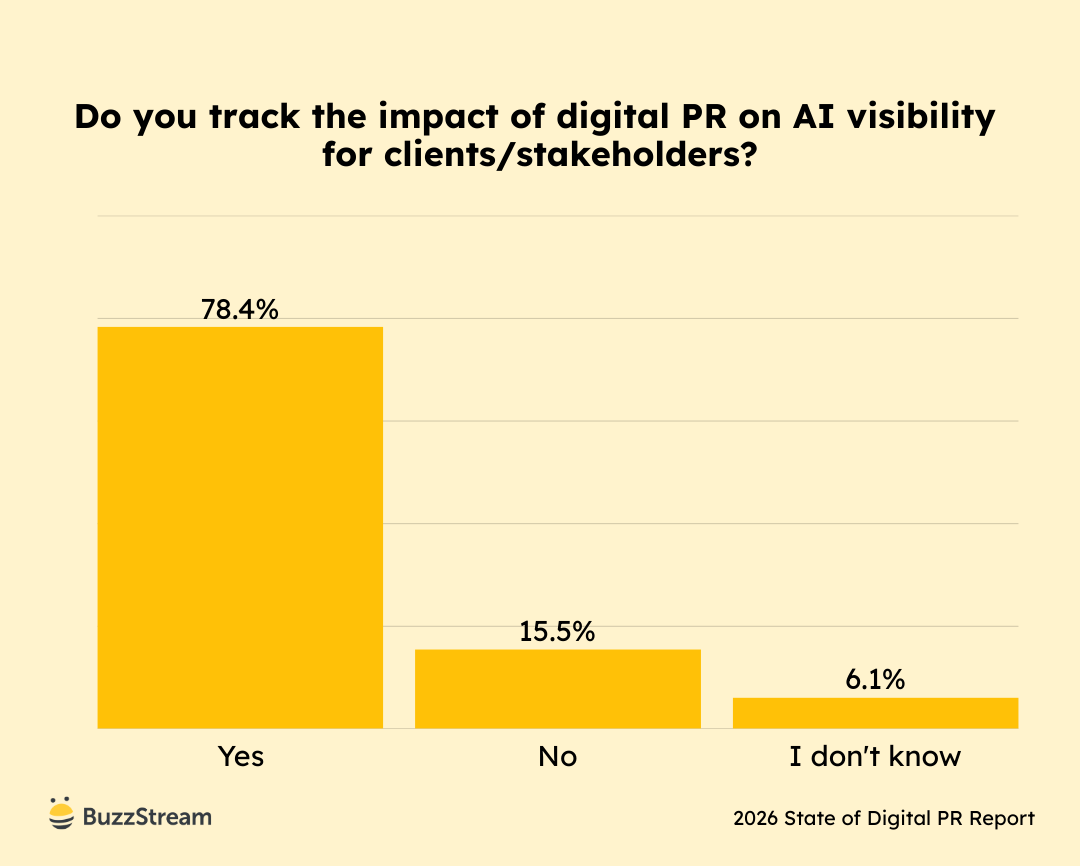
78.4% of digital PR pros track AI visibility for clients.
Given that AI is permeating Google search in AI Overviews and AI Mode searches, this seems like a given. As mentioned previously, Ahrefs research has shown a strong correlation between brand mentions and AI Overview mentions.
For those who aren’t tracking, it’s a missed opportunity.
35
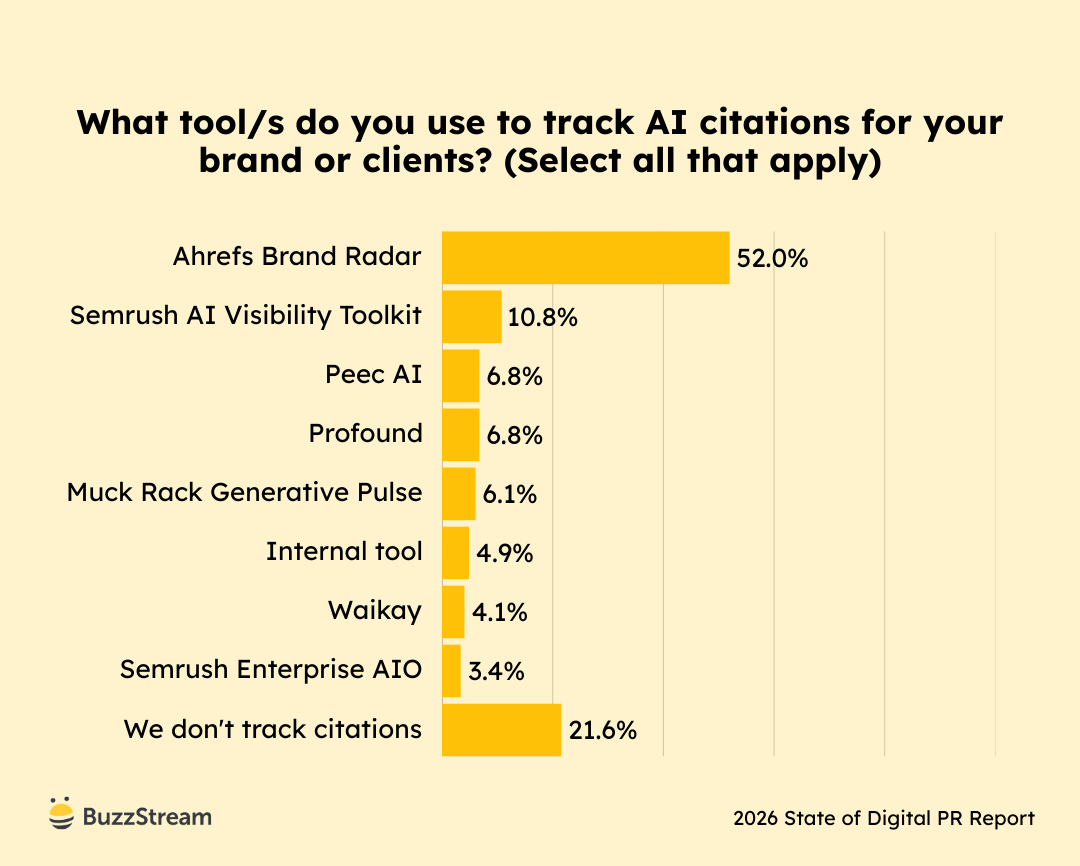
The tool of choice for tracking AI citations is Ahrefs Brand Radar (52%), followed by Semrush’s AI Visibility Toolkit at a distant second.
36
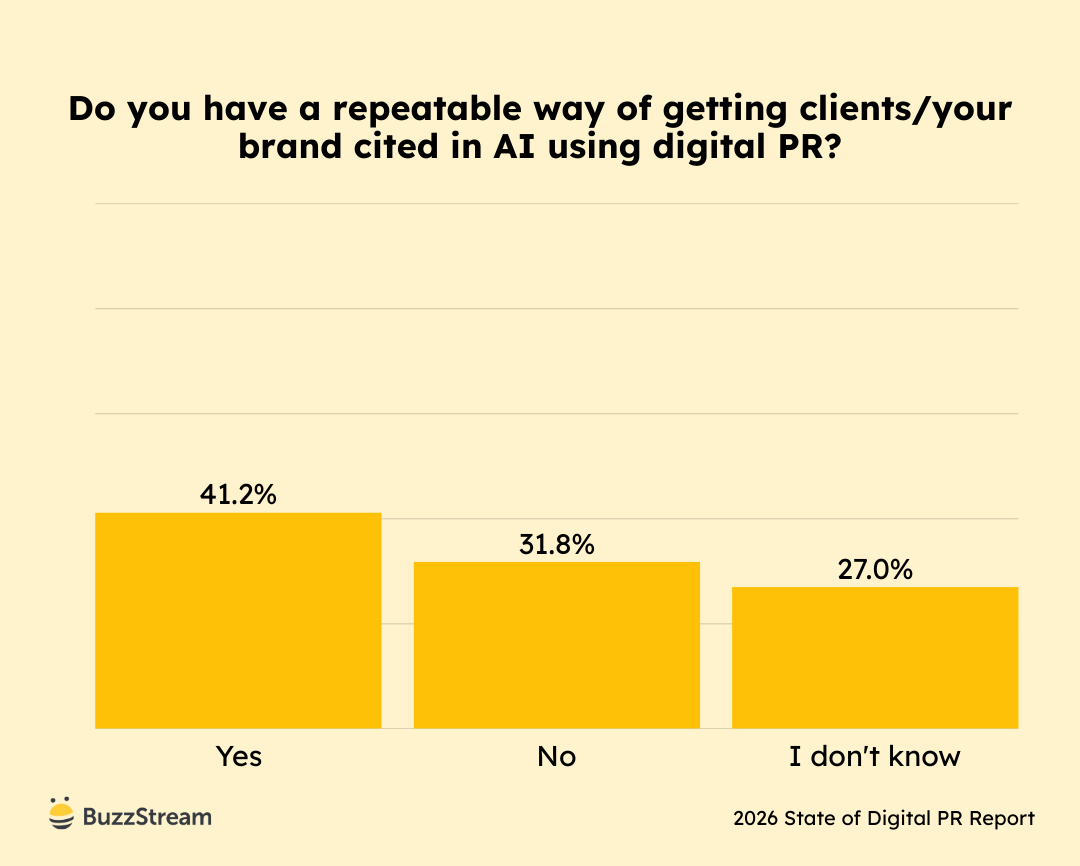
Just about 40% of digital PRs have a repeatable way of getting clients and brands cited by AI.
When we asked this of link builders in our Link Building Trends Report, in conjunction with Citation Labs, just 11% reported having a repeatable way to get their clients cited by AI.
There does seem to be some momentum here.
37
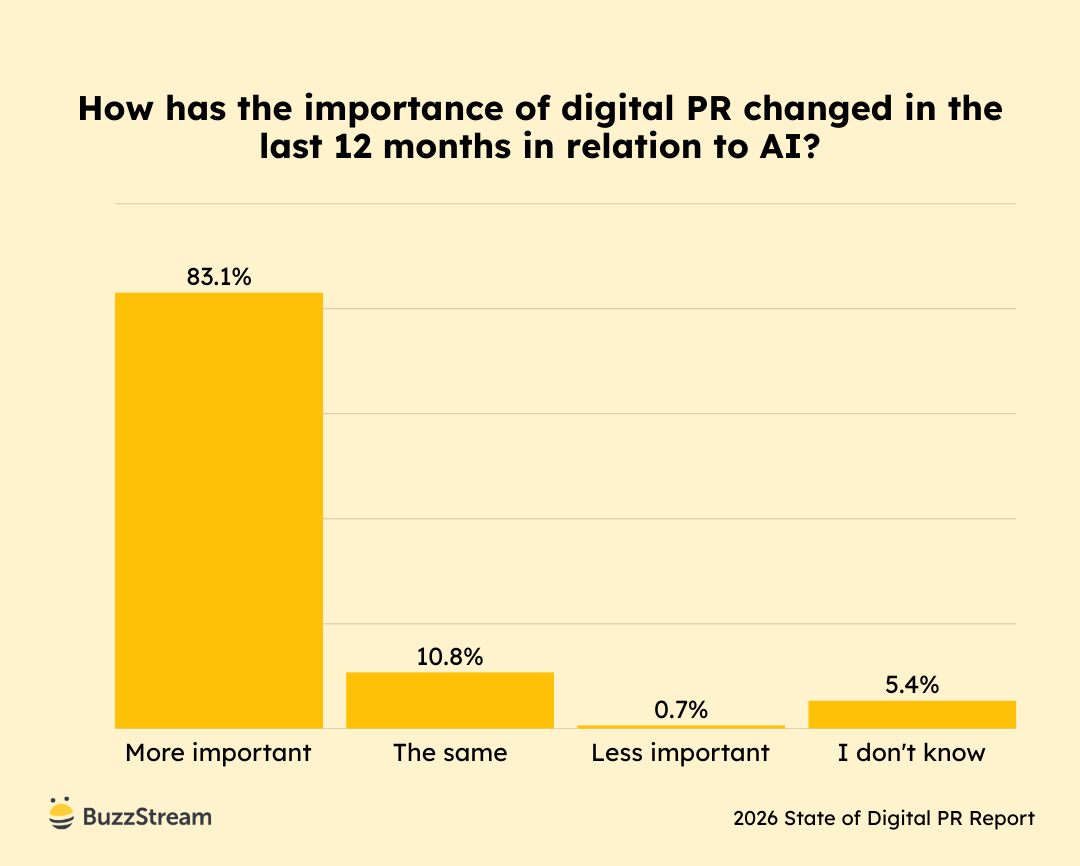
AI appears to be a driving force for digital PR in 2026, with 83.1% of digital PRs saying it has become more important in the last 12 months in relation to AI.
38
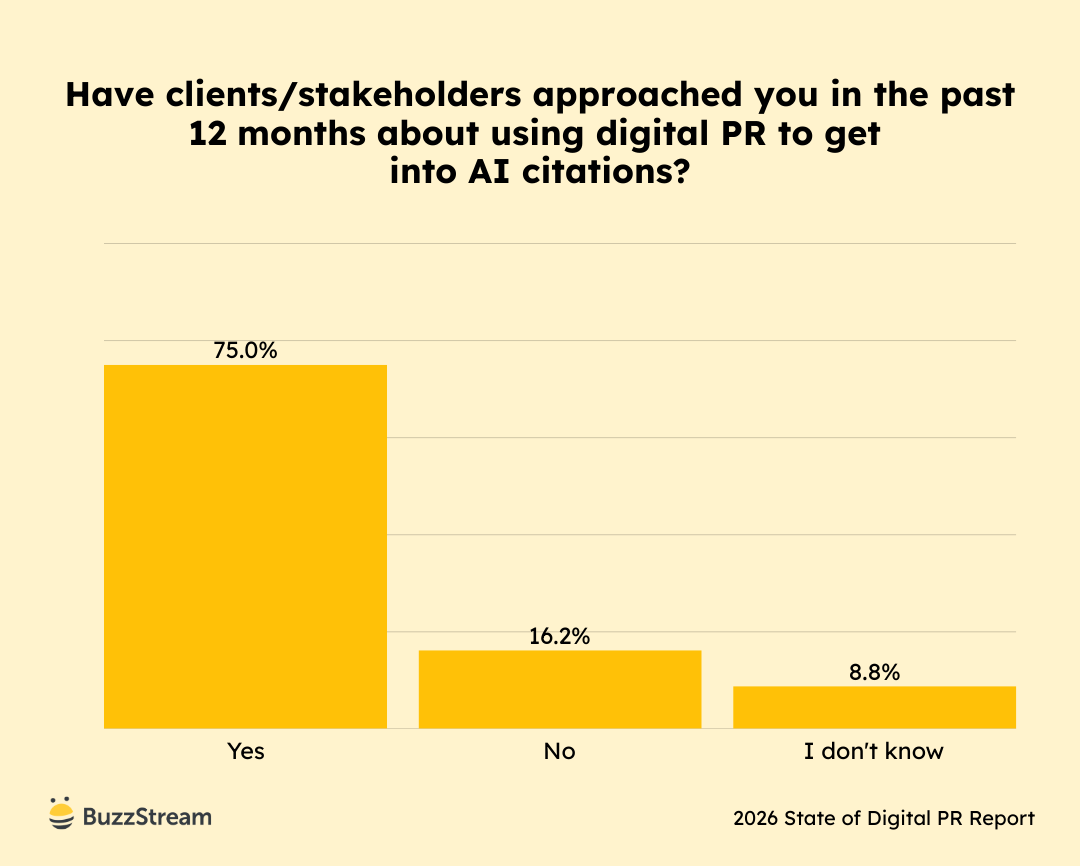
75% of digital PRs have been approached about using digital PR to get into AI citations in the last 12 months.
This further cements what we found in the previous question.
39
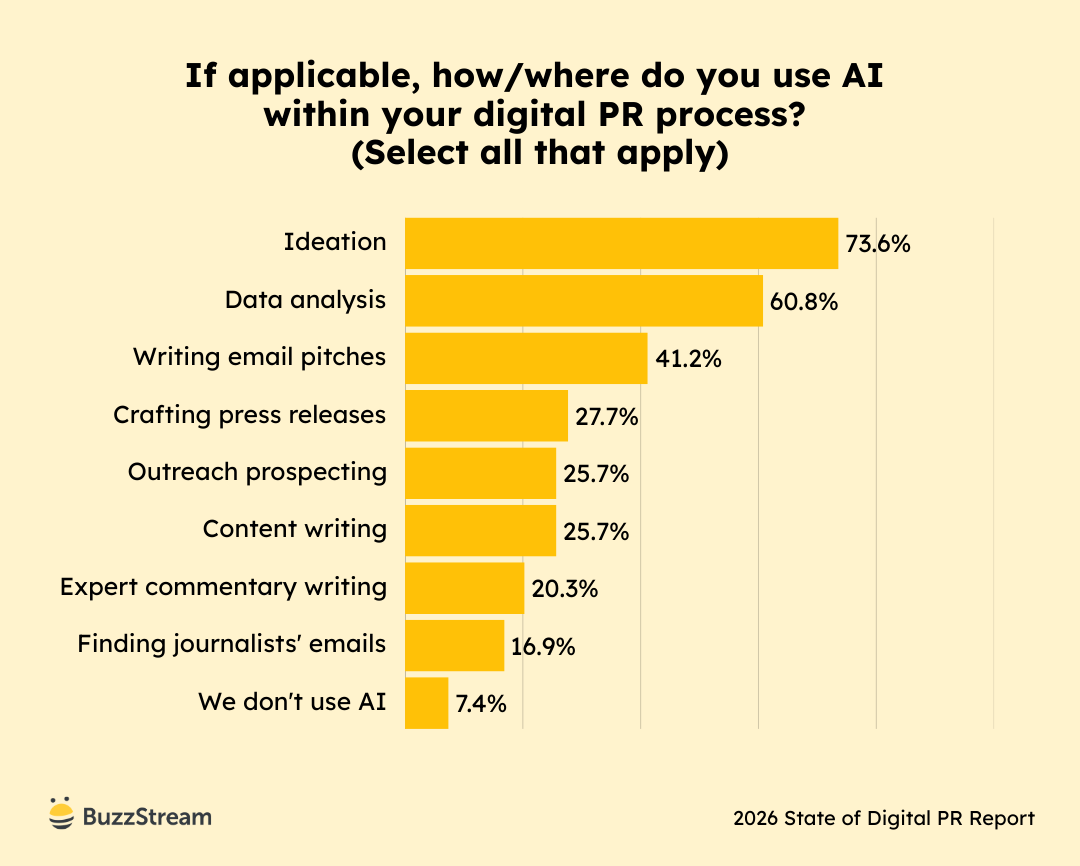
When asked how digital PR pros use AI in their processes, the most common areas are ideation (73.6%) and data analysis (60.8%).
Just a quarter use AI for outreach prospecting (16.9%), which we’ve found to be fairly dismal in our own studies on using Google’s AI Mode to find email addresses.
Next, we dig into how often people really use AI in their processes.
40
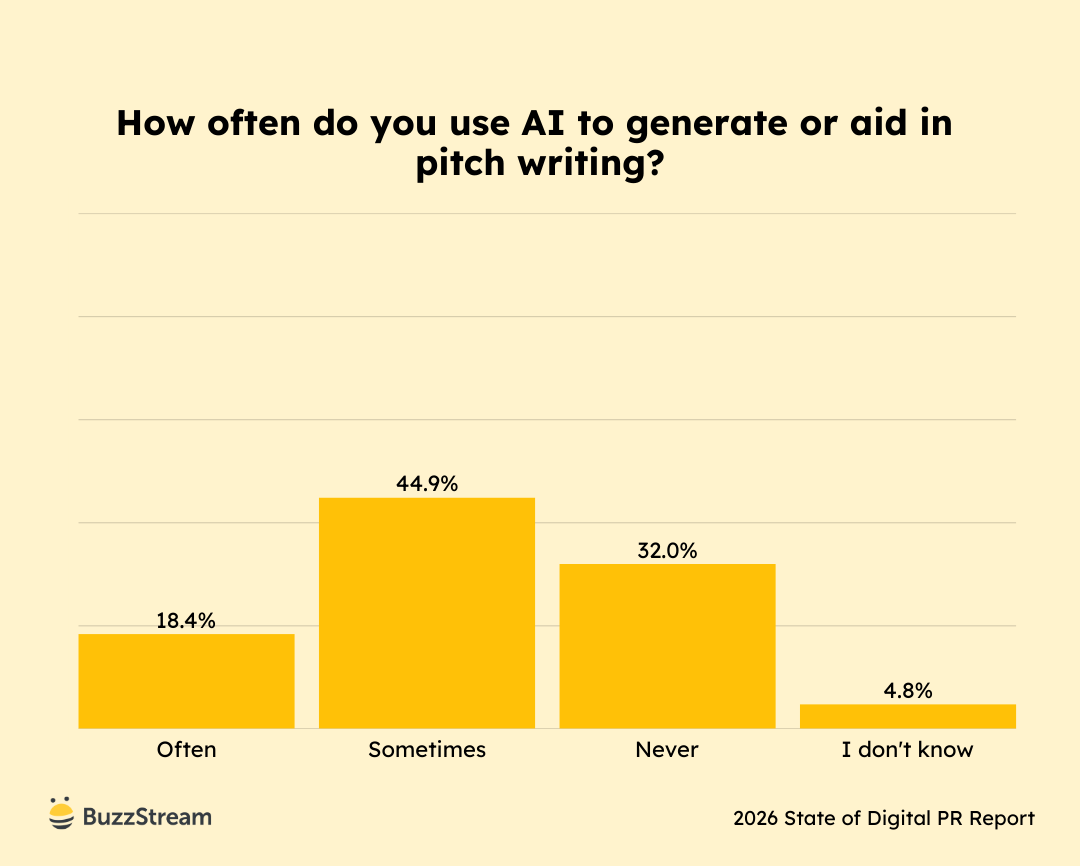
Just about one-third of digital PRs reported never using AI to help write or aid in pitch writing.
A much larger majority (63.3%) often or sometimes use AI in their pitch writing process.
41
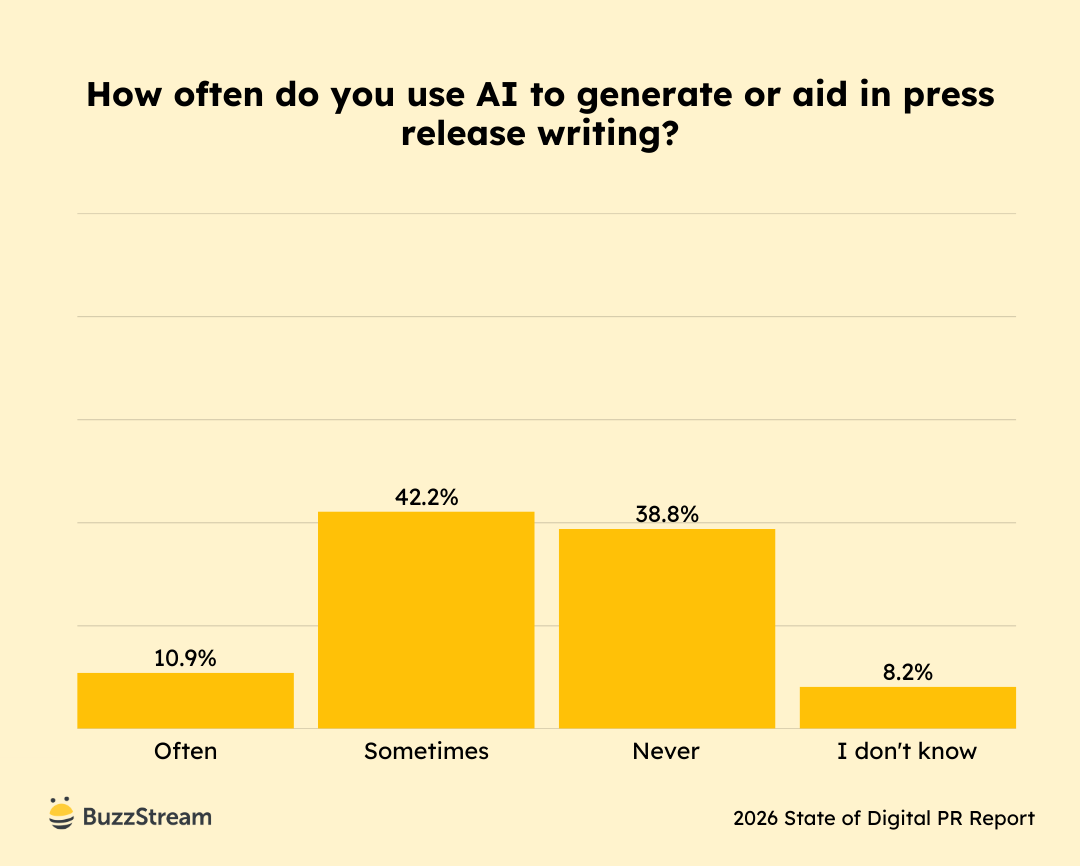
About 41.2% use it to write email pitches, and even fewer (27.7%) for crafting press releases, which is probably a good thing after hearing the backlash from journalists about AI-written pitches.
EXPERT OPINIONS
AI has “fundamentally changed” how most digital PRs work—what’s the biggest change you’ve made personally?
At Journey Further, we’re using AI in multiple ways. We’ve used it since 2019 to fuel our proprietary natural language understanding tool, Salient™, to understand the relevance of our coverage and backlinks. Now, we’re using it to react to trends faster, improve the effectiveness of our processes, and ultimately deliver more for less for our clients.
From a search perspective, and getting cited in AI Overviews and LLMs, the value of non-linking coverage and brand mentions in SEO has increased because AI algorithms are no longer strictly link-based but consider brand awareness and trust signals across the whole web.
As such, we’ve expanded our focus from securing brand mentions and links in digital media to broadcast and social platforms too. As our audience’s search behaviour has changed, our strategies have too, to ensure we’re getting brands discovered across every relevant touchpoint.
AI has completely reshaped how we operate at Linkifi. The biggest shift has been building repeatable systems that get brands cited in AI-generated answers, because that’s where visibility is headed.
For us, “repeatable” means having processes in place to land Tier 1 editorial coverage that feeds brand mentions into LLMs. That includes doubling down on relationship building with journalists—it’s the only repeatable and scalable way to consistently land this sort of coverage for clients.
Clients aren’t just asking for links anymore; they’re asking how to show up in AI results.
First, I want to be clear that Bright Valley Marketing is not in the business of replacing human employees with AI—that’s a fundamental principle for us.
Where AI has genuinely helped is in strengthening the parts of our work that rely on in-depth analytics. Our campaigns have always been built around data, but AI has allowed us to analyse that data faster and from angles we may not have previously spotted.
By feeding raw survey results, state-by-state breakdowns, or multi-variable datasets into AI, we’re often presented with correlations, outliers, or narrative threads that would take a human much longer to uncover. In practice, it’s helped us discover unexpected angles—the kind that become headline-worthy and push campaigns into top-tier media.
Digital PR teams have a significant opportunity to impact brand visibility in AI results, and marketing teams are increasingly recognising the role that digital PR plays in delivering ROI.
We shouldn’t overcomplicate the value behind it: AI results are our new operating medium for generating organic brand visibility and share of voice among target audiences.
As audience search habits move towards AI results, brands must follow suit. So far, the value has been in providing exposure to informational searches and brand awareness at the top of the funnel, though we’re already seeing this shift further down the funnel and closer to customer conversions.
We’re no longer just building digital PR strategies around journalist coverage and traditional link targets—we’re now actively building them around where AI is actually pulling citations from.
We’ve started running strategy projects that look at where our clients are already being cited in AI, where competitors are being cited, and which sites and formats consistently show up in answers.
That insight now shapes what we prioritise in DPR, both in terms of where we target and how we build campaigns.
EXPERT OPINIONS
Only ~40% say they have a repeatable way of getting cited by AI—what does “repeatable” actually look like in practice?
This surprised me, because in my opinion best-practice PR—building trust, positive reputation, fame, and engagement—is the best way to get cited in AI, just as it is to earn visibility in traditional Google rankings.
To consistently get cited by AI, you need to consistently show up in media publications. PR tactics such as sharing interesting data insights, expert commentary, product placement, and fame-driving campaigns all help generate the third-party validation both machines and humans are looking for.
The SEO industry has often tried to manipulate SERPs through spammy link building and buying links en masse, and I’m delighted that this no longer works in the AI search era—the machines are simply too intelligent.
To me, “repeatable” means it’s not random—it’s a process you can run consistently and improve over time.
In practice, that means tracking where AI citations come from most often for your category, tracking where competitors appear, and shaping your DPR strategy to deliberately earn visibility in those places.
Instead of saying “let’s get links,” you’re asking, “These are the sources AI trusts in our space—how do we show up there more often?”
EXPERT OPINIONS
Clients are asking for AI citations more than ever—what business value are they targeting, and how effective has AI inclusion been?
We’re operating in a new era where the traditional marketing funnel no longer exists. AI has collapsed the “messy middle,” pulling exploration and evaluation into a single summary with one prompt.
That means your brand can be found in one moment and forgotten the next.
Being continuously surfaced in AI ensures brands remain visible across the broader search journey. While Google’s AI Overviews are undeniably stealing traffic, every citation is essentially free digital billboard space—the most valuable real estate there is: the answer itself.
Clients see AI visibility as future-proofing. They want to know where they appear today, where competitors outperform them, and what it takes to become more “known” in AI answers.
Digital PR plays a clear role because it’s one of the most scalable ways to build mentions, citations, authority, and brand association across the web.
It’s not a quick win—it’s consistency over time. As those signals build, LLMs become more familiar with the brand and cite it more naturally.
Clients are asking for AI citations because they see them as the next frontier of brand visibility.
Being cited by AI functions like a new form of SEO—persistent, compounding presence in conversational search. It also acts as a credibility signal: repeated references tell audiences (and clients) that the insights are authoritative.
We’ve seen AI inclusion work best when the underlying content is clean, structured, and data-driven. Survey data, rankings, and regional insights are exactly the types of content AI tends to surface—and we’re seeing stronger traction now than even six months ago.
Section 10
Demographics & Occupation
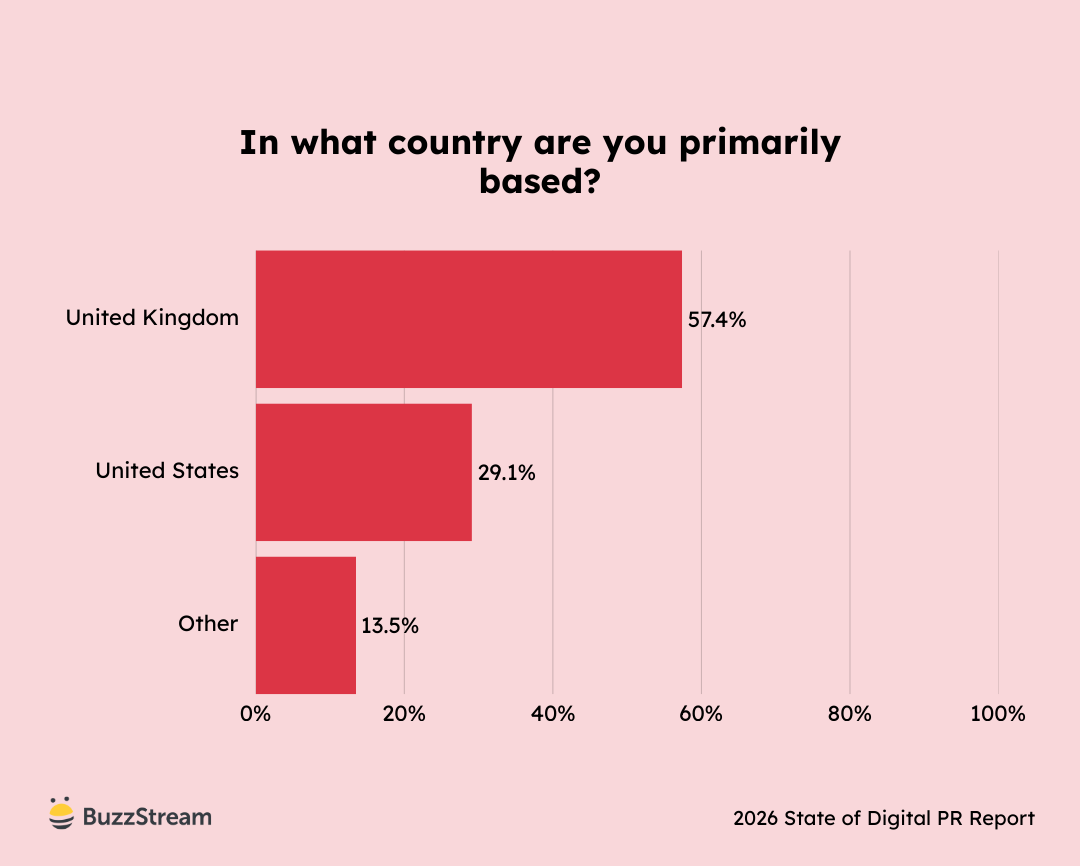
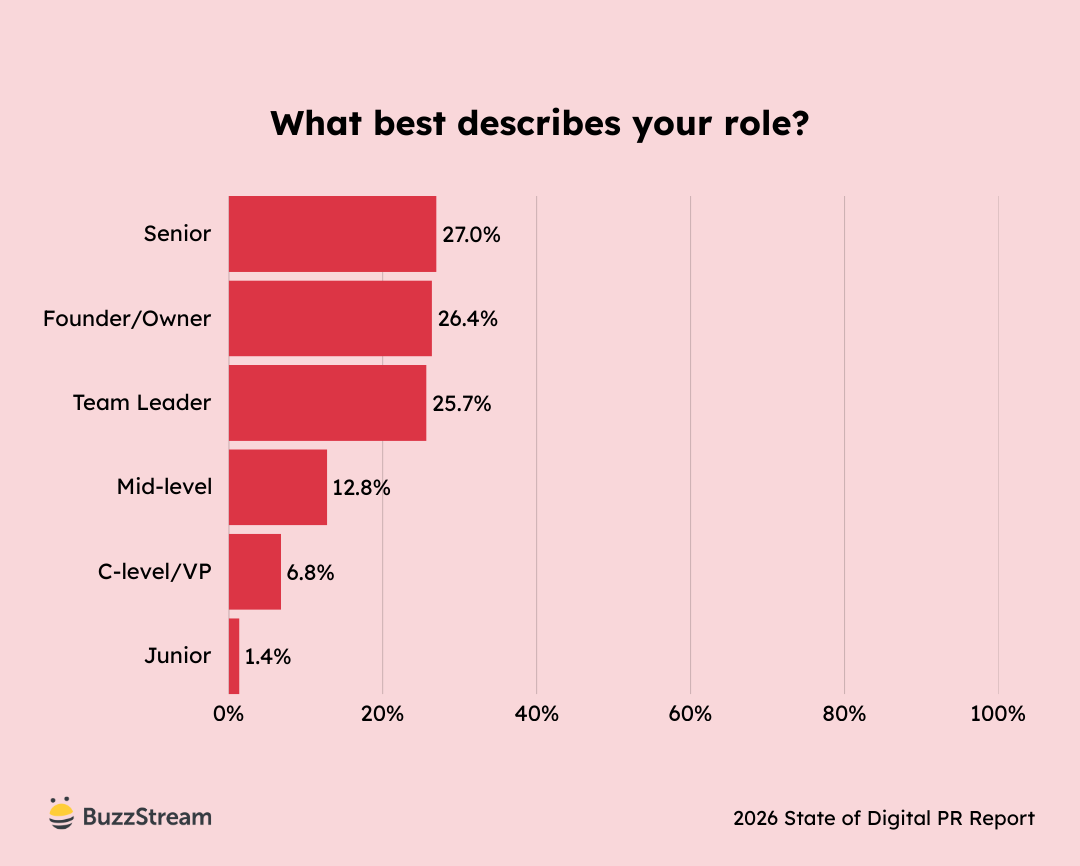
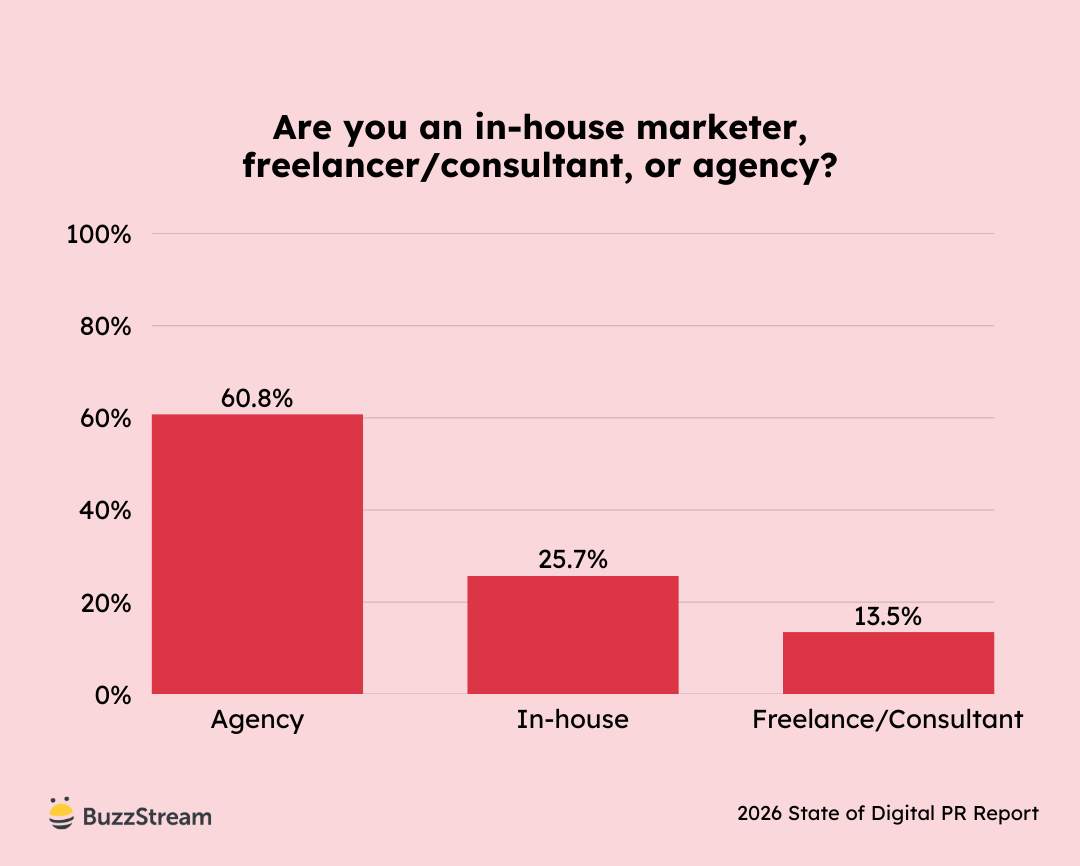
Here is a demographic breakdown of our survey respondents.
Section 11
Thank You, Contributors
On behalf of the BuzzStream team, I wanted to thank everyone once again who took the time out of their work to help answer our survey.
The digital PR community continues to show that it is one of the kindest and most helpful communities out there.
I also wanted to thank our expert panel of contributors, who you can see below:
Shai Aharony — Reboot Online — rebootonline.com
Louise Ali — PrettyGreen — itsprettygreen.com
Abi Bennetts — Launch PR — launchpr.co.uk
Olivia Bence — Glass Atlas — glassatlas.com
Dan Bermingham-Shaw — Brave Bison — bravebison.com
James Brockbank — Digitaloft — digitaloft.co.uk
Amber Carnegie — Better B2B — b2b-better.com
Alex Cassidy — NeoMam — neomam.com
Tom Chivers — Sabot — wearesabot.com
Gabriela Covay — Bright Valley Marketing — brightvalleymarketing.com
Collin Czarnecki — NOBLE Digital Studio — thisisnoble.co
Nicole DeLeon — North Star Inbound — northstarinbound.com
Jane Hunt — JBH – The Digital PR Agency — jbh.co.uk
Ellie Hearn — Digitaloft — digitaloft.co.uk
Tom Hemingway — Embryo — embryo.com
Will Hobson — Rise at Seven — riseatseven.com
Michael Johnson — Resolve — growresolve.com
Darren Kingman — Root Digital — rootdigital.co.uk
Britt Klontz — BK Digital / Vada Communications — vadacommunications.com
Kelsey Libert — Fractl — frac.tl
Chris Lewis — Launch Potato — launchpotato.com
Olivia Lott — Lakeview Digital — lakeviewdigital.co.uk
Kalina MacKay — Go Fish Digital — gofishdigital.com
Hana Montgomery — Incubeta — incubeta.com
Robyn Munro — Vega Comms — vegacomms.co.uk
Beth Nunnington — Journey Further — journeyfurther.com
James Olliver — Reboot Online — rebootonline.com
Christopher Panteli — Linkifi — linkifi.io
Katy Powell — Bottled Imagination — bottledimagination.com
Bekki Ramsay — Belta PR — belta-pr.com
James Reisner-Watkins — Tank — tank.co.uk
Victoria Schmid — KURU Footwear — kurufootwear.com
Matt Seabridge — Digital PR Tips — digitalprtips.com
Oliver Sissons — Reboot Online — rebootonline.com
Keren Speck — Notice Factory — noticefactory.com
Ellie Sumner — Prosperity Media — prosperitymedia.com.au
Sage Singleton — Clearlink — clearlink.com
Tamara Sykes — Stacker — stacker.com
Carrie Van Brunt-Wiley — Siege Media — siegemedia.com
Amanda Walls — Cedarwood Digital — cedarwood.digital
Will Waldron — Connective3 — connective3.com

Vince Nero
Vince is the Director of Content Marketing at Buzzstream. He thinks content marketers should solve for users, not just Google. He also loves finding creative content online.
His previous work includes content marketing agency Siege Media for six years, Homebuyer.com, and The Grit Group. Outside of work, you can catch Vince running, playing with his 2 kids, enjoying some video games, or watching Phillies baseball.
[ad_2]
Source link